
Love Letters of a Violinist, and Other Poems
Eric Mackay
THE CLASSIC COLLECTION · 1800
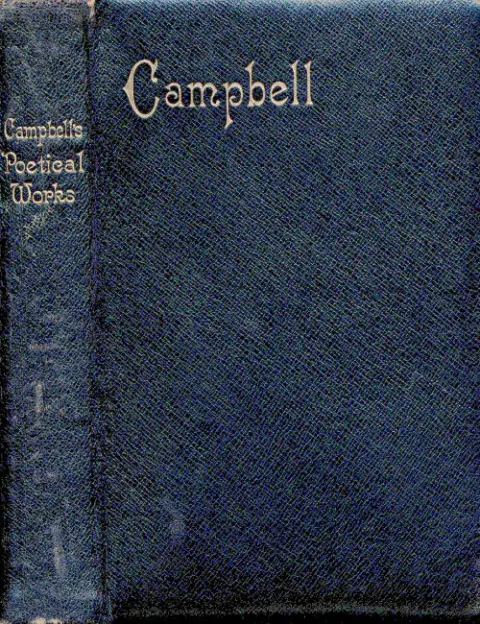
"The Poetical Works of Thomas Campbell" by Thomas Campbell is a collection of poetry written in the early 19th century. This work features a variety of poems, notable among them "The Pleasures of Hope," "Gertrude of Wyoming," and other lyrical pieces, reflecting on themes of love, nature, human experience, and social commentary. The collection highlights Campbell's concern for humanity, hope, and the human condition, often expressed through vivid imagery and emotive language. At the start of the collection, the prefatory memoir provides insight into Campbell's early life, education, and the influences that shaped his poetic career. It outlines his beginnings in Glasgow, his formative experiences with nature, and his introduction to literature. The opening poem, "The Pleasures of Hope," establishes the central theme of the importance of hope in navigating life's hardships. It juxtaposes the beauty of distant landscapes with the promise of love and humanity's potential for growth, addressing personal and political struggles while celebrating the enduring power of aspiration. Through poignant reflections, the early verses set the tone for the collection, evoking a sense of nostalgia and yearning for connection in both love and life.
Introduction adapted from the source catalogue; source summaries may be automatically generated.
Free to read · English · 69,844 words · No account needed
MAKE TIME FOR A GOOD BOOK
On by default. Untick to stop anonymous reading totals. Each page counts after 10 seconds in view. How this works.
Anonymous counting is on unless you have switched it off.
But sense foils fury—as the blowing whale Spouts, bleeds, and dyes the waves without avail— Wears out the cable’s length that makes him fast, But, worn himself, comes up harpooned at last— E’en so, devoid of sense, succumbs at length Mere strength of zeal to intellectual strength. His son’s close logic so perplexed his pate, Th’ old hero rather shunned than sought debate; Exhausting his vocabulary’s store Of oaths and nicknames, he could say no more, But tapp’d his mull,[101] rolled mutely in his chair, Or only whistled Killiecrankie’s air.
Witch legends Ronald scorned—ghost, kelpie, wraith,
And all the trumpery of vulgar faith;
Grave matrons ev’n were shocked to hear him slight
Authenticated facts of second-sight—
Yet never flinched his mockery to confound
The brutal superstition reigning round.
Reserved himself, still Ronald loved to scan
Men’s natures—and he liked th’ old hearty man;
So did the partner of his heart and life—
Who pleased her Ronald, ne’er displeased his wife.
His sense, ’tis true, compared with Norman’s son,
Was commonplace—his tales too long outspun:
Yet Allan Campbell’s sympathizing mind
Had held large intercourse with human kind;
Seen much, and gaily, graphically drew
The men of every country, clime, and hue;
Nor ever stooped, though soldier-like his strain,
To ribaldry of mirth or oath profane.
All went harmonious till the guest began
To talk about his kindred, chief and clan,
And, with his own biography engrossed,
Marked not the changed demeanour of each host;
Nor how old choleric Norman’s cheek became
Flushed at the Campbell and Breadalbane name.
Assigning, heedless of impending harm,
Their stedfast silence to his story’s charm,
He touched a subject perilous to touch—
Saying, “’Midst this well-known vale I wondered much
To lose my way. In boyhood, long ago,
I roamed and loved each pathway of Glencoe;
Trapped leverets, plucked wild berries on its braes,
And fished along its banks long summer days.
But times grew stormy—bitter feuds arose,
Our clan was merciless to prostrate foes.
I never palliated my chieftain’s blame,
But mourned the sin, and reddened for the shame
Of that foul morn (Heaven blot it from the year!)
Whose shapes and shrieks still haunt my dreaming ear.
What could I do? a serf—Glenlyon’s page,
A soldier sworn at nineteen years of age;
T’ have breathed one grieved remonstrance to our chief,
The pit or gallows[102] would have cured my grief.
Forced, passive as the musket in my hand,
I marched—when, feigning royalty’s command,
Against the clan Macdonald, Stairs’s lord
Sent forth exterminating fire and sword;
And troops at midnight through the vale defiled,
Enjoined to slaughter woman, man, and child.
My clansmen many a year had cause to dread
The curse that day entailed upon their head;
Glenlyon’s self confessed the avenging spell—
I saw it light on him.
“It so befell:—
A soldier from our ranks to death was brought,
By sentence deemed too dreadful for his fault;
All was prepared—the coffin and the cart
Stood near twelve muskets, levelled at his heart.
The chief, whose breast for ruth had still some room,
Obtained reprieve a day before his doom;—
But of the awarded boon surmised no breath.
The sufferer knelt, blindfolded, waiting death,—
And met it. Though Glenlyon had desired
The musketeers to watch before they fired;
If from his pocket they should see he drew
A handkerchief—their volley should ensue;
But if he held a paper in its place,
It should be hailed the sign of pardoning grace:—
He, in a fatal moment’s absent fit,
Drew forth the handkerchief, and not the writ;
Wept o’er the corpse, and wrung his hands in woe,
Crying ‘Here’s thy curse again—Glencoe! Glencoe!’”
Though thus his guest spoke feelings just and clear,
The cabin’s patriarch lent impatient ear;
Wroth that, beneath his roof, a living man
Should boast the swine-blood of the Campbell clan,
He hastened to the door—called out his son
To follow; walked a space, and thus begun:—
“You have not, Ronald, at this day to learn
The oath I took beside my father’s cairn,
When you were but a babe a twelvemonth born;
Sworn on my dirk—by all that’s sacred, sworn
To be revenged for blood that cries to Heaven—
Blood unforgiveable, and unforgiven:
But never power, since then, have I possessed
To plant my dagger in a Campbell’s breast.
Now, here’s a self-accusing partisan,
Steeped in the slaughter of Macdonald’s clan;
I scorn his civil speech and sweet-lipped show
Of pity—he is still our house’s foe:
I’ll perjure not myself—but sacrifice
The caitiff ere to-morrow’s sun arise.
Stand! hear me—you’re my son, the deed is just;
And if I say—it must be done—it must:
A debt of honour which my clansmen crave,
Their very dead demand it from the grave.”
Conjuring then their ghosts, he humbly prayed
Their patience till the blood-debt should be paid.
Your reading position is saved on this browser. Take it to another device with a library code. Reading pages adapt to text, rather than matching a printed edition.
BEHIND THE BOOK
This eBook is for the use of anyone anywhere in the United States and most other parts of the world at no cost and with almost no restrictions whatsoever. You may copy it, give it away or re-use it under the terms of the Project Gutenberg License included with this eBook or online at www.gutenberg.org. If you are not located in the United States, you will have to check the laws of the country where you are located before using this eBook. Read the source licence.
The original source file, including credits and licence, is retained by this library. Request an original-format copy at no charge. Please include the book title and Project Gutenberg identifier #59788.
KEEP YOUR CURIOSITY GOING
Eric Mackay
Edmund Gosse
Sophia Margaretta Hensley
Gilbert Parker
George MacDonald

Elizabeth Bibesco