
Love Letters of a Violinist, and Other Poems
Eric Mackay
THE CLASSIC COLLECTION · 1800
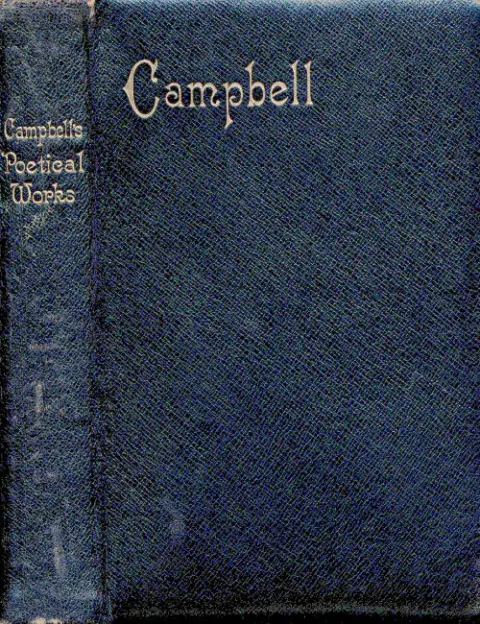
"The Poetical Works of Thomas Campbell" by Thomas Campbell is a collection of poetry written in the early 19th century. This work features a variety of poems, notable among them "The Pleasures of Hope," "Gertrude of Wyoming," and other lyrical pieces, reflecting on themes of love, nature, human experience, and social commentary. The collection highlights Campbell's concern for humanity, hope, and the human condition, often expressed through vivid imagery and emotive language. At the start of the collection, the prefatory memoir provides insight into Campbell's early life, education, and the influences that shaped his poetic career. It outlines his beginnings in Glasgow, his formative experiences with nature, and his introduction to literature. The opening poem, "The Pleasures of Hope," establishes the central theme of the importance of hope in navigating life's hardships. It juxtaposes the beauty of distant landscapes with the promise of love and humanity's potential for growth, addressing personal and political struggles while celebrating the enduring power of aspiration. Through poignant reflections, the early verses set the tone for the collection, evoking a sense of nostalgia and yearning for connection in both love and life.
Introduction adapted from the source catalogue; source summaries may be automatically generated.
Free to read · English · 69,844 words · No account needed
MAKE TIME FOR A GOOD BOOK
On by default. Untick to stop anonymous reading totals. Each page counts after 10 seconds in view. How this works.
Anonymous counting is on unless you have switched it off.
SPEECH OF THE CHORUS IN THE SAME TRAGEDY, TO DISSUADE MEDEA FROM HER PURPOSE OF PUTTING HER CHILDREN TO DEATH, AND FLYING FOR PROTECTION TO ATHENS.
O haggard queen! to Athens dost thou guide
Thy glowing chariot, steeped in kindred gore;
Or seek to hide thy damnèd parricide
Where Peace and Mercy dwell for evermore?
The land where Truth, pure, precious, and sublime, Woos the deep silence of sequestered bowers, And warriors, matchless since the first of time, Rear their bright banners o’er unconquered towers!
Where joyous youth, to Music’s mellow strain, Twines in the dance with nymphs for ever fair, While Spring eternal on the lilied plain, Waves amber radiance through the fields of air.
The tuneful Nine (so sacred legends tell) First waked their heavenly lyre these scenes among; Still in your greenwood bowers they love to dwell, Still in your vales they swell the choral song!
But there the tuneful, chaste, Pierian fair, The guardian nymphs of green Parnassus, now Sprung from Harmonia, while her graceful hair Waved in bright auburn o’er her polished brow!
Where silent vales, and glades of green array,
The murmuring wreaths of cool Cephisus lave,
There, as the muse hath sung, at noon of day,
The Queen of Beauty bowed to taste the wave;
And blest the stream, and breathed across the land The soft sweet gale that fans yon summer bowers; And there the sister Loves, a smiling band, Crowned with the fragrant wreaths of rosy flowers!
“And go,” she cries, “in yonder valleys rove, With Beauty’s torch the solemn scenes illume; Wake in each eye the radiant light of Love, Breathe on each cheek young Passion’s tender bloom!
“Entwine, with myrtle chains, your soft control, To sway the hearts of Freedom’s darling kind! With glowing charms enrapture Wisdom’s soul, And mould to grace ethereal Virtue’s mind.”
The land where Heaven’s own hallowed waters play, Where friendship binds the generous and the good, Say, shall it hail thee from thy frantic way, Unholy woman! with thy hands embrued
In thine own children’s gore? Oh! ere they bleed, Let Nature’s voice thy ruthless heart appal! Pause at the bold, irrevocable deed— The mother strikes—the guiltless babes shall fall!
Think what remorse thy maddening thoughts shall sting, When dying pangs their gentle bosoms tear! Where shalt thou sink, when lingering echoes ring The screams of horror in thy tortured ear?
No! let thy bosom melt to Pity’s cry,—
In dust we kneel—by sacred Heaven implore—
O! stop thy lifted arm, ere yet they die,
Nor dip thy horrid hands in infant gore!
Your reading position is saved on this browser. Take it to another device with a library code. Reading pages adapt to text, rather than matching a printed edition.
BEHIND THE BOOK
This eBook is for the use of anyone anywhere in the United States and most other parts of the world at no cost and with almost no restrictions whatsoever. You may copy it, give it away or re-use it under the terms of the Project Gutenberg License included with this eBook or online at www.gutenberg.org. If you are not located in the United States, you will have to check the laws of the country where you are located before using this eBook. Read the source licence.
The original source file, including credits and licence, is retained by this library. Request an original-format copy at no charge. Please include the book title and Project Gutenberg identifier #59788.
KEEP YOUR CURIOSITY GOING
Eric Mackay
Edmund Gosse
Sophia Margaretta Hensley
Gilbert Parker
George MacDonald

Elizabeth Bibesco