
Love Letters of a Violinist, and Other Poems
Eric Mackay
THE CLASSIC COLLECTION · 1800
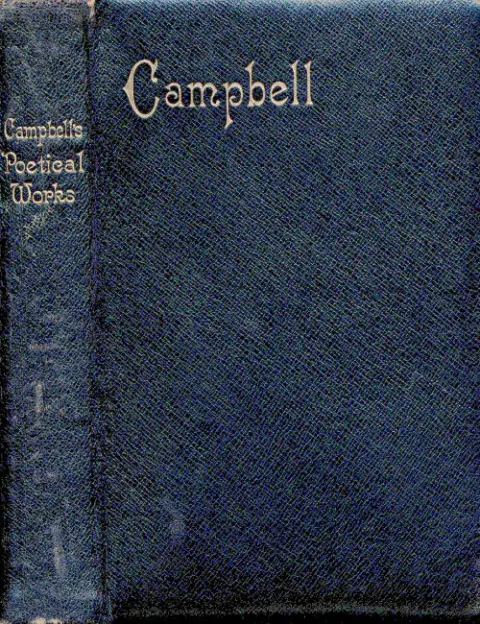
"The Poetical Works of Thomas Campbell" by Thomas Campbell is a collection of poetry written in the early 19th century. This work features a variety of poems, notable among them "The Pleasures of Hope," "Gertrude of Wyoming," and other lyrical pieces, reflecting on themes of love, nature, human experience, and social commentary. The collection highlights Campbell's concern for humanity, hope, and the human condition, often expressed through vivid imagery and emotive language. At the start of the collection, the prefatory memoir provides insight into Campbell's early life, education, and the influences that shaped his poetic career. It outlines his beginnings in Glasgow, his formative experiences with nature, and his introduction to literature. The opening poem, "The Pleasures of Hope," establishes the central theme of the importance of hope in navigating life's hardships. It juxtaposes the beauty of distant landscapes with the promise of love and humanity's potential for growth, addressing personal and political struggles while celebrating the enduring power of aspiration. Through poignant reflections, the early verses set the tone for the collection, evoking a sense of nostalgia and yearning for connection in both love and life.
Introduction adapted from the source catalogue; source summaries may be automatically generated.
Free to read · English · 69,844 words · No account needed
MAKE TIME FOR A GOOD BOOK
On by default. Untick to stop anonymous reading totals. Each page counts after 10 seconds in view. How this works.
Anonymous counting is on unless you have switched it off.
Away, thou lover of the race
That hither chased yon weeping deer!
If Nature’s all majestic face
More pitiless than man’s appear;
Or if the wild winds seem more drear
Than man’s cold charities below,
Behold around his peopled plains,
Where’er the social savage reigns,
Exuberance of woe!
His art and honours wouldst thou seek
Embossed on grandeur’s giant walls?
Or hear his moral thunders speak
Where senates light their airy halls,
Where man his brother man enthralls;
Or sends his whirlwind warrants forth
To rouse the slumbering fiends of war,
To dye the blood-warm waves afar,
And desolate the earth?
From clime to clime pursue the scene,
And mark in all thy spacious way,
Where’er the tyrant man has been,
There Peace, the cherub, cannot stay;
In wilds and woodlands far away
She builds her solitary bower,
Where only anchorites have trod,
Or friendless men, to worship God,
Have wandered for an hour.
In such a far forsaken vale,—
And such, sweet Eldurn vale, is thine,—
Afflicted nature shall inhale
Heaven-borrowed thoughts and joys divine:
No longer wish, no more repine
For man’s neglect or woman’s scorn;—
Then wed thee to an exile’s lot,
For if the world hath loved thee not,
Its absence may be borne.
[86] In Catholic countries you often hear the church bells rung to propitiate Heaven during thunder storms.
O thou by whose expressive art
Her perfect image Nature sees
In union with the Graces start,
And sweeter by reflection please!
In whose creative hand the hues
Fresh from yon orient rainbow shine;
I bless thee, Promethéan Muse!
And call thee brightest of the Nine!
Possessing more than vocal power,
Persuasive more than poet’s tongue;
Whose lineage, in a raptured hour,[87]
From Love, the Sire of Nature, sprung.
Does Hope her high possession meet?
Is joy triumphant, sorrow flown?
Sweet is the trance, the tremor sweet,
When all we love is all our own.
But oh! thou pulse of pleasure dear,
Slow throbbing, cold, I feel thee part;
Lone absence plants a pang severe,
Or death inflicts a keener dart.
Then for a beam of joy to light
In memory’s sad and wakeful eye!
Or banish from the noon of night
Her dreams of deeper agony.
Shall Song its witching cadence roll?
Yea, even the tenderest air repeat,
That breathed when soul was knit to soul,
And heart to heart responsive beat?
What visions rise! to charm, to melt!
The lost, the loved, the dead are near!
Oh, hush that strain too deeply felt!
And cease that solace too severe!
Your reading position is saved on this browser. Take it to another device with a library code. Reading pages adapt to text, rather than matching a printed edition.
BEHIND THE BOOK
This eBook is for the use of anyone anywhere in the United States and most other parts of the world at no cost and with almost no restrictions whatsoever. You may copy it, give it away or re-use it under the terms of the Project Gutenberg License included with this eBook or online at www.gutenberg.org. If you are not located in the United States, you will have to check the laws of the country where you are located before using this eBook. Read the source licence.
The original source file, including credits and licence, is retained by this library. Request an original-format copy at no charge. Please include the book title and Project Gutenberg identifier #59788.
KEEP YOUR CURIOSITY GOING
Eric Mackay
Edmund Gosse
Sophia Margaretta Hensley
Gilbert Parker
George MacDonald

Elizabeth Bibesco