
Love Letters of a Violinist, and Other Poems
Eric Mackay
THE CLASSIC COLLECTION · 1800
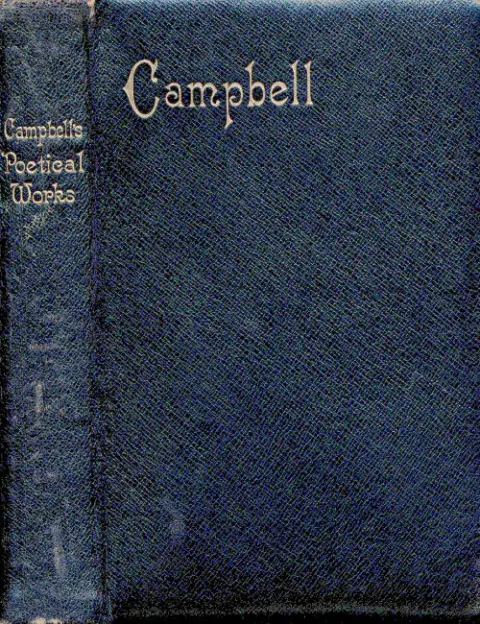
"The Poetical Works of Thomas Campbell" by Thomas Campbell is a collection of poetry written in the early 19th century. This work features a variety of poems, notable among them "The Pleasures of Hope," "Gertrude of Wyoming," and other lyrical pieces, reflecting on themes of love, nature, human experience, and social commentary. The collection highlights Campbell's concern for humanity, hope, and the human condition, often expressed through vivid imagery and emotive language. At the start of the collection, the prefatory memoir provides insight into Campbell's early life, education, and the influences that shaped his poetic career. It outlines his beginnings in Glasgow, his formative experiences with nature, and his introduction to literature. The opening poem, "The Pleasures of Hope," establishes the central theme of the importance of hope in navigating life's hardships. It juxtaposes the beauty of distant landscapes with the promise of love and humanity's potential for growth, addressing personal and political struggles while celebrating the enduring power of aspiration. Through poignant reflections, the early verses set the tone for the collection, evoking a sense of nostalgia and yearning for connection in both love and life.
Introduction adapted from the source catalogue; source summaries may be automatically generated.
Free to read · English · 69,844 words · No account needed
MAKE TIME FOR A GOOD BOOK
On by default. Untick to stop anonymous reading totals. Each page counts after 10 seconds in view. How this works.
Anonymous counting is on unless you have switched it off.
By this the storm grew loud apace,
The water-wraith was shrieking;[81]
And in the scowl of heaven each face
Grew dark as they were speaking.
But still as wilder blew the wind,
And as the night grew drearer,
Adown the glen rode armèd men,
Their trampling sounded nearer.
“O haste thee, haste!” the lady cries,
“Though tempests round us gather;
I’ll meet the raging of the skies,
But not an angry father.”
The boat has left a stormy land,
A stormy sea before her,—
When, oh! too strong for human hand,
The tempest gathered o’er her.
And still they rowed amidst the roar
Of waters fast prevailing:
Lord Ullin reached that fatal shore,
His wrath was changed to wailing.
For sore dismayed, through storm and shade,
His child he did discover:
One lovely hand she stretched for aid,
And one was round her lover.
“Come back! come back!” he cried in grief,
“Across this stormy water:
And I’ll forgive your Highland chief,
My daughter!—oh my daughter!”
Twas vain: the loud waves lashed the shore,
Return or aid preventing:
The waters wild went o’er his child—
And he was left lamenting.
[81] The evil spirit of the waters.
Soul of the Poet! wheresoe’er,
Reclaimed from earth, thy genius plume
Her wings of immortality:
Suspend thy harp in happier sphere,
And with thine influence illume
The gladness of our jubilee.
And fly like fiends from secret spell,
Discord and strife, at BURNS’S name,
Exorcised by his memory;
For he was chief of bards that swell
The heart with songs of social flame,
And high delicious revelry.
And Love’s own strain to him was given,
To warble all its ecstasies
With Pythian words unsought, unwilled—
Love, the surviving gift of Heaven,
The choicest sweet of Paradise,
In life’s else bitter cup distilled.
Who that has melted o’er his lay
To Mary’s soul, in Heaven above,
But pictured sees, in fancy strong,
The landscape and the livelong day
That smiled upon their mutual love?
Who that has felt forgets the song?
Nor skilled one flame alone to fan:
His country’s high-souled peasantry
What patriot-pride he taught!—how much
To weigh the inborn worth of man!
And rustic life and poverty
Grow beautiful beneath his touch.
Him, in his clay-built cot,[82] the muse
Entranced, and showed him all the forms
Of fairy-light and wizard gloom
(That only gifted Poet views),
The Genii of the floods and storms,
And martial shades from Glory’s tomb.
Your reading position is saved on this browser. Take it to another device with a library code. Reading pages adapt to text, rather than matching a printed edition.
BEHIND THE BOOK
This eBook is for the use of anyone anywhere in the United States and most other parts of the world at no cost and with almost no restrictions whatsoever. You may copy it, give it away or re-use it under the terms of the Project Gutenberg License included with this eBook or online at www.gutenberg.org. If you are not located in the United States, you will have to check the laws of the country where you are located before using this eBook. Read the source licence.
The original source file, including credits and licence, is retained by this library. Request an original-format copy at no charge. Please include the book title and Project Gutenberg identifier #59788.
KEEP YOUR CURIOSITY GOING
Eric Mackay
Edmund Gosse
Sophia Margaretta Hensley
Gilbert Parker
George MacDonald

Elizabeth Bibesco