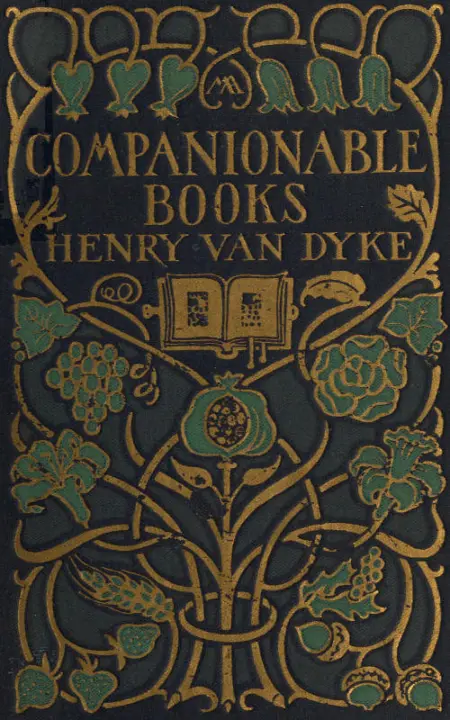
Companionable Books
Henry Van Dyke
THE CLASSIC COLLECTION · 1911
"The Poems of Henry Van Dyke" by Henry Van Dyke is a collection of poetry written in the late 19th century to early 20th century. This compilation features a range of themes, including nature, faith, love, and the human experience, showcasing Van Dyke's contemplative and lyrical style. The poems delve into the beauty of the natural world, the trials of human emotion, and reflections on spirituality, creating a resonant tapestry of poetic expression. At the start of this volume, readers are introduced to various poems that celebrate the experiences of nature and the human spirit. For example, "The After-Echo" explores the idea of memories lingering in the soul, touching on themes of nostalgia and the passage of time. Other poems reflect the serenity and beauty found in nature, such as "Dulciora," which contemplates the deep meanings in simple moments. Through vivid imagery and a melodic tone, the opening portion sets the stage for a rich exploration of life’s complexities, inviting readers to immerse themselves in Van Dyke's thoughtful reflections.
Introduction adapted from the source catalogue; source summaries may be automatically generated.
Free to read · English · 78,062 words · No account needed
MAKE TIME FOR A GOOD BOOK
On by default. Untick to stop anonymous reading totals. Each page counts after 10 seconds in view. How this works.
Anonymous counting is on unless you have switched it off.
There is a bird I know so well,
It seems as if he must have sung
Beside my crib when I was young;
Before I knew the way to spell
The name of even the smallest bird,
His gentle-joyful song I heard.
Now see if you can tell, my dear.
What bird it is that, every year,
Sings "Sweet--sweet--sweet--very merry cheer."
He comes in March, when winds are strong,
And snow returns to hide the earth;
But still he warms his heart with mirth,
And waits for May. He lingers long
While flowers fade; and every day
Repeats his small, contented lay;
As if to say, we need not fear
The season's change, if love is here
With "Sweet--sweet--sweet--very merry cheer."
He does not wear a Joseph's-coat
Of many colours, smart and gay;
His suit is Quaker brown and gray,
With darker patches at his throat.
And yet of all the well-dressed throng
Not one can sing so brave a song.
It makes the pride of looks appear
A vain and foolish thing, to hear
His "Sweet--sweet--sweet--very merry cheer."
A lofty place he does not love,
But sits by choice, and well at ease,
In hedges, and in little trees
That stretch their slender arms above
The meadow-brook; and there he sings
Till all the field with pleasure rings;
And so he tells in every ear,
That lowly homes to heaven are near
In "Sweet--sweet--sweet--very merry cheer."
I like the tune, I like the words;
They seem so true, so free from art,
So friendly, and so full of heart,
That if but one of all the birds
Could be my comrade everywhere,
My little brother of the air,
I'd choose the song-sparrow, my dear,
Because he'd bless me, every year,
With "Sweet--sweet--sweet--very merry cheer."
When May bedecks the naked trees
With tassels and embroideries,
And many blue-eyed violets beam
Along the edges of the stream,
I hear a voice that seems to say,
Now near at hand, now far away,
"Witchery--witchery--witchery."
An incantation so serene,
So innocent, befits the scene:
There's magic in that small bird's note--
See, there he flits--the Yellow-throat;
A living sunbeam, tipped with wings,
A spark of light that shines and sings
"Witchery--witchery--witchery."
You prophet with a pleasant name,
If out of Mary-land you came,
You know the way that thither goes
Where Mary's lovely garden grows:
Fly swiftly back to her, I pray,
And try to call her down this way,
"Witchery--witchery--witchery!"
Tell her to leave her cockle-shells,
And all her little silver bells
That blossom into melody,
And all her maids less fair than she.
She does not need these pretty things,
For everywhere she comes, she brings
"Witchery--witchery--witchery!"
Your reading position is saved on this browser. Take it to another device with a library code. Reading pages adapt to text, rather than matching a printed edition.
Henry Van Dyke
Henry Van Dyke
Henry Van Dyke
Henry Van Dyke
BEHIND THE BOOK
This eBook is for the use of anyone anywhere in the United States and most other parts of the world at no cost and with almost no restrictions whatsoever. You may copy it, give it away or re-use it under the terms of the Project Gutenberg License included with this eBook or online at www.gutenberg.org. If you are not located in the United States, you will have to check the laws of the country where you are located before using this eBook. Read the source licence.
The original source file, including credits and licence, is retained by this library. Request an original-format copy at no charge. Please include the book title and Project Gutenberg identifier #16229.
KEEP YOUR CURIOSITY GOING

Eric Mackay
Edmund Gosse
Sophia Margaretta Hensley
Gilbert Parker
George MacDonald

Elizabeth Bibesco