THE CLASSIC COLLECTION✦ChildhoodCLASSIC FREE BOOKS
Childhood
Alice Meynell
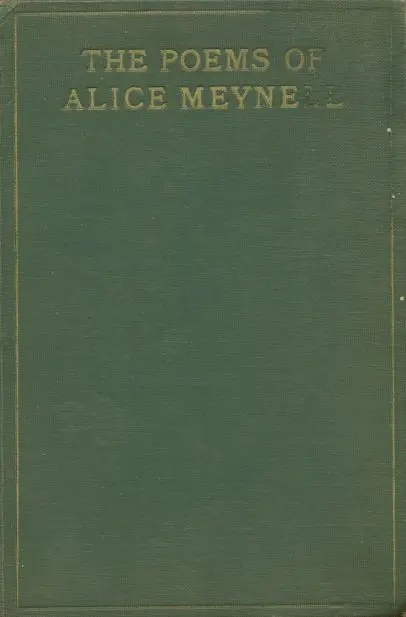
THE CLASSIC COLLECTION · 1923
"The Poems of Alice Meynell" by Alice Meynell is a collection of poetry published in the early 20th century. This complete edition encompasses her entire body of poetic work, including early pieces and later poems that reflect a profound engagement with themes of nature, love, spirituality, and the complexity of human experience. Through her verses, Meynell's lyrical style seeks to capture both the beauty and the melancholy inherent in the world around her. At the start of the collection, the opening poem, "In Early Spring," sets a tone of introspection and connection with nature. The speaker expresses a deep understanding of the seasonal changes, imbued with a sense of nostalgia and anticipation for new life. Meynell blends personal emotions with vivid imagery of nature, contemplating the mysteries of life and the rhythms of the universe. The subsequent poems, such as "To the Beloved" and "An Unmarked Festival," continue to navigate themes of love and the passage of time, suggesting a continuous dialogue between human emotions and the external world. Through this rich exploration, Meynell invites readers into her poetic universe, where each poem acts as a reflection on the interplay between the individual and the greater tapestry of existence.
Introduction adapted from the source catalogue; source summaries may be automatically generated.
Free to read · English · 16,663 words · No account needed
MAKE TIME FOR A GOOD BOOK
On by default. Untick to stop anonymous reading totals. Each page counts after 10 seconds in view. How this works.
Anonymous counting is on unless you have switched it off.
The Art of Painting had in the Primitive years looked with the light, not towards it. Before Tintoretto's date, however, many painters practised shadows and lights, and turned more or less sunwards; but he set the figure between himself and a full sun. His work is to be known in Venice by the splendid trick of an occluded sun and a shadow thrown straight at the spectator.
Master, thy enterprise,
Magnificent, magnanimous, was well done,
Which seized the head of Art, and turned her eyes--
The simpleton--and made her front the sun.
Long had she sat content,
Her young unlessoned back to a morning gay,
To a solemn noon, to a cloudy firmament,
And looked upon a world in gentle day.
But thy imperial call
Bade her to stand with thee and breast the light,
And therefore face the shadows, mystical,
Sombre, translucent, vestiges of night,
Yet glories of the day.
Eagle! we know thee by thy undaunted eyes
Sky-ward, and by thy glooms; we know thy way
Ambiguous, and those halo-misted dyes.
Thou Cloud, the bridegroom's friend
(The bridegroom sun)! Master, we know thy sign:
A mystery of hues world-without-end;
And hide-and-seek of gamesome and divine;
Shade of the noble head
Cast hitherward upon the noble breast;
Human solemnities thrice hallowed;
The haste to Calvary, the Cross at rest.
Look sunward, Angel, then!
Carry the fortress-heavens by that hand;
Still be the interpreter of suns to men;
And shadow us, O thou Tower! for thou shalt stand.
A voice peals in this end of night
A phrase of notes resembling stars,
Single and spiritual notes of light.
What call they at my window-bars?
The South, the past, the day to be,
An ancient infelicity.
Darkling, deliberate, what sings
This wonderful one, alone, at peace?
What wilder things than song, what things
Sweeter than youth, clearer than Greece,
Dearer than Italy, untold
Delight, and freshness centuries old?
And first first-loves, a multitude,
The exaltation of their pain;
Ancestral childhood long renewed;
And midnights of invisible rain;
And gardens, gardens, night and day,
Gardens and childhood all the way.
What Middle Ages passionate,
O passionless voice! What distant bells
Lodged in the hills, what palace state
Illyrian! For it speaks, it tells,
Without desire, without dismay,
Some morrow and some yesterday.
All-natural things! But more--Whence came
This yet remoter mystery?
How do these starry notes proclaim
A graver still divinity?
This hope, this sanctity of fear?
O innocent throat! O human ear!
Your reading position is saved on this browser. Take it to another device with a library code. Reading pages adapt to text, rather than matching a printed edition.
Alice Meynell
Alice Meynell
Alice Meynell
Alice Meynell
BEHIND THE BOOK
This eBook is for the use of anyone anywhere in the United States and most other parts of the world at no cost and with almost no restrictions whatsoever. You may copy it, give it away or re-use it under the terms of the Project Gutenberg License included with this eBook or online at www.gutenberg.org. If you are not located in the United States, you will have to check the laws of the country where you are located before using this eBook. Read the source licence.
The original source file, including credits and licence, is retained by this library. Request an original-format copy at no charge. Please include the book title and Project Gutenberg identifier #62251.
KEEP YOUR CURIOSITY GOING

Eric Mackay
Edmund Gosse
Sophia Margaretta Hensley
Gilbert Parker
George MacDonald

Elizabeth Bibesco