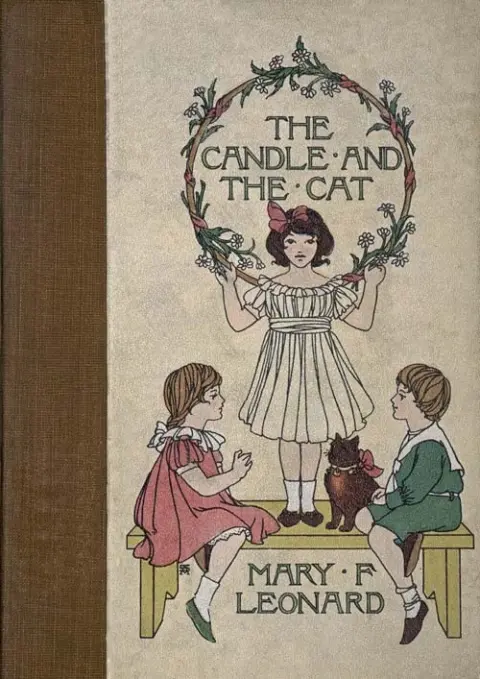
The Candle and the Cat
Mary Finley Leonard
THE CLASSIC COLLECTION · 1903
"The Pleasant Street Partnership: A Neighborhood Story" by Mary Finley Leonard is a fictional narrative written in the early 20th century. The story centers around various residents of Pleasant Street and the dynamic changes they face, particularly with the opening of a new shop that stirs both excitement and apprehension within the established neighborhood. The opening chapters introduce key characters, such as Norah Pennington, a young woman determined to bring a fresh and welcoming business to the area, as well as the notable community residents who may resist or embrace these changes. The opening of the book sets the stage for a neighborhood in transition, highlighting the contrasting views of the established residents of the Terrace and the newcomers on Pleasant Street. As a drug store is proposed and ultimately transformed into a shop for notions run by Norah and her partner Marion, the initial excitement is juxtaposed with skepticism from the old guard of the neighborhood. The narrative delves into the lives of characters like the curious James Mandeville and the rigid Mrs. Millard, illustrating their relationships and reactions to the encroaching changes, ultimately suggesting themes of community, adaptation, and the tension between tradition and progress.
Introduction adapted from the source catalogue; source summaries may be automatically generated.
Free to read · English · 46,186 words · No account needed
MAKE TIME FOR A GOOD BOOK
On by default. Untick to stop anonymous reading totals. Each page counts after 10 seconds in view. How this works.
Anonymous counting is on unless you have switched it off.
To Philadelphia--that child! Miss Virginia, who never travelled alone, was overcome with the terror of it. What could she do? Was it too late to stop her? Oh, for some one to help! She ran out into the hall, but something checked her first impulse to call the servants. At what hour did the evening train leave for the north? She hastened downstairs for the paper.
"It is all my fault! all my fault!" she murmured to herself, as with trembling hands she searched for the railroad column. It was too late; the train must have left half an hour ago.
She must consult somebody. Surely, something could be done. Opening the front door, she looked out into the night. A bright light shone from the Russells' across the way. Forgetting to close the door behind her, she hurried over the street and rang the bell.
She told the servant tremblingly that she wished to speak to Miss Alex, who presently came to her in evident surprise.
"Why, Miss Virginia! Is anything the matter?"
"Oh, Alex, something dreadful has happened!" In her agitation it was
not possible to say more.
"Is any one ill?"
"No, it is Charlotte--she has gone!"
"Gone?" echoed Alex. "But do come in, Miss Virginia."
"I can't; I left the door open. I don't want people to know. Oh, Alex,
what shall I do?"
"I'll go back with you," said Alex. "I don't understand yet what has happened. Where has Charlotte gone?"
Once inside her own door, Miss Virginia thrust Charlotte's note into Alexina's hand. "What shall I do?" she cried. "That long journey alone, and it is all my fault!"
"Don't say that; I am afraid it is partly mine. I was hard on her this afternoon, but I didn't dream-- There must be some way to stop her,--by telegraphing ahead, you know. I wonder-- It should be done at once. The train left half an hour ago, you say?"
Miss Virginia nodded; words were beyond her.
And now into the drawing-room, where they stood in agitated uncertainty, walked Miss Pennington, the shopkeeper. Her face was flushed, her hair a little disordered by the wind, but she was smiling, and somehow her presence seemed at once to relieve the tension.
"Perhaps you can help me," cried poor Miss Virginia, hardly knowing
what she said.
"I am sure I can," answered the stranger, going to her and taking the trembling hands in her own firm ones. "Are you worried about Charlotte? If you are, I have come to tell you she is safe, and is not going to Philadelphia to-night."
"You are sure? How do you know?" cried Miss Virginia, in bewilderment.
Your reading position is saved on this browser. Take it to another device with a library code. Reading pages adapt to text, rather than matching a printed edition.
Mary Finley Leonard
Mary Finley Leonard
Mary Finley Leonard
Mary Finley Leonard
BEHIND THE BOOK
This eBook is for the use of anyone anywhere in the United States and most other parts of the world at no cost and with almost no restrictions whatsoever. You may copy it, give it away or re-use it under the terms of the Project Gutenberg License included with this eBook or online at www.gutenberg.org. If you are not located in the United States, you will have to check the laws of the country where you are located before using this eBook. Read the source licence.
The original source file, including credits and licence, is retained by this library. Request an original-format copy at no charge. Please include the book title and Project Gutenberg identifier #21944.
KEEP YOUR CURIOSITY GOING
Coulson Kernahan

Maurice Baring
Frances Wright
Cécile Tormay

Frederic Jesup Stimson

W. H. P. (William Henry Pope) Jarvis