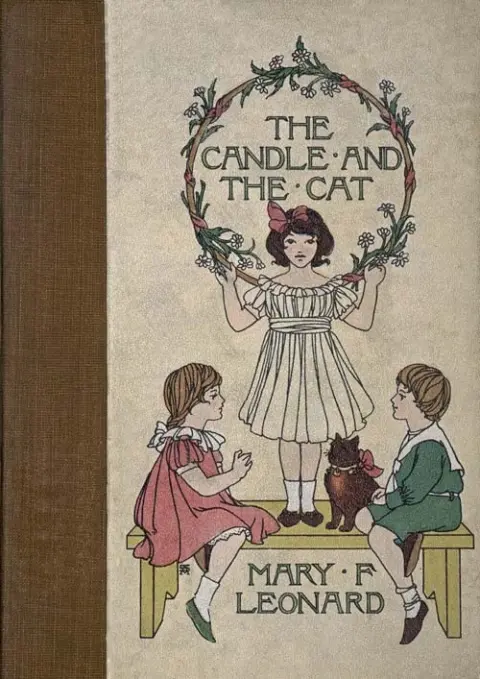
The Candle and the Cat
Mary Finley Leonard
THE CLASSIC COLLECTION · 1903
"The Pleasant Street Partnership: A Neighborhood Story" by Mary Finley Leonard is a fictional narrative written in the early 20th century. The story centers around various residents of Pleasant Street and the dynamic changes they face, particularly with the opening of a new shop that stirs both excitement and apprehension within the established neighborhood. The opening chapters introduce key characters, such as Norah Pennington, a young woman determined to bring a fresh and welcoming business to the area, as well as the notable community residents who may resist or embrace these changes. The opening of the book sets the stage for a neighborhood in transition, highlighting the contrasting views of the established residents of the Terrace and the newcomers on Pleasant Street. As a drug store is proposed and ultimately transformed into a shop for notions run by Norah and her partner Marion, the initial excitement is juxtaposed with skepticism from the old guard of the neighborhood. The narrative delves into the lives of characters like the curious James Mandeville and the rigid Mrs. Millard, illustrating their relationships and reactions to the encroaching changes, ultimately suggesting themes of community, adaptation, and the tension between tradition and progress.
Introduction adapted from the source catalogue; source summaries may be automatically generated.
Free to read · English · 46,186 words · No account needed
MAKE TIME FOR A GOOD BOOK
On by default. Untick to stop anonymous reading totals. Each page counts after 10 seconds in view. How this works.
Anonymous counting is on unless you have switched it off.
"It is very fortunate that so many of us happen to be together this evening," began Mrs. Millard, "for I think we should decide upon our course in regard to the shop." Her white hand, veiled in a fall of lace, made a slight motion in the direction of the corner.
"Don't you want some chocolate candy?" asked Miss Virginia, in an
audible aside to Miss Sarah. "Charlotte and I made some this
afternoon."
"When we have decided the fate of the shop," the lady whispered back.
"Seriously," continued Mrs. Millard, turning toward her sister with a slight frown, "should we not take some action?"
"You are right, Caroline. In my day shops kept to their own territory," Mrs. Leigh responded. "I remember the colonel used to say--but there! I promised Sarah I wouldn't tell any stories this evening. She says I bore people."
"Why, Aunt Sally! you are telling the biggest kind of a one this
minute," cried her niece.
A good-natured warfare waged continually between these two. Mrs. Leigh, who was in reality the most petted and indulged of old ladies, pretending to live in constant fear of Miss Sarah.
"But what can we do?" Alexina was heard asking, as the skirmishers finally retired, Mrs. Leigh having the last word. "We can't exactly blame these persons, whoever they may be, for coming here. They could not know we did not want them."
"I saw some one standing in the door of the shop this morning who looked like a lady," Miss Virginia remarked.
"How do you define a lady, Virginia?" her sister asked with some
severity.
"Why, Caroline, I am not a dictionary; I wish you wouldn't ask me to define things," replied Miss Virginia, with a little laugh. Then with the manner of one who regretted this flippancy she added, "I think I understand the word as you do."
"It seems to me we are too often content with a surface meaning," Mrs.
Millard continued.
"That is true," agreed Alex. "Now, there is no reason in the world why these shopkeepers may not be ladies."
Mrs. Millard looked at her doubtfully. "Still," she interposed, "ladies do not as a usual thing keep shops."
"No; they sweep and scrub and cook, and pretend they don't,--that is the difference," put in Miss Sarah, crossing her knees and bending forward with the air of one who had found a congenial theme. "I am a paper-hanger, a painter, and a maid-of-all-work; and this is what it usually means to be a lady when you are poor."
"Teaching has always seemed to me a most suitable occupation for a woman," suggested Mrs. Millard.
Your reading position is saved on this browser. Take it to another device with a library code. Reading pages adapt to text, rather than matching a printed edition.
Mary Finley Leonard
Mary Finley Leonard
Mary Finley Leonard
Mary Finley Leonard
BEHIND THE BOOK
This eBook is for the use of anyone anywhere in the United States and most other parts of the world at no cost and with almost no restrictions whatsoever. You may copy it, give it away or re-use it under the terms of the Project Gutenberg License included with this eBook or online at www.gutenberg.org. If you are not located in the United States, you will have to check the laws of the country where you are located before using this eBook. Read the source licence.
The original source file, including credits and licence, is retained by this library. Request an original-format copy at no charge. Please include the book title and Project Gutenberg identifier #21944.
KEEP YOUR CURIOSITY GOING
Coulson Kernahan

Maurice Baring
Frances Wright
Cécile Tormay

Frederic Jesup Stimson

W. H. P. (William Henry Pope) Jarvis