
The lost dirigible
Ralph Henry Barbour
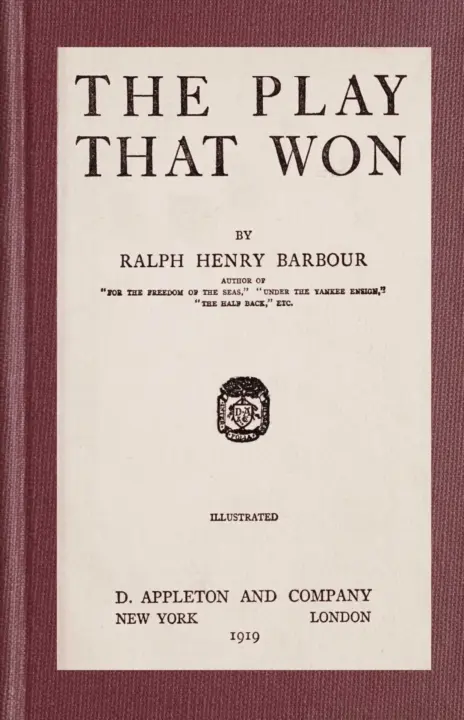
THE CLASSIC COLLECTION · 1919
"The Play That Won" by Ralph Henry Barbour is a sports-themed novel written in the early 20th century. The story revolves around the experiences of a group of boys at a private school, particularly focusing on the dynamics of their baseball team and the challenges they face both on and off the field. The main character, Ted Bowman, navigates friendships, rivalries, and critical decisions that ultimately impact the fate of his school’s baseball season. At the start of the narrative, we are introduced to Ted Bowman as he reflects on his baseball team’s recent victory over a rival school, Prospect Hill. Ted is also contemplating the troubles of his teammate, Hal Saunders, who risks facing disciplinary action from the school's Principal because of unpaid debts. As the story unfolds, we see the intricate relationships and tensions among the team members, including the disappointment Ted feels for his captain, George Tempest. The stakes are raised as the championship game approaches, and Ted grapples with feelings of loyalty, jealousy, and the desire to contribute to the team's success, setting the stage for further conflict and teamwork in the ensuing chapters.
Introduction adapted from the source catalogue; source summaries may be automatically generated.
Free to read · English · 50,351 words · No account needed
MAKE TIME FOR A GOOD BOOK
On by default. Untick to stop anonymous reading totals. Each page counts after 10 seconds in view. How this works.
Anonymous counting is on unless you have switched it off.
They were revising the line-up for the final game of the season, that with Fairfield, when Jack Groom entered: Coach Thornton, Payson Walsh, manager; Larry Logan, quarterback; and Jim Walsh, left guard. Had Tinker, the trainer, been on hand too, the Board of Football Strategy of Staunton School would have been, with Jack’s advent, complete. “Tink’s” absence, however, had been discounted: and the same was true of Jack, for none of those in the coach’s study had expected the captain to hobble all that half-mile between campus and village. There were four simultaneous exclamations of surprise when he appeared in the doorway.
“Oh, Doc says I’m out of it for good,” defended Jack. He lowered himself into a chair, leaned his crutches alongside and scowled malignantly at the bulky swathings of his right foot.
“Maybe, son, but you don’t want to have trouble with that ankle, even if you can’t play,” said Mr. Thornton.
“I’ve got all winter to coddle it,” Jack growled. “Shove that footstool over, Larry, will you? Well, what have you decided?”
“There wasn’t much to decide, Cap,” replied the coach. “With you out of it――――”
“Preston or Morely.”
“Exactly. And it’s Preston, to my mind.” There was a suggestion of challenge in Mr. Thornton’s voice. Jack glanced at the others. Logan nodded, and so did Payson Walsh, but his brother remained non-committal.
“Ted Morely played a pretty snappy game to-day after I came out,”
suggested Jack.
“Oh, Morely’s all right,” agreed the coach, “but in my opinion Preston’s a better man to start the game Saturday. We’ve got to get the jump on Fairfield, Cap, and to do that we ought to start with the best we have. Morely’s smart and fast and――and snappy, but I consider Preston more dependable.”
“Sure,” said the manager. “Ted’s a quitter.”
Jack turned to him, but Jim Walsh was quicker. “Cut that, Pay,” he growled. “You never saw Ted Morely quit in your life.”
“Well, you know what I mean,” his brother protested. “Maybe he isn’t a quitter, exactly, but――he quits! Doesn’t he, now? Didn’t he lie down in the Fielding game? Oh, I know he did something to his shoulder, but he was all right the next morning. It couldn’t have been much. I like Ted, but when it comes to picking a right half for Saturday――――”
“The trouble is that he’s always getting hurt,” said Logan.
Your reading position is saved on this browser. Take it to another device with a library code. Reading pages adapt to text, rather than matching a printed edition.
Ralph Henry Barbour
Ralph Henry Barbour

Ralph Henry Barbour

Ralph Henry Barbour
BEHIND THE BOOK
This eBook is for the use of anyone anywhere in the United States and most other parts of the world at no cost and with almost no restrictions whatsoever. You may copy it, give it away or re-use it under the terms of the Project Gutenberg License included with this eBook or online at www.gutenberg.org. If you are not located in the United States, you will have to check the laws of the country where you are located before using this eBook. Read the source licence.
The original source file, including credits and licence, is retained by this library. Request an original-format copy at no charge. Please include the book title and Project Gutenberg identifier #68062.
KEEP YOUR CURIOSITY GOING
Coulson Kernahan

Maurice Baring
Frances Wright
Cécile Tormay

Frederic Jesup Stimson

W. H. P. (William Henry Pope) Jarvis