
The lost dirigible
Ralph Henry Barbour
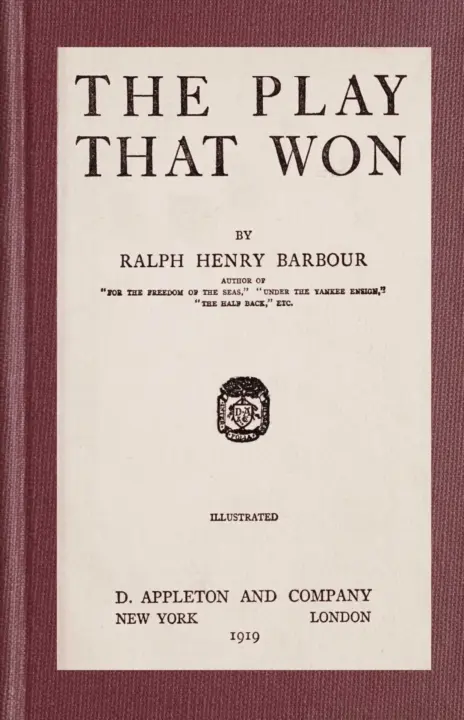
THE CLASSIC COLLECTION · 1919
"The Play That Won" by Ralph Henry Barbour is a sports-themed novel written in the early 20th century. The story revolves around the experiences of a group of boys at a private school, particularly focusing on the dynamics of their baseball team and the challenges they face both on and off the field. The main character, Ted Bowman, navigates friendships, rivalries, and critical decisions that ultimately impact the fate of his school’s baseball season. At the start of the narrative, we are introduced to Ted Bowman as he reflects on his baseball team’s recent victory over a rival school, Prospect Hill. Ted is also contemplating the troubles of his teammate, Hal Saunders, who risks facing disciplinary action from the school's Principal because of unpaid debts. As the story unfolds, we see the intricate relationships and tensions among the team members, including the disappointment Ted feels for his captain, George Tempest. The stakes are raised as the championship game approaches, and Ted grapples with feelings of loyalty, jealousy, and the desire to contribute to the team's success, setting the stage for further conflict and teamwork in the ensuing chapters.
Introduction adapted from the source catalogue; source summaries may be automatically generated.
Free to read · English · 50,351 words · No account needed
MAKE TIME FOR A GOOD BOOK
On by default. Untick to stop anonymous reading totals. Each page counts after 10 seconds in view. How this works.
Anonymous counting is on unless you have switched it off.
“Come in!” called Jonesie.
Entered Cummings, smiling knowingly, and seated himself with a fine nonchalance. Jonesie, looking up from Latin, eyed him with disfavor.
“What you grinning about?” he demanded coldly.
Cummings winked and leered. “You win,” he announced cheerfully, and managed a deprecatory laugh. Jonesie frowned darkly.
“Win what?”
“You know. I don’t know how you do it――That is, I’m not certain, but I have an idea. Anyhow, it’s clever, Jonesie. You had me guessing at first, all right. But I guess we’re quits now, eh?”
“Would you mind giving me a hint? I’ve got Latin and math to get and there isn’t much time for conundrums, Cummings. If it’s one of the ‘What’s-the-difference-between’ kind, I never could guess those.”
“Oh, don’t keep it up. I tell you I give in, don’t I? What more do you
want?”
“Say, what are you gabbing about, anyway?” inquired Jonesie crossly. “If you’ve got something on your mind come out with it.”
“You know plaguey well what I’m talking about,” replied Cummings, losing his temper. “I came in here ready to call quits. If you won’t have it, all right. Then I’ll go to Faculty. A joke’s a joke, but you don’t need to keep it up forever!”
“Of course not; that’s what they call monotony,” Jonesie agreed blandly. Cummings scowled.
“You think you’re smart, don’t you? Well, you won’t when you get hauled up at the Office.”
“What for?”
“What for! For――for making a beastly pig-pen of my study! For upsetting my things! You know what for!”
“Not again?” exclaimed Jonesie in shocked tones.
“Half a dozen times! More! I’m sick of it. A joke’s a joke――――”
“You said that before,” said the other, sweetly. “Now look here, Cummings: you blamed me two or three days ago for ‘pieing’ your room. I stood for that, but I’m not going to have you keep it up all――――”
“Then you quit――――”
“――The year. If――if you annoy me any more with――with your unjust accusations I’ll go straight to Faculty. It――it’s getting monotonous.”
Cummings’s jaw fell and for a moment speech deserted him. At last: “You’ll go to Faculty! Ha, ha! Why, you――you little button-nosed――――”
“Never mind my nose. At least I keep it out of other fellows’ affairs! I don’t――――”
“You keep it out of my study then! Just once more――――”
“Don’t be an ass, Cummings,” begged Jonesie. “How could I get into your old study if the door’s locked? Use your bean.”
Your reading position is saved on this browser. Take it to another device with a library code. Reading pages adapt to text, rather than matching a printed edition.
Ralph Henry Barbour
Ralph Henry Barbour

Ralph Henry Barbour

Ralph Henry Barbour
BEHIND THE BOOK
This eBook is for the use of anyone anywhere in the United States and most other parts of the world at no cost and with almost no restrictions whatsoever. You may copy it, give it away or re-use it under the terms of the Project Gutenberg License included with this eBook or online at www.gutenberg.org. If you are not located in the United States, you will have to check the laws of the country where you are located before using this eBook. Read the source licence.
The original source file, including credits and licence, is retained by this library. Request an original-format copy at no charge. Please include the book title and Project Gutenberg identifier #68062.
KEEP YOUR CURIOSITY GOING
Coulson Kernahan

Maurice Baring
Frances Wright
Cécile Tormay

Frederic Jesup Stimson

W. H. P. (William Henry Pope) Jarvis