THE CLASSIC COLLECTION✦The Journal of Sir Walter Scott From the Original Manuscript at AbbotsfordCLASSIC FREE BOOKS
The Journal of Sir Walter Scott From the Original Manuscript at Abbotsford
Walter Scott
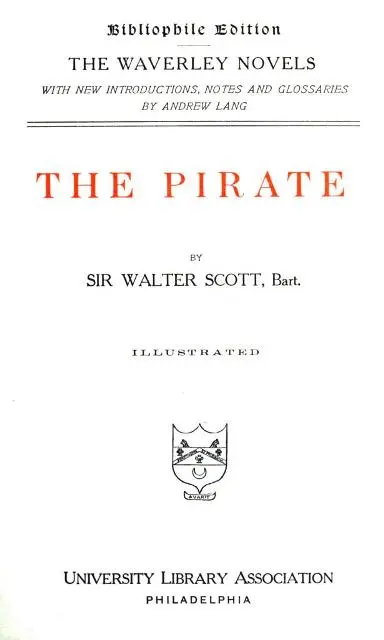
THE CLASSIC COLLECTION · 1893
"The Pirate" by Walter Scott is a novel published in 1821. Set in the Shetland Islands at the end of the 17th century, it tells the story of young Mordaunt, whose friendship with the Troil sisters is shattered by the arrival of a mysterious shipwrecked captain named Cleveland. As rivalry grows between the two men, Minna falls for the charismatic stranger, unaware of his dark secret. When pirates capture the Troils, hidden identities are revealed and loyalties tested in this tale of romance and adventure.
Introduction adapted from the source catalogue; source summaries may be automatically generated.
Free to read · English · 198,419 words · No account needed
MAKE TIME FOR A GOOD BOOK
On by default. Untick to stop anonymous reading totals. Each page counts after 10 seconds in view. How this works.
Anonymous counting is on unless you have switched it off.
Meantime young Triptolemus, having received such instructions as the Curate could give him, (for though Dame Yellowley adhered to the persecuted remnant, her jolly husband, edified by the black gown and prayer-book, still conformed to the church as by law established,) was, in due process of time, sent to Saint Andrews to prosecute his studies. He went, it is true; but with an eye turned back with sad remembrances on his father's plough, his father's pancakes, and his father's ale, for which the small-beer of the college, commonly there termed "thorough-go-nimble," furnished a poor substitute. Yet he advanced in his learning, being found, however, to show a particular favour to such authors of antiquity as had made the improvement of the soil the object of their researches. He endured the Bucolics of Virgil--the Georgics he had by heart--but the Æneid he could not away with; and he was particularly severe upon the celebrated line expressing a charge of cavalry, because, as he understood the word putrem,[21] he opined that the combatants, in their inconsiderate ardour, galloped over a new-manured ploughed field. Cato, the Roman Censor was his favourite among classical heroes and philosophers, not on account of the strictness of his morals, but because of his treatise, de Re Rustica. He had ever in his mouth the phrase of Cicero, Jam neminem antepones Catoni. He thought well of Palladius, and of Terentius Varro, but Columella was his pocket-companion. To these ancient worthies, he added the more modern Tusser, Hartlib, and other writers on rural economics, not forgetting the lucubrations of the Shepherd of Salisbury Plain, and such of the better-informed Philomaths, who, instead of loading their almanacks with vain predictions of political events, pretended to see what seeds would grow and what would not, and direct the attention of their readers to that course of cultivation from which the production of good crops may be safely predicted; modest sages, in fine, who, careless of the rise and downfall of empires, content themselves with pointing out the fit seasons to reap and sow, with a fair guess at the weather which each month will be likely to present; as, for example, that if Heaven pleases, we shall have snow in January, and the author will stake his reputation that July proves, on the whole, a month of sunshine. Now, although the Rector of Saint Leonard's was greatly pleased, in general, with the quiet, laborious, and studious bent of Triptolemus Yellowley, and deemed him, in so far, worthy of a name of four syllables having a Latin termination, yet he relished not, by any means, his exclusive attention to his favourite authors. It savoured of the earth, he said, if not of something worse, to have a man's mind always grovelling in mould, stercorated or unstercorated; and he pointed out, but in vain, history, and poetry, and divinity, as more elevating subjects of occupation. Triptolemus Yellowley was obstinate in his own course: Of the battle of Pharsalia, he thought not as it affected the freedom of the world, but dwelt on the rich crop which the Emathian fields were likely to produce the next season. In vernacular poetry, Triptolemus could scarce be prevailed upon to read a single couplet, excepting old Tusser, as aforesaid, whose Hundred Points of Good Husbandry he had got by heart; and excepting also Piers Ploughman's Vision, which, charmed with the title, he bought with avidity from a packman, but after reading the two first pages, flung it into the fire as an impudent and misnamed political libel. As to divinity, he summed that matter up by reminding his instructors, that to labour the earth and win his bread with the toil of his body and sweat of his brow, was the lot imposed upon fallen man; and, for his part, he was resolved to discharge, to the best of his abilities, a task so obviously necessary to existence, leaving others to speculate as much as they would, upon the more recondite mysteries of theology.
Your reading position is saved on this browser. Take it to another device with a library code. Reading pages adapt to text, rather than matching a printed edition.
Walter Scott
Walter Scott
Walter Scott
S. R. (Samuel Rutherford) Crockett & Walter Scott
BEHIND THE BOOK
This eBook is for the use of anyone anywhere in the United States and most other parts of the world at no cost and with almost no restrictions whatsoever. You may copy it, give it away or re-use it under the terms of the Project Gutenberg License included with this eBook or online at www.gutenberg.org. If you are not located in the United States, you will have to check the laws of the country where you are located before using this eBook. Read the source licence.
The original source file, including credits and licence, is retained by this library. Request an original-format copy at no charge. Please include the book title and Project Gutenberg identifier #42389.
KEEP YOUR CURIOSITY GOING
Cécile Tormay

Moritz Busch
Coulson Kernahan
John L. Ransom

Maurice Baring
Frances Wright