THE CLASSIC COLLECTION✦The Journal of Sir Walter Scott From the Original Manuscript at AbbotsfordCLASSIC FREE BOOKS
The Journal of Sir Walter Scott From the Original Manuscript at Abbotsford
Walter Scott
THE CLASSIC COLLECTION · 1893
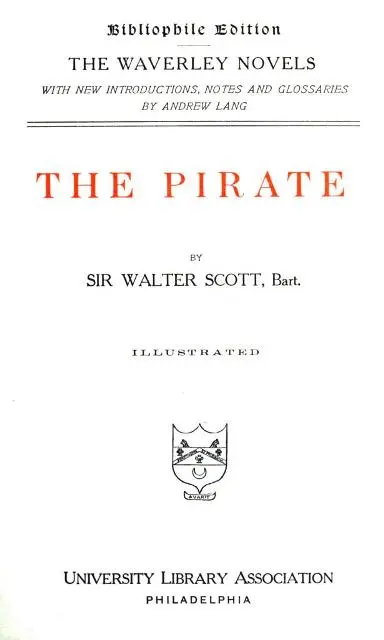
"The Pirate" by Walter Scott is a novel published in 1821. Set in the Shetland Islands at the end of the 17th century, it tells the story of young Mordaunt, whose friendship with the Troil sisters is shattered by the arrival of a mysterious shipwrecked captain named Cleveland. As rivalry grows between the two men, Minna falls for the charismatic stranger, unaware of his dark secret. When pirates capture the Troils, hidden identities are revealed and loyalties tested in this tale of romance and adventure.
Introduction adapted from the source catalogue; source summaries may be automatically generated.
Free to read · English · 198,419 words · No account needed
MAKE TIME FOR A GOOD BOOK
On by default. Untick to stop anonymous reading totals. Each page counts after 10 seconds in view. How this works.
Anonymous counting is on unless you have switched it off.
Many prodigious stories of these marine monsters, and of many others less known, were then universally received among the Zetlanders, whose descendants have not as yet by any means abandoned faith in them.[18]
Such legends are, indeed, everywhere current amongst the vulgar; but the imagination is far more powerfully affected by them on the deep and dangerous seas of the north, amidst precipices and headlands, many hundred feet in height,--amid perilous straits, and currents, and eddies,--long sunken reefs of rock, over which the vivid ocean foams and boils,--dark caverns, to whose extremities neither man nor skiff has ever ventured,--lonely, and often uninhabited isles,--and occasionally the ruins of ancient northern fastnesses, dimly seen by the feeble light of the Arctic winter. To Mordaunt, who had much of romance in his disposition, these superstitions formed a pleasing and interesting exercise of the imagination, while, half doubting, half inclined to believe, he listened to the tales chanted concerning these wonders of nature, and creatures of credulous belief, told in the rude but energetic language of the ancient Scalds.
But there wanted not softer and lighter amusement, that might seem better suited to Mordaunt's age, than the wild tales and rude exercises which we have already mentioned. The season of winter, when, from the shortness of the daylight, labour becomes impossible, is in Zetland the time of revel, feasting, and merriment. Whatever the fisherman has been able to acquire during summer, was expended, and often wasted, in maintaining the mirth and hospitality of his hearth during this period; while the landholders and gentlemen of the island gave double loose to their convivial and hospitable dispositions, thronged their houses with guests, and drove away the rigour of the season with jest, glee, and song, the dance, and the wine-cup.
Amid the revels of this merry, though rigorous season, no youth added more spirit to the dance, or glee to the revel, than the young stranger, Mordaunt Mertoun. When his father's state of mind permitted, or indeed required, his absence, he wandered from house to house a welcome guest whereever he came, and lent his willing voice to the song, and his foot to the dance. A boat, or, if the weather, as was often the case, permitted not that convenience, one of the numerous ponies, which, straying in hordes about the extensive moors, may be said to be at any man's command who can catch them, conveyed him from the mansion of one hospitable Zetlander to that of another. None excelled him in performing the warlike sword-dance, a species of amusement which had been derived from the habits of the ancient Norsemen. He could play upon the gue, and upon the common violin, the melancholy and pathetic tunes peculiar to the country; and with great spirit and execution could relieve their monotony with the livelier airs of the North of Scotland. When a party set forth as maskers, or, as they are called in Scotland, guizards, to visit some neighbouring Laird, or rich Udaller, it augured well of the expedition if Mordaunt Mertoun could be prevailed upon to undertake the office of skudler, or leader of the band. Upon these occasions, full of fun and frolic, he led his retinue from house to house, bringing mirth where he went, and leaving regret when he departed. Mordaunt became thus generally known and beloved as generally, through most of the houses composing the patriarchal community of the Main Isle; but his visits were most frequently and most willingly paid at the mansion of his father's landlord and protector, Magnus Troil.
Your reading position is saved on this browser. Take it to another device with a library code. Reading pages adapt to text, rather than matching a printed edition.
Walter Scott
Walter Scott
Walter Scott
S. R. (Samuel Rutherford) Crockett & Walter Scott
BEHIND THE BOOK
This eBook is for the use of anyone anywhere in the United States and most other parts of the world at no cost and with almost no restrictions whatsoever. You may copy it, give it away or re-use it under the terms of the Project Gutenberg License included with this eBook or online at www.gutenberg.org. If you are not located in the United States, you will have to check the laws of the country where you are located before using this eBook. Read the source licence.
The original source file, including credits and licence, is retained by this library. Request an original-format copy at no charge. Please include the book title and Project Gutenberg identifier #42389.
KEEP YOUR CURIOSITY GOING
Cécile Tormay

Moritz Busch
Coulson Kernahan
John L. Ransom

Maurice Baring
Frances Wright