THE CLASSIC COLLECTION✦Karl GrierCLASSIC FREE BOOKS
Karl Grier
Louis Tracy
THE CLASSIC COLLECTION · 1904
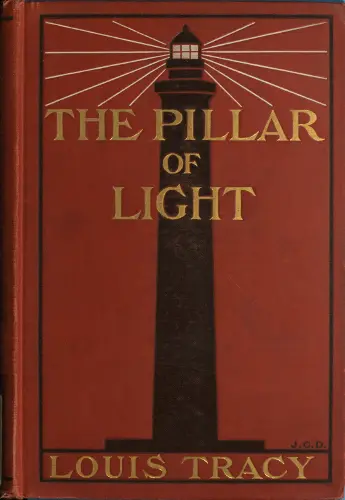
"The Pillar of Light" by Louis Tracy is a novel written in the early 20th century. The story is centered around the Gulf Rock lighthouse, focusing on its keeper, Stephen Brand, and his companions as they navigate the challenges of life at sea, including a dramatic rescue that intertwines their fates with an abandoned baby. The book explores themes of duty, adventure, and the complexity of human relationships, promising both suspense and emotional depth as the characters confront the mysteries of the ocean and their own pasts. At the start of the narrative, we are introduced to the solitary yet vital life of the lighthouse keeper, Stephen Brand, watching over the treacherous waters and responding to the foggy night. The atmosphere is heavy with suspense as Brand spots a drifting lifeboat, leading to the discovery of a baby hidden beneath a sail, representing both a miracle and a mystery. As Brand grapples with the potential tragedy surrounding the lifeboat, he is drawn into a life-altering event that forces him to confront his own past. The chapters unfold amidst vivid descriptions of the sea, revealing not only the dangers of the environment but also the characters' connections to one another as they face impending storms, both literal and metaphorical.
Introduction adapted from the source catalogue; source summaries may be automatically generated.
Free to read · English · 80,398 words · No account needed
MAKE TIME FOR A GOOD BOOK
On by default. Untick to stop anonymous reading totals. Each page counts after 10 seconds in view. How this works.
Anonymous counting is on unless you have switched it off.
He knew that Brand was not likely to leave them in any dubiety as to the past. Discussion now was useless, a mere idle guessing at probabilities, so he boldly plunged into the mystery as yet surrounding Enid's first year of existence.
Mr. Traill, glad enough to discuss a more congenial subject, marshalled the ascertained facts. It was easy to see that here, at least, he stood on firm ground.
"Your father, as you know, was a noted yachtsman, Charlie," he said. "Indeed, he was one of the first men to cross the Atlantic in his own boat under steam and sail. Twenty years ago, in this very month, he took my wife and me, with your mother, you, and our little Edith, then six months' old, on a delightful trip along the Florida coast and the Gulf of Mexico. It was then arranged that we should pass the summer among the Norwegian fiords, but the two ladies were nervous about the ocean voyage east in April, so your father brought the Esmeralda across, and we followed by mail steamer. During the last week of May and the whole of June we cruised from Christiania almost to the North Cape. The fine keen air restored my wife's somewhat delicate health, and you and Edith throve amazingly. Do you remember the voyage?"
"It is a dim memory, helped a good deal, I imagine, by what I have heard
since."
"Well, on the fourth of July, putting into Hardanger to celebrate the day with some fellow-countrymen, I received a cable which rendered my presence in New York absolutely imperative. There was a big development scheme just being engineered in connection with our property. In fact, the event which had such a tragic sequel practically quadrupled your fortune and mine. By that time, the ladies were so enthusiastic about the sea-going qualities of the yacht that they would have sailed round the world in her, and poor Pyne had no difficulty in persuading them to take the leisurely way home, whilst I raced off via Newcastle and Liverpool to the other side. I received my last cable from them dated Southampton, July 20th, and they were due in New York somewhere about August 5th or 6th, allowing for ordinary winds and weather. During the night of July 21st, when midway between the Scilly Isles and the Fastnet, they ran into a dense fog. Within five minutes, without the least warning, the Esmeralda was struck amidships by a big Nova Scotian barque. The little vessel sank almost like a stone. Nevertheless, your father, backed by his skipper and a splendid crew, lowered two boats, and all hands were saved, for the moment. It was Pyne's boast that his boats were always stored with food and water against any kind of emergency, but, of course, they made every effort to reach the ship which had sunk them, rather than endeavor to sail back to this coast. As the Esmeralda was under steam at the time, her boilers exploded as she went down, and this undoubtedly caused the second catastrophe. The captain noticed that the strange ship went off close hauled to the wind, which blew steadily from the west, so he, in the leading boat, with your father and mother, you and my wife and child, followed in that direction. He shouted to four men in the second boat to keep close, as the fog was terrific. The barque, the John S., hearing the noise of the bursting boilers, promptly swung round, and in the effort to render assistance caused the second and far more serious catastrophe. The captain's boat encountered her just as the two crafts were getting way on them. Someone in the boat shouted, they heard an answering hail, and instantly crashed into the barque's bows. The sail became entangled in the martingale of the bowsprit, the boat was driven under and filled, and the second boat crashed into her. All the occupants of the captain's boat were thrown into the sea. You were grasped by a negro, a powerful swimmer. He, with yourself and two sailors, were rescued, and that was all. Your father was a strong man and he could swim well. He must have been stunned or injured in some way. The two sailors jumped from the second boat and clung to the barque's bobstays. The whole thing was over in a few seconds."
Your reading position is saved on this browser. Take it to another device with a library code. Reading pages adapt to text, rather than matching a printed edition.
Louis Tracy
Louis Tracy
Louis Tracy
Louis Tracy
BEHIND THE BOOK
This eBook is for the use of anyone anywhere in the United States and most other parts of the world at no cost and with almost no restrictions whatsoever. You may copy it, give it away or re-use it under the terms of the Project Gutenberg License included with this eBook or online at www.gutenberg.org. If you are not located in the United States, you will have to check the laws of the country where you are located before using this eBook. Read the source licence.
The original source file, including credits and licence, is retained by this library. Request an original-format copy at no charge. Please include the book title and Project Gutenberg identifier #40912.
KEEP YOUR CURIOSITY GOING
Coulson Kernahan

Maurice Baring
Frances Wright
Cécile Tormay

Frederic Jesup Stimson

W. H. P. (William Henry Pope) Jarvis