
Last letters from the living dead man
David Patterson (Spirit) Hatch
THE CLASSIC COLLECTION · 1877
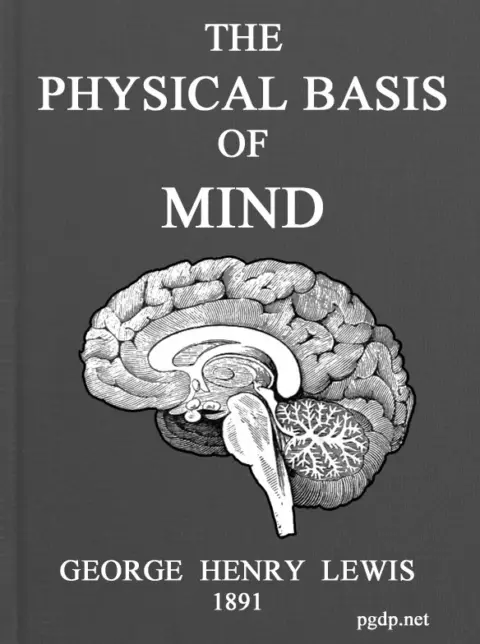
"The Physical Basis of Mind" by George Henry Lewes is a scientific publication written in the late 19th century. This work delves into the intricate relationship between life, the mind, and their biological foundations, aiming to clarify the principles that underlie the functioning of both mental and organic phenomena. It addresses the complex interplay between physical conditions and psychological functions, offering a framework that integrates biological understanding into psychological inquiry. At the start of the book, Lewes introduces the concept that the human mind, as conceived by scientists, is tightly interwoven with the organic life of the individual, emphasizing that every mental event has a basis in the vital functions of the organism. He argues for a twofold analysis of mind: one part rooted in individual biological conditions and the other shaped by social factors. The opening chapters lay the groundwork for a comprehensive exploration of vital processes, the nervous system, and the connections between the physical and mental realms, suggesting that knowledge of physiology is indispensable for psychologists seeking to understand the nature of consciousness and thought.
Introduction adapted from the source catalogue; source summaries may be automatically generated.
Free to read · English · 168,886 words · No account needed
MAKE TIME FOR A GOOD BOOK
On by default. Untick to stop anonymous reading totals. Each page counts after 10 seconds in view. How this works.
Anonymous counting is on unless you have switched it off.
[222] Printed in the Fortnightly Review, November, 1874, from which
all my citations are made.
[223] SCHIFF, Lehrbuch der Physiol., 1858, p. 212. HERMANN, Physiology, translated by GAMGEE, 1875, p. 511.
[224] Meanwhile the reader is referred to SCHRÖDER VAN DER KOLK, Pathologie der Geisteskrankheiten, 1863, p. 51; or JESSEN, Physiologie des menschlichen Denkens, 1872, p. 66.
[225] GRIESINGER, Les Maladies Mentales, p. 96.
[226] M. LUYS cites the case of a patient who conversed quite rationally with a visitor “sans en avoir conscience, et ne se souvenait de rien”; and he draws the extraordinary conclusion that the conversation “s’opérait en vertu des forces réflexes.”--Études de Physiologie et de Pathologie Cérébrales, 1874, p. 117. Is it not obvious that the patient must have been conscious at the time, though the consciousness vanished like that in a dream? The persistent consciousness is the continuous linking on of one state with previous states--the apperception of the past.
[227] ABERCROMBIE, Inquiries concerning the Intellectual Powers, 1840, p. 151. WIGAN, The Duality of the Mind, 1844, p. 270. DESPINE, La Psychologie Naturelle, 1868, I. 54.
[228] Dr. HUGHLINGS JACKSON has quite recently cited some curious examples in his own practice. See West Riding Lunatic Asylum Reports for 1875.
[229] PROBLEMS, Vol. II. p. 478, sq.
[230] “Le sentiment fait naître le mouvement, et le mouvement donne naissance au sentiment.”--VAN DEEN, Traités et Découvertes sur la Moëlle Épinière, 1841, p. 102.
[231] Dr. CARPENTER tells a similar story of Admiral CODRINGTON, who, when a midshipman, could always be awakened from the profoundest slumber if the word “signal” were uttered; whereas no other word disturbed him.
[232] Compare an interesting personal example given by JOUFFROY, quoted in Sir W. HAMILTON’S Lectures, I. 331.
[233] Lancet, 10th July, 1858.
[234] MARSHALL HALL in Philos. Trans., 1833. Lectures on the Nervous System and its Diseases, 1836. New Memoir on the Nervous System, 1843.
[235] MÜLLER, Physiology, I. 721.
[236] It is better simply to remove the brain, than to remove the whole head, which causes a serious loss of blood. An etherized animal may be operated on with ease and accuracy. For many experiments, mere division of the spinal cord is better than decapitation. Great variations in the results must be expected, because the condition of the animal, its age and sex--whether fasting or digesting--whether the season be spring or summer--and a hundred other causes, complicate the experiment.
[237] VOLKMANN, quoted by PFLÜGER.
[238] UNZER, The Principles of Physiology (translated for the
Sydenham Society), p. 235.
Your reading position is saved on this browser. Take it to another device with a library code. Reading pages adapt to text, rather than matching a printed edition.
BEHIND THE BOOK
This eBook is for the use of anyone anywhere in the United States and most other parts of the world at no cost and with almost no restrictions whatsoever. You may copy it, give it away or re-use it under the terms of the Project Gutenberg License included with this eBook or online at www.gutenberg.org. If you are not located in the United States, you will have to check the laws of the country where you are located before using this eBook. Read the source licence.
The original source file, including credits and licence, is retained by this library. Request an original-format copy at no charge. Please include the book title and Project Gutenberg identifier #60212.
KEEP YOUR CURIOSITY GOING
David Patterson (Spirit) Hatch
Coulson Kernahan

Ralph Waldo Emerson
Frances Wright

Edwin Abbott Abbott

Joseph Droz