
Last letters from the living dead man
David Patterson (Spirit) Hatch
THE CLASSIC COLLECTION · 1877
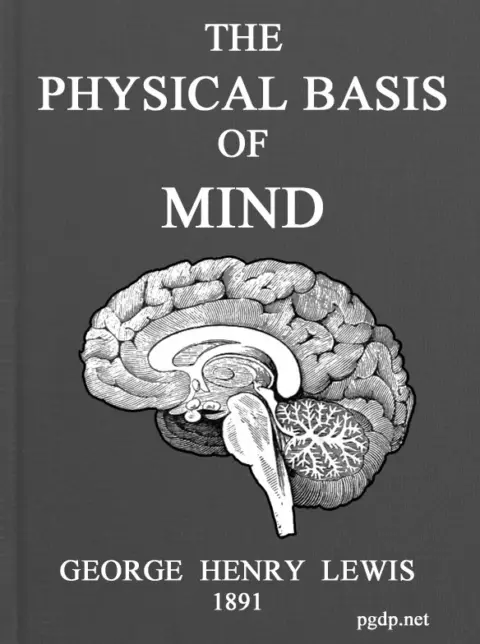
"The Physical Basis of Mind" by George Henry Lewes is a scientific publication written in the late 19th century. This work delves into the intricate relationship between life, the mind, and their biological foundations, aiming to clarify the principles that underlie the functioning of both mental and organic phenomena. It addresses the complex interplay between physical conditions and psychological functions, offering a framework that integrates biological understanding into psychological inquiry. At the start of the book, Lewes introduces the concept that the human mind, as conceived by scientists, is tightly interwoven with the organic life of the individual, emphasizing that every mental event has a basis in the vital functions of the organism. He argues for a twofold analysis of mind: one part rooted in individual biological conditions and the other shaped by social factors. The opening chapters lay the groundwork for a comprehensive exploration of vital processes, the nervous system, and the connections between the physical and mental realms, suggesting that knowledge of physiology is indispensable for psychologists seeking to understand the nature of consciousness and thought.
Introduction adapted from the source catalogue; source summaries may be automatically generated.
Free to read · English · 168,886 words · No account needed
MAKE TIME FOR A GOOD BOOK
On by default. Untick to stop anonymous reading totals. Each page counts after 10 seconds in view. How this works.
Anonymous counting is on unless you have switched it off.
[148] Archiv für mikros. Anat., 1869, p. 217. Compere also BUTZKE, Archiv für Psychiatrie, 1872, p. 584.
[149] HENLE, Nervenlehre, 1871, p. 58, Fig. 21.
[150] When men of such experience and skill as KÖLLIKER, BIDDER, GOLL, and LOCKHART CLARKE declare that they have never seen a cell-process pass directly into a dark-bordered fibre in the anterior root, what are we to say to such figures and descriptions as those given in the works of SCHRÖDER VAN DER KOLK, GRATIOLET, and LUYS? Even did such arrangements exist, no transverse nor longitudinal section could display them, owing to the different planes at which the fibres enter, and the length and irregularity of their course.
[151] Long after the text was written, WILLIGK published in Virchow’s Archiv, 1875, LXIV. p. 163, observations of anastomoses which even KÖLLIKER admitted to be undeniable. Yet out of sixty-four preparations, amid hundreds of cells, he could only reckon seven cases of conjunction.
[152] See the history given in STILLING’S learned work, Ueber den Bau der Nervenprimitiv-Faser, p. 34; and compare MAX SHULTZE, De Retinæ Structura, p. 8, and Bau der Nasenschleimhaut, p. 66; WALDEYER, in the Zeitschrift für rat. Med., 1863; LISTER and TURNER, Observations on the Structure of Nerve-Fibres, in Quarterly Micros. Journal, 1859; RANVIER, in the Archives de Physiologie, 1872.
[153] Virchow’s Archiv, Bd. LXXII. p. 193.
[154] Monthly Journal of Micros. Science, 1874, XI. p. 214.
[155] BABUCHIN, Centralblatt, 1868, p. 756.
[156] Even so eminent an authority as W. KRAUSE holds this both with regard to the varicose aspect and the double contour: Handbuch der menschlichen Anatomie, 1876, I. 367. BUTSCHLI, however, describes the nerves in a living Nematode as varicose: Archiv für Anat., 1873, p. 78; and I have somewhere met with an observation of the double contour being visible in the living animal.
[157] BUTZKE, Archiv für Psychiatrie, 1872, p. 594, states that the granular substance has the chemical composition of myeline. If this be so, we may suppose the “fibrils of crystallization” to represent the coagulation of the substance which is in solution amid the myeline granules, and corresponds with the axis cylinder of a fibre. I may remark that in almost every good preparation nerve-cells will be found in which, while one process is distinctly granular, another is striated or even fibrillated.
[158] BOLL, Die Histiologie und Histiogenese der nervösen Centralorgane, in the Archiv für Psychiatrie, 1873, p. 47.
[159] STIEDA, Studien über das Centralnervensystem der Vögel, 1868, p. 65. MAUTHNER, Op. cit., p. 4.
[160] TURNER and LISTER, Op. cit., p. 8.
[161] BLESSIG, De Retinæ Structura, 1857.
Your reading position is saved on this browser. Take it to another device with a library code. Reading pages adapt to text, rather than matching a printed edition.
BEHIND THE BOOK
This eBook is for the use of anyone anywhere in the United States and most other parts of the world at no cost and with almost no restrictions whatsoever. You may copy it, give it away or re-use it under the terms of the Project Gutenberg License included with this eBook or online at www.gutenberg.org. If you are not located in the United States, you will have to check the laws of the country where you are located before using this eBook. Read the source licence.
The original source file, including credits and licence, is retained by this library. Request an original-format copy at no charge. Please include the book title and Project Gutenberg identifier #60212.
KEEP YOUR CURIOSITY GOING
David Patterson (Spirit) Hatch
Coulson Kernahan

Ralph Waldo Emerson
Frances Wright

Edwin Abbott Abbott

Joseph Droz