
Last letters from the living dead man
David Patterson (Spirit) Hatch
THE CLASSIC COLLECTION · 1877
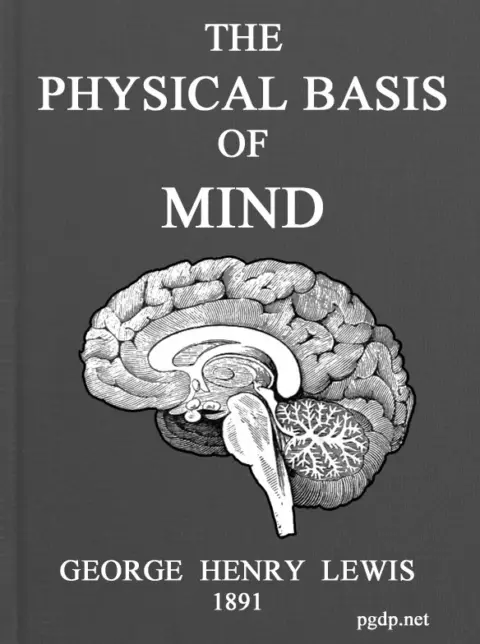
"The Physical Basis of Mind" by George Henry Lewes is a scientific publication written in the late 19th century. This work delves into the intricate relationship between life, the mind, and their biological foundations, aiming to clarify the principles that underlie the functioning of both mental and organic phenomena. It addresses the complex interplay between physical conditions and psychological functions, offering a framework that integrates biological understanding into psychological inquiry. At the start of the book, Lewes introduces the concept that the human mind, as conceived by scientists, is tightly interwoven with the organic life of the individual, emphasizing that every mental event has a basis in the vital functions of the organism. He argues for a twofold analysis of mind: one part rooted in individual biological conditions and the other shaped by social factors. The opening chapters lay the groundwork for a comprehensive exploration of vital processes, the nervous system, and the connections between the physical and mental realms, suggesting that knowledge of physiology is indispensable for psychologists seeking to understand the nature of consciousness and thought.
Introduction adapted from the source catalogue; source summaries may be automatically generated.
Free to read · English · 168,886 words · No account needed
MAKE TIME FOR A GOOD BOOK
On by default. Untick to stop anonymous reading totals. Each page counts after 10 seconds in view. How this works.
Anonymous counting is on unless you have switched it off.
[7] I am often reminded of the surprising movements of particles of carbonate of lime in water which my friend Professor PREYER showed me during a visit to Bonn. He had removed one of the concretions, usually found in connection with nerves along the spine of old frogs, and crushed it in water; under the microscope the seeming spontaneity and variety of the movements of the particles was such that had we not known their origin we should certainly have attributed them to vitality: no infusoria could have moved with more seeming spontaneity. It is hardly physiological to conclude that because fragments of tissue manifest ambœbiform movements therefore they are alive (STRICKER, art. Die Zelle in his Handbuch der Lehre von den Geweben, 1868, p. 7), or that the heart removed from the body is alive because it still beats. LIEBERKÜHN, Ueber Bewegungserschsinungen der Zellen, 1870, pp. 357–359, cites examples of such movements in undeniably dead substances. For Life, we demand not only Movement, but Functional Activity.
[8] TELESIUS, De Natura Rerum, 1586, V. 184. TELESIO might have been saved from the mistake had he attended to what NIPHUS had said on the point in his Expositio subtilissima, 1559, p. 245. Comp. also PHILELPHUS, Epist. Familiarum, 1502, p. 253, verso.
[9] The authorities just cited are ARISTOTLE, De Anima, Lib. II. c. I. KANT, Kritik der Urtheilskraft. MÜLLER, Physiology. BEALE, Bioplasm, and Introduction to Todd and Bowman’s Anatomy. SCHELLING, Erster Entwurf, and Transcendent. Idealismus. BICHAT, Recherches sur la Vie et la Mort. STAHL, Theoria Vera Medica. DUGÈS, Physiologie Comparée. BÉCLARD, Anatomie Générale. LAMARCK, Philosophie Zoologique. COMTE, Cours de Philosophie Positive. OWEN’S Hunterian Lectures, 1854. HERBERT SPENCER, Principles of Biology.
[10] FLETCHER, as quoted by DRYSDALE, Life and the Equivalence of
Force, Part II. p. 120.
[11] ROBIN et VERDEIL, Traité de Chimie Anatomique, 1853.
[12] PAGET, Lectures on Surgical Pathology, p. 14.
[13] Comp. HAECKEL, in Siebold und Kölliker’s Zeitschrift, 1865, p. 342, and his Generelle Morphologie, 1866, I, 135, 336.
[14] In the Archiv für mikros. Anatomie, 1865, p. 211.
[15] Here organization is the simplest form of all--molecular organized structure, which in the higher forms becomes tissue structure, and organ structure. The word structure properly means orderly arrangement of different materials; and molecular structure refers to the different proximate principles which constitute the organized substance. Usually, however, the word structureless indicates the absence of visible arrangement of the parts; a cell has structure since it has nucleus and protoplasm.
Your reading position is saved on this browser. Take it to another device with a library code. Reading pages adapt to text, rather than matching a printed edition.
BEHIND THE BOOK
This eBook is for the use of anyone anywhere in the United States and most other parts of the world at no cost and with almost no restrictions whatsoever. You may copy it, give it away or re-use it under the terms of the Project Gutenberg License included with this eBook or online at www.gutenberg.org. If you are not located in the United States, you will have to check the laws of the country where you are located before using this eBook. Read the source licence.
The original source file, including credits and licence, is retained by this library. Request an original-format copy at no charge. Please include the book title and Project Gutenberg identifier #60212.
KEEP YOUR CURIOSITY GOING
David Patterson (Spirit) Hatch
Coulson Kernahan

Ralph Waldo Emerson
Frances Wright

Edwin Abbott Abbott

Joseph Droz