The Islets of the Channel
Walter Cooper Dendy
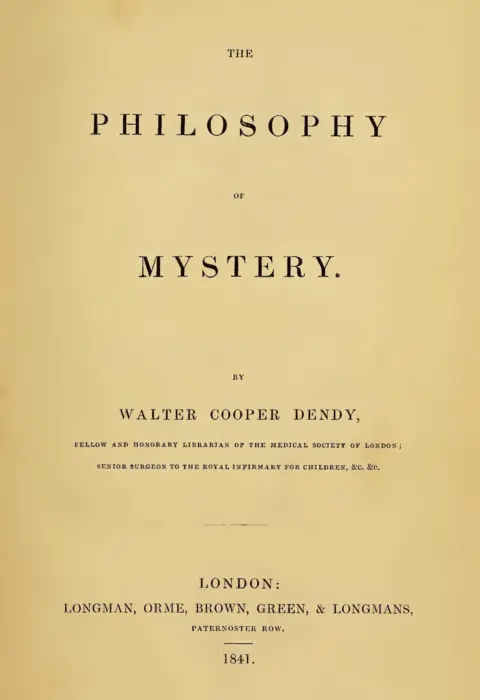
THE CLASSIC COLLECTION · 1841
"The Philosophy of Mystery" by Walter Cooper Dendy is a philosophical treatise examining the nature and implications of the supernatural, particularly focusing on ghosts, spirits, and their representations throughout history. Written in the early 19th century, it combines elements of philosophy, psychology, and anecdotal narrative to explore belief in the supernatural and the motivations behind such beliefs. The text likely appeals to readers interested in metaphysical discussions and the intersection of literature and philosophy. The beginning of the book introduces a scene set on the Wye River, featuring two young women and a thoughtful bachelor named Astrophel, who delves into ghostly phenomena and the pursuit of wisdom regarding the supernatural. As they discuss the existence of spirits, the dialogue reflects the contrasting beliefs about ghosts and the philosophical inquiries surrounding the nature of reality and illusion. The characters express a mixture of skepticism and curiosity, setting the stage for a philosophical exploration of mystery, belief, and the narratives that surround such spectral topics.
Introduction adapted from the source catalogue; source summaries may be automatically generated.
Free to read · English · 131,777 words · No account needed
MAKE TIME FOR A GOOD BOOK
On by default. Untick to stop anonymous reading totals. Each page counts after 10 seconds in view. How this works.
Anonymous counting is on unless you have switched it off.
Simonides, four hundred years after the siege of Troy, ungallantly reversed this doctrine, deciding that “the souls of women were formed of the principles and elements of brutes.” The Pythagorean system was, if not more courteous, at least more just.
“Thus all things are but altered, nothing dies; And here and there th’ embodied spirit flies. By time, or force, or sickness, dispossess’d, And lodges, where it lights, in bird or beast; Or hunts without, till ready limbs it find, And actuates those according to their kind. From tenement to tenement is toss’d, The soul is still the same, the figure only lost.”
This is from Dryden’s translation of Chaucer.
And Burton’s record is as follows:
“The Pythagoreans defend Metempsychosis and Palingenesia, that souls go from one body to another, epotâ prius Lethes nudâ, as men into wolves, beares, dogs, hogs, as they were inclined in their lives, or participated in conditions:
‘——inque ferinas
Possumus ire domus pecudumque in corpora condi.’
“Lucian’s cock was first Euphorbus, a captaine:
‘Ille ego (nam memini) Trojani tempore belli
Panthoides Euphorbus eram.’”
And Plato, in Timæus, and in Phædo—
EV. Enough of Plato, dear Astrophel; or believe, with me, that his philosophy on this point was merely figurative of the similarity of mind, or genius, or feature, between the dead and the living;—as it was said of old, that the soul of Raphael had transmigrated to the body of Francesco Mazzola (Parmegiano), because his style and personal beauty so closely resembled those of the all but divine master of his art.
And pray what was the gist of that special astronomer, who affirmed that he “saw something written in the moon?”—A wild romance only? No, forsooth. Pythagoras may classically vociferate—
“——errat, et illinc,
Huc venit, hinc illuc, et quoslibet occupat artus
Spiritus: eque feris humana in corpora transit,
Inque feras noster.”
But read further, and you will find the high moral to be a severe injunction against flesh-eating:
“Then let not piety be put to flight, To please the taste of glutton appetite; But suffer innate souls secure to dwell, Lest from their seats your parents you expel: With rabid hunger feed upon your kind, Or from a beast dislodge a brother’s mind.”
Think you this injunction will be obeyed, in the face of the “Almanac
des Gourmands?”
Your reading position is saved on this browser. Take it to another device with a library code. Reading pages adapt to text, rather than matching a printed edition.
Walter Cooper Dendy
BEHIND THE BOOK
This eBook is for the use of anyone anywhere in the United States and most other parts of the world at no cost and with almost no restrictions whatsoever. You may copy it, give it away or re-use it under the terms of the Project Gutenberg License included with this eBook or online at www.gutenberg.org. If you are not located in the United States, you will have to check the laws of the country where you are located before using this eBook. Read the source licence.
The original source file, including credits and licence, is retained by this library. Request an original-format copy at no charge. Please include the book title and Project Gutenberg identifier #56822.
KEEP YOUR CURIOSITY GOING

David Patterson (Spirit) Hatch
Coulson Kernahan

Ralph Waldo Emerson
Frances Wright

Edwin Abbott Abbott

Joseph Droz