
The Islets of the Channel
Walter Cooper Dendy
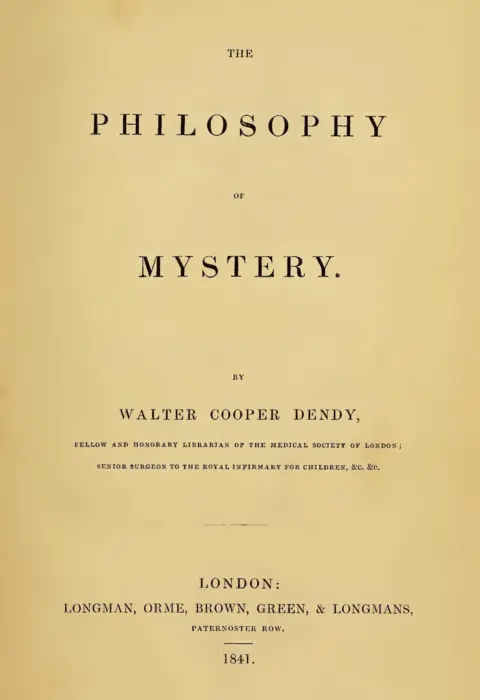
THE CLASSIC COLLECTION · 1841
"The Philosophy of Mystery" by Walter Cooper Dendy is a philosophical treatise examining the nature and implications of the supernatural, particularly focusing on ghosts, spirits, and their representations throughout history. Written in the early 19th century, it combines elements of philosophy, psychology, and anecdotal narrative to explore belief in the supernatural and the motivations behind such beliefs. The text likely appeals to readers interested in metaphysical discussions and the intersection of literature and philosophy. The beginning of the book introduces a scene set on the Wye River, featuring two young women and a thoughtful bachelor named Astrophel, who delves into ghostly phenomena and the pursuit of wisdom regarding the supernatural. As they discuss the existence of spirits, the dialogue reflects the contrasting beliefs about ghosts and the philosophical inquiries surrounding the nature of reality and illusion. The characters express a mixture of skepticism and curiosity, setting the stage for a philosophical exploration of mystery, belief, and the narratives that surround such spectral topics.
Introduction adapted from the source catalogue; source summaries may be automatically generated.
Free to read · English · 131,777 words · No account needed
MAKE TIME FOR A GOOD BOOK
On by default. Untick to stop anonymous reading totals. Each page counts after 10 seconds in view. How this works.
Anonymous counting is on unless you have switched it off.
I believe, he should rather have referred his feelings to his recovery, if the words of the pale girl were true; for, when consciousness and sensation are returning, the feeling is intense. Throughout the body, as it is recovering from apathetic numbness, the sense of returning circulation of the blood is terrible: an acute sensation of pins and needles in the brain and the marrow of the spine. No wonder, then, that these resuscitated beings will request that no efforts may be made, should they again be in the state of suspended animation. The sensation on being born is probably as acute as that on dissolution.
IDA. Then there is consciousness?
EV. The evidence of Dr. Adam Clarke will illustrate this interesting question. Yet I differ somewhat with him, regarding so perfect a consciousness during submersion. In his life, you will see the following dialogue with Dr. Lettsom, in which Clarke describes his own case of immersion:
“Dr. Lettsom said,—‘Of all that I have seen restored, or questioned afterwards, I never found one who had the smallest recollection of any thing that passed, from the moment they went under water, till the time in which they were restored to life and thought.’ Dr. Clarke answered Dr. L.,—‘I knew a case to the contrary.’ ‘Did you, indeed?’ ‘Yes, Dr. L., and the case was my own. I was once drowned.’ And then related the circumstances, and added,—‘I saw my danger, but thought the mare would swim, and I knew I could ride when we were overwhelmed. It appeared to me, that I had gone to the bottom with my eyes open. At first, I thought I saw the bottom clearly, and then felt neither apprehension nor pain; on the contrary, I felt as if I had been in the most delightful situation; my mind was tranquil and uncommonly happy. I felt as if in Paradise, and yet I do not recollect that I saw any person; the impressions of happiness seemed not to be derived from any thing around me, but from the state of my mind. And yet I had a general apprehension of pleasing objects; and I cannot recollect that any thing appeared defined, nor did my eye take in any object, only I had a general impression of a green colour, as of fields or gardens. But my happiness did not arise from these, but appeared to consist merely in the tranquil, indescribably tranquil, state of my mind. By and by, I seemed to awake as out of a slumber, and felt unutterable pain and difficulty of breathing; and now I found I had been carried by a strong wave, and left in very shallow water upon the shore, and the pain I felt was occasioned by the air once more inflating my lungs and producing respiration. How long I had been under water I cannot tell; it may however be guessed at by this circumstance: when restored to the power of reflection, I looked for the mare, and saw her walking leisurely down shore towards home, then about half a mile distant from the place where we were submerged. Now, I aver,—1st. That in being drowned I felt no pain;—2nd. That I did not, for a simple moment, lose my consciousness;—3rd. I felt indescribably happy, and, though dead as to the total suspension of all the functions of life, yet I felt no pain in dying; and I take for granted, from this circumstance, those who die by drowning feel no pain, and that probably it is the easiest of all deaths;—4th. That I felt no pain till once more exposed to the action of the atmospheric air, and then I felt great pain and anguish in returning to life, which anguish, had I continued under water, I should have never felt;—5th. That animation must have been totally suspended from the time I must have been under water, which time might be in some measure ascertained by the distance the mare was from the place of my submersion, which was at least half a mile, and she was not, when I first observed her, making any speed;—6th. Whether there were any thing preternatural in my escape, I cannot tell; or whether a ground swell had not, in a merely natural way, borne me to the shore, and the retrocession of the tide (for it was then ebbing), left me exposed to the open air, I cannot tell. My preservation must have been the effect of natural causes; and yet it appears to be more rational to attribute it to a superior agency. Here then, Dr. L., is a case widely different, it appears, from those you have witnessed, and which argues very little for the modish doctrine of the materiality of the soul.’ Dr. Lettsom appeared puzzled with this relation, but did not attempt to make any remarks on it.”
Your reading position is saved on this browser. Take it to another device with a library code. Reading pages adapt to text, rather than matching a printed edition.
Walter Cooper Dendy
BEHIND THE BOOK
This eBook is for the use of anyone anywhere in the United States and most other parts of the world at no cost and with almost no restrictions whatsoever. You may copy it, give it away or re-use it under the terms of the Project Gutenberg License included with this eBook or online at www.gutenberg.org. If you are not located in the United States, you will have to check the laws of the country where you are located before using this eBook. Read the source licence.
The original source file, including credits and licence, is retained by this library. Request an original-format copy at no charge. Please include the book title and Project Gutenberg identifier #56822.
KEEP YOUR CURIOSITY GOING

David Patterson (Spirit) Hatch
Coulson Kernahan

Ralph Waldo Emerson
Frances Wright

Edwin Abbott Abbott

Joseph Droz