The Islets of the Channel
Walter Cooper Dendy
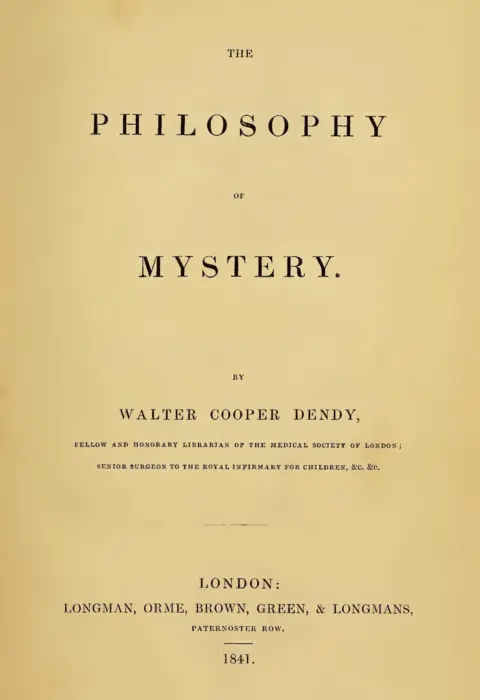
THE CLASSIC COLLECTION · 1841
"The Philosophy of Mystery" by Walter Cooper Dendy is a philosophical treatise examining the nature and implications of the supernatural, particularly focusing on ghosts, spirits, and their representations throughout history. Written in the early 19th century, it combines elements of philosophy, psychology, and anecdotal narrative to explore belief in the supernatural and the motivations behind such beliefs. The text likely appeals to readers interested in metaphysical discussions and the intersection of literature and philosophy. The beginning of the book introduces a scene set on the Wye River, featuring two young women and a thoughtful bachelor named Astrophel, who delves into ghostly phenomena and the pursuit of wisdom regarding the supernatural. As they discuss the existence of spirits, the dialogue reflects the contrasting beliefs about ghosts and the philosophical inquiries surrounding the nature of reality and illusion. The characters express a mixture of skepticism and curiosity, setting the stage for a philosophical exploration of mystery, belief, and the narratives that surround such spectral topics.
Introduction adapted from the source catalogue; source summaries may be automatically generated.
Free to read · English · 131,777 words · No account needed
MAKE TIME FOR A GOOD BOOK
On by default. Untick to stop anonymous reading totals. Each page counts after 10 seconds in view. How this works.
Anonymous counting is on unless you have switched it off.
The case of Colonel Townsend I adduce, as one of undoubted authority. This officer was able to suspend the action both of his heart and lungs, after which he became motionless, icy cold, and rigid,—a glassy film overspreading his eyes. As there was no breathing, there was no vapour apparent on the glass, when held to his mouth. During the many hours in which this voluntary trance existed, there was a total absence of consciousness, yet a faculty of self-reanimation!
Avicenna speaks of one that could “cast himself into a palsie when he list;” and Celsus, of a priest that could “separate himself from his senses when he list, and lie like a dead man, void of life and sense.” Cardan, the Pavian astrologer, brags of himself that he could do as much, and that “when he list.”
Dr. Cleghorn, of Glasgow, relates the case of a man who could stop the pulse at his wrist, and reduce himself to the condition of syncope, by his will, of course.
Barton, the holy maid of Kent, was enabled thus to “absorb her
faculties.”
Restitutus, a presbyter, could also throw himself into a trance,—being insensible, except to the very loudest sounds. So says Augustin.
ASTR. So that there may not be much imposture in the case, recorded in the “Spectator,” of Nicholas Hart, a professor of somnolency, who lived by sleeping. The following is his advertisement in the “Daily Courant,” of that time:—
“Nicholas Hart, who slept last year in Saint Bartholomew’s Hospital, intends to sleep this year at the ‘Cock and Bottle,’ in Little Britain.”
I will freely confess to you, Evelyn, my scepticism as to these ultra romantic legends; but may my own memory fail me not, while I relate a few strange stories, and demand of yourself confirmation.
Euphemia Lindsay, of Forfarshire, slept eight weeks, having taken nothing but (possibly) a little cold water. In the eighth week she died.
Angelica Vlies, of Delft, had fasted in a state of insensibility from 1822 to 1828. She took nothing but water, tea, and whey, and these in the most minute quantities.
In a record, A.D. 1545, I read that “William Foxley, a pot-maker to the Mint in London, slept in the Tower of London (not being by any means to be waked) fourteen days and fifteen nights; and, when he waked, it seemed to him that the interval was but as one night.”
Samuel Clinton, of Timbury, near Bath, often slept for a month; and once, from April to August. He would, during this period, suddenly wake, but ere food could be administered to him, he lapsed again into a trance.
Your reading position is saved on this browser. Take it to another device with a library code. Reading pages adapt to text, rather than matching a printed edition.
Walter Cooper Dendy
BEHIND THE BOOK
This eBook is for the use of anyone anywhere in the United States and most other parts of the world at no cost and with almost no restrictions whatsoever. You may copy it, give it away or re-use it under the terms of the Project Gutenberg License included with this eBook or online at www.gutenberg.org. If you are not located in the United States, you will have to check the laws of the country where you are located before using this eBook. Read the source licence.
The original source file, including credits and licence, is retained by this library. Request an original-format copy at no charge. Please include the book title and Project Gutenberg identifier #56822.
KEEP YOUR CURIOSITY GOING

David Patterson (Spirit) Hatch
Coulson Kernahan

Ralph Waldo Emerson
Frances Wright

Edwin Abbott Abbott

Joseph Droz