The Islets of the Channel
Walter Cooper Dendy
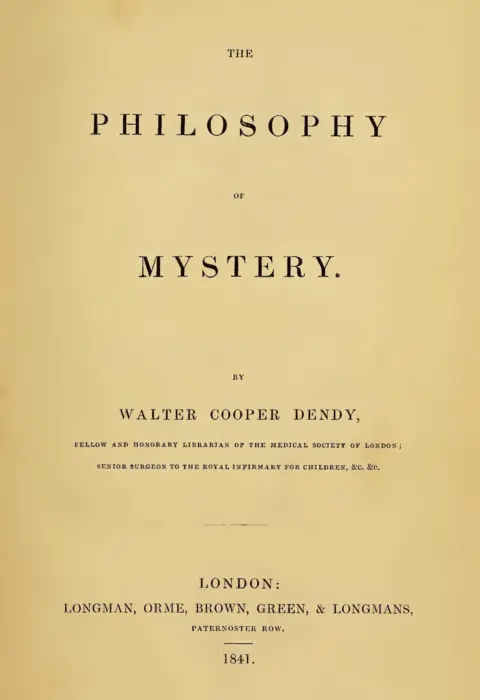
THE CLASSIC COLLECTION · 1841
"The Philosophy of Mystery" by Walter Cooper Dendy is a philosophical treatise examining the nature and implications of the supernatural, particularly focusing on ghosts, spirits, and their representations throughout history. Written in the early 19th century, it combines elements of philosophy, psychology, and anecdotal narrative to explore belief in the supernatural and the motivations behind such beliefs. The text likely appeals to readers interested in metaphysical discussions and the intersection of literature and philosophy. The beginning of the book introduces a scene set on the Wye River, featuring two young women and a thoughtful bachelor named Astrophel, who delves into ghostly phenomena and the pursuit of wisdom regarding the supernatural. As they discuss the existence of spirits, the dialogue reflects the contrasting beliefs about ghosts and the philosophical inquiries surrounding the nature of reality and illusion. The characters express a mixture of skepticism and curiosity, setting the stage for a philosophical exploration of mystery, belief, and the narratives that surround such spectral topics.
Introduction adapted from the source catalogue; source summaries may be automatically generated.
Free to read · English · 131,777 words · No account needed
MAKE TIME FOR A GOOD BOOK
On by default. Untick to stop anonymous reading totals. Each page counts after 10 seconds in view. How this works.
Anonymous counting is on unless you have switched it off.
I may add, that, in the heat of engagement, soldiers and sailors are often unconscious of being even seriously wounded. In the battle of Lake Thrasymene, the armies of Rome and Carthage were so absorbed in the tumult and din of war, that an earthquake, which spread desolation around them, was unheeded by these determined soldiers.
IDA. I have gleaned enough from your illustrations, Evelyn, to believe that we may explain by them that solemn and last reverie of the dying, when all other ideas have ceased to influence, but the most impressive—
“The ruling passion strong in death;”
when earthly life is on the wane, and the spirit, in this expiring thought, takes its last farewell of the flesh. I remember some beautiful evidences of this influence.
It was observed that Porson, after a paralytic fit, scarcely uttered a word of English; but to the last moment spoke Greek fluently.
Dr. Adam (a master of Sir Walter Scott), on the subsidence of delirium, exclaimed, “It grows dark—the boys may dismiss;” and instantly expired.
The last words of Dr. Abercrombie were addressed to an imaginary patient, regarding the care of his digestive functions.
Some time after the trial of the Bristol magistrates, Lord Tenterden lapsed into a stupor from exhaustion. A short period before death he rallied, and, after conversing with his friends for a few minutes, he raised himself on his couch, and said, “Gentlemen of the jury, you may retire;” and then fell back and expired.
——“In this borrow’d likeness of shrunk death, Thou shalt remain full two and forty hours, And then awake, as from a pleasant sleep.” ROMEO AND JULIET.
CAST. Evelyn, you have again bewildered my thoughts. Sleep, that should be the anodyne of the mind, has awakened afresh my curiosity. I am in a mood for mystery. Any more wonders?
EV. The prototypes of sleep, dear Castaly, are all “mysteries,” as you call them, and marked by ever-varying shades.
The most impressive conditions of the mind are these:
Unconscious and passive, as in sound sleep.
Conscious yet passive, as in dreaming.
Conscious and willing, yet powerless, as in night-mare.
Unconscious yet active, as in somnambulism.
If we go deeper in our analysis, we shall discover a state more wondrous still than all we have unravelled, in which mind is unconscious, sensationless, unwishing, motionless, powerless, as in trance or catalepsy; an absolute apathy of body and complete oblivion of mind. And yet life is there!
Your reading position is saved on this browser. Take it to another device with a library code. Reading pages adapt to text, rather than matching a printed edition.
Walter Cooper Dendy
BEHIND THE BOOK
This eBook is for the use of anyone anywhere in the United States and most other parts of the world at no cost and with almost no restrictions whatsoever. You may copy it, give it away or re-use it under the terms of the Project Gutenberg License included with this eBook or online at www.gutenberg.org. If you are not located in the United States, you will have to check the laws of the country where you are located before using this eBook. Read the source licence.
The original source file, including credits and licence, is retained by this library. Request an original-format copy at no charge. Please include the book title and Project Gutenberg identifier #56822.
KEEP YOUR CURIOSITY GOING

David Patterson (Spirit) Hatch
Coulson Kernahan

Ralph Waldo Emerson
Frances Wright

Edwin Abbott Abbott

Joseph Droz