The Islets of the Channel
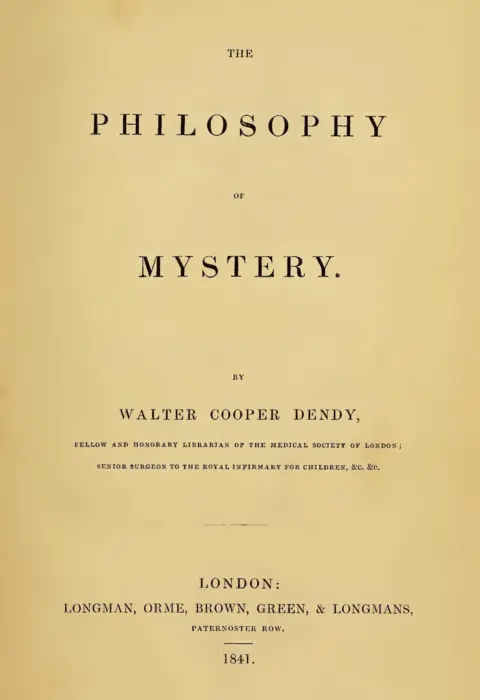
Walter Cooper Dendy
THE CLASSIC COLLECTION · 1841
"The Philosophy of Mystery" by Walter Cooper Dendy is a philosophical treatise examining the nature and implications of the supernatural, particularly focusing on ghosts, spirits, and their representations throughout history. Written in the early 19th century, it combines elements of philosophy, psychology, and anecdotal narrative to explore belief in the supernatural and the motivations behind such beliefs. The text likely appeals to readers interested in metaphysical discussions and the intersection of literature and philosophy. The beginning of the book introduces a scene set on the Wye River, featuring two young women and a thoughtful bachelor named Astrophel, who delves into ghostly phenomena and the pursuit of wisdom regarding the supernatural. As they discuss the existence of spirits, the dialogue reflects the contrasting beliefs about ghosts and the philosophical inquiries surrounding the nature of reality and illusion. The characters express a mixture of skepticism and curiosity, setting the stage for a philosophical exploration of mystery, belief, and the narratives that surround such spectral topics.
Introduction adapted from the source catalogue; source summaries may be automatically generated.
Free to read · English · 131,777 words · No account needed
MAKE TIME FOR A GOOD BOOK
On by default. Untick to stop anonymous reading totals. Each page counts after 10 seconds in view. How this works.
Anonymous counting is on unless you have switched it off.
ASTR. So that in these cases it is one faculty only which is interrupted, and not the combined intellect. But all the faculties but one may be deranged, may they not?
EV. Yes. When the patient is insane on all points but one, we term it,
“Folie raisonnante.”
The very idiot, indeed, is often fond of most exact arrangement. The savage of Aveyron instantly put things in order when they were deranged.
White, in his “History of Selborne,” records the propensities of an idiot, who, he says, was a very Merops-apiaster, or Bee-bird. Honey-bees, humblebees, and wasps, were his prey: he would seize them, disarm them of their weapons, and suck their bodies for the sake of their honey-bags. Except in this adroitness, he had no understanding.
Pinel states the case of a mechanical genius, who became insane, believing his head to be changed. Yet he invented mechanism of the most intricate combinations. We are informed, too, of a clergyman, who was ever insane, but when delivering his discourses from the pulpit.
I believe some parts of a national establishment were constructed from the plans of one of its inmates, who was to all other intents and purposes a madman.
Dr. Uwins once told me, that some of the lines in his biographical work were written by a maniac in the Hoxton Asylum, who was ever aware of the approach of his mania. These lines were thought to be among the best in the work.
Nay, idiots will sometimes reason, and work out a syllogism. I think Dr. Conolly relates a story of two, who quarrelled, because each asserted that he was the Holy Ghost; at length, one decided that the other was the Holy Ghost, and that he could not be, because there were not two.
From this “folie raisonnante” there is an easy transition to that eccentricity which seems to be a set-off against the strength of mind of the deep thinker. The permanent derangement, however, we term insanity; the transient, eccentricity.
Marullus informs us that Bernard rode all day long by the Lemnian Lake, and at last inquired where he was. Archimedes rushed into the street naked from the bath, in an ecstacy at having discovered the alloy in the crown of Syracuse. Pinel tells us of a priest, who, in an abstract mood, felt no pain, although part of his body was burning.
“Viote,” says Zimmerman, “during his fits of mathematical abstraction, would often remain sleepless and foodless for three days and nights.”
Your reading position is saved on this browser. Take it to another device with a library code. Reading pages adapt to text, rather than matching a printed edition.
Walter Cooper Dendy
BEHIND THE BOOK
This eBook is for the use of anyone anywhere in the United States and most other parts of the world at no cost and with almost no restrictions whatsoever. You may copy it, give it away or re-use it under the terms of the Project Gutenberg License included with this eBook or online at www.gutenberg.org. If you are not located in the United States, you will have to check the laws of the country where you are located before using this eBook. Read the source licence.
The original source file, including credits and licence, is retained by this library. Request an original-format copy at no charge. Please include the book title and Project Gutenberg identifier #56822.
KEEP YOUR CURIOSITY GOING

David Patterson (Spirit) Hatch
Coulson Kernahan

Ralph Waldo Emerson
Frances Wright

Edwin Abbott Abbott

Joseph Droz