The Islets of the Channel
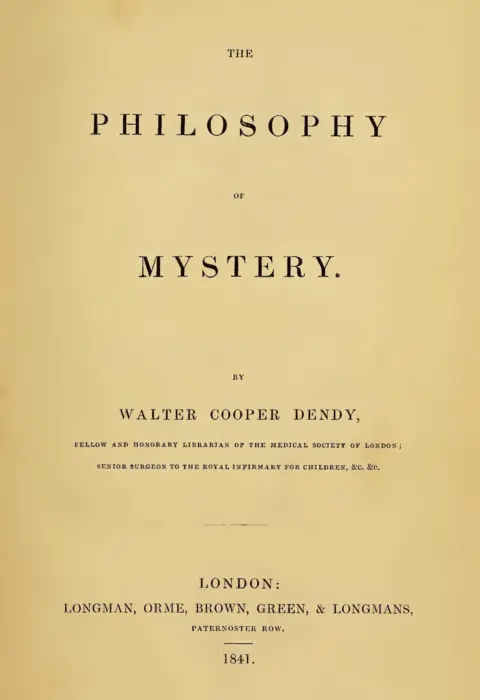
Walter Cooper Dendy
THE CLASSIC COLLECTION · 1841
"The Philosophy of Mystery" by Walter Cooper Dendy is a philosophical treatise examining the nature and implications of the supernatural, particularly focusing on ghosts, spirits, and their representations throughout history. Written in the early 19th century, it combines elements of philosophy, psychology, and anecdotal narrative to explore belief in the supernatural and the motivations behind such beliefs. The text likely appeals to readers interested in metaphysical discussions and the intersection of literature and philosophy. The beginning of the book introduces a scene set on the Wye River, featuring two young women and a thoughtful bachelor named Astrophel, who delves into ghostly phenomena and the pursuit of wisdom regarding the supernatural. As they discuss the existence of spirits, the dialogue reflects the contrasting beliefs about ghosts and the philosophical inquiries surrounding the nature of reality and illusion. The characters express a mixture of skepticism and curiosity, setting the stage for a philosophical exploration of mystery, belief, and the narratives that surround such spectral topics.
Introduction adapted from the source catalogue; source summaries may be automatically generated.
Free to read · English · 131,777 words · No account needed
MAKE TIME FOR A GOOD BOOK
On by default. Untick to stop anonymous reading totals. Each page counts after 10 seconds in view. How this works.
Anonymous counting is on unless you have switched it off.
Indeed these experiments seem so replete with the ludicrous, that I wonder Cruikshank and Hood have not often caught a fact, as a theme for their brilliant fancy.
“That fools should be so deep-contemplative.”
“In his brain
He hath strange places cramm’d
With observation, the which he vents
In mangled forms.”
AS YOU LIKE IT.
ASTR. I was dreaming last night, Evelyn, of your eccentric puppets; and I cannot but wonder at the contrasted influences of nitrous oxide on the brain and marrow, as you say. In one, we see the wondrous phenomena of somnambulism; in the other, a state of apathy, like the almost senseless reverie of the idiot.
EV. You are shrewd, Astrophel, and have hit on these objective analogies with the acuteness of a pathologist. Contrasts they truly are; and yet there is a natural transition from one to the other.
Somnambulism is the most eccentric condition of sleep; and Reverie is that state which constitutes the nearest approximation to slumber. But the French verb, rêver, is a comprehensive word, signifying all the eccentricities of mind, from idiocy to divine philosophy; so that its derivative, “Reverie,” may be construed into Dream, Delirium, Raving, Thought, Fancy, Meditation, Abstraction.
You may wonder at this combination, but, however you may smile, the existence of every one is marked by a certain degree of moral or instinctive mania, modified by the peculiarity of habit, taste, or sentiment; and, I may add, of intellectual monomania (“monomanie raisonnante”), in reference to some particular subject. There may indeed be an incubation of madness; and, if circumstances occur to sit and hatch, the germs will be developed. When these two, moral and intellectual error (which may separately pass current in the world for eccentricity), unite, then the man is mad, and becomes an irresponsible agent.
The term “Reverie,” then, will imply the varied conditions of that faculty, which phrenology terms concentrativeness; the extremes of which mark the idiot and the sage.
Idiocy is the most abject and imperfect condition of the waking mind, resembling closely the first disposition to slumber, the sensation of doziness. The creature will commit the most absurd acts, and utter the most ridiculous or profane expressions, without the redeeming apology of being engaged in abstract thought or abstruse calculation.
It is consolatory, however, to know that this weakness is usually connate, or manifested at the very dawn of intellect; so that we have not the painful study of contrasting, in one being, the light of mind with its shadowy darkness.
Your reading position is saved on this browser. Take it to another device with a library code. Reading pages adapt to text, rather than matching a printed edition.
Walter Cooper Dendy
BEHIND THE BOOK
This eBook is for the use of anyone anywhere in the United States and most other parts of the world at no cost and with almost no restrictions whatsoever. You may copy it, give it away or re-use it under the terms of the Project Gutenberg License included with this eBook or online at www.gutenberg.org. If you are not located in the United States, you will have to check the laws of the country where you are located before using this eBook. Read the source licence.
The original source file, including credits and licence, is retained by this library. Request an original-format copy at no charge. Please include the book title and Project Gutenberg identifier #56822.
KEEP YOUR CURIOSITY GOING

David Patterson (Spirit) Hatch
Coulson Kernahan

Ralph Waldo Emerson
Frances Wright

Edwin Abbott Abbott

Joseph Droz