The Islets of the Channel
Walter Cooper Dendy
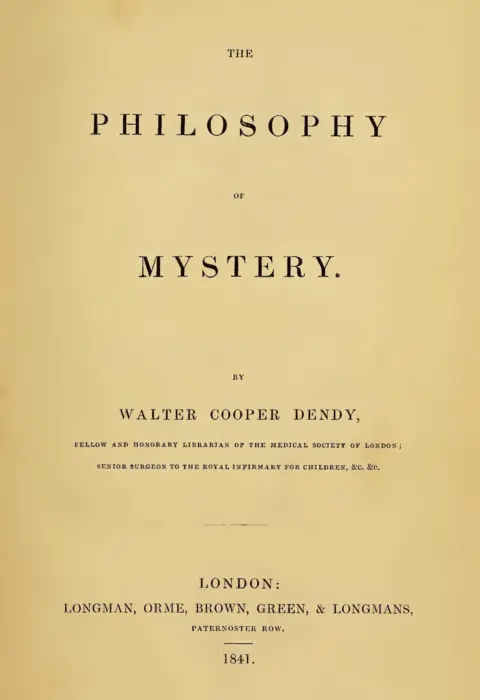
THE CLASSIC COLLECTION · 1841
"The Philosophy of Mystery" by Walter Cooper Dendy is a philosophical treatise examining the nature and implications of the supernatural, particularly focusing on ghosts, spirits, and their representations throughout history. Written in the early 19th century, it combines elements of philosophy, psychology, and anecdotal narrative to explore belief in the supernatural and the motivations behind such beliefs. The text likely appeals to readers interested in metaphysical discussions and the intersection of literature and philosophy. The beginning of the book introduces a scene set on the Wye River, featuring two young women and a thoughtful bachelor named Astrophel, who delves into ghostly phenomena and the pursuit of wisdom regarding the supernatural. As they discuss the existence of spirits, the dialogue reflects the contrasting beliefs about ghosts and the philosophical inquiries surrounding the nature of reality and illusion. The characters express a mixture of skepticism and curiosity, setting the stage for a philosophical exploration of mystery, belief, and the narratives that surround such spectral topics.
Introduction adapted from the source catalogue; source summaries may be automatically generated.
Free to read · English · 131,777 words · No account needed
MAKE TIME FOR A GOOD BOOK
On by default. Untick to stop anonymous reading totals. Each page counts after 10 seconds in view. How this works.
Anonymous counting is on unless you have switched it off.
IDA. You are a witch, Castaly. Yet I have as little faith in the quaint stories of Astrophel. A mystery must be purified and chastened by sacred solemnity, ere it may be blended with the contemplation of holy study. And yet there is an arch voluptuary, Boccacio, the coryphæus of a loose band of novelists, who has stained a volume by his profane union of holiness and passion. The scenes of his Decameron are played amidst the raging of the plague, by flaunting youths and maidens, but that moment arisen from the solemnity of a cathedral prayer!
ASTR. You will call up the shade of Valdarfar, Ida, that idol of the Roxburghe club, and printer of the Decameron——
IDA. If he appear, he shall vanish at a word, Astrophel. Yet we may not lightly yield the influence of special visitations, even in our own days, when solemn belief is chastened by holy motives, and becomes the spring of living waters. Even the taint of superstition may be almost sanctified on such a plea; and Baxter may be forgiven half his credulity when he wrote his “Saints’ Rest,” and the “Essay on Apparitions,” to convert the sceptics of London, who, in the dearth of signs and wonders, expressed their willingness to believe the soul’s immortality, if they had proofs of ghostly visitations.
I will myself even quote a mystery, (I believe recorded in Sandys’s Ovid,) for the sake of the moral which it bears. It is the legend of “The Room of the Ladyes Figure:” whether it be a tale of Bavaria, or a mere paraphrase from the Saxon Sabinus, I know not.
This is the story of Otto, a Bavarian gentleman, of passionate nature, mourning for his wife. On one of his visits to her tomb, a mournful voice, which murmured, “A blessed evening, sir!” came o’er his ear; and while his eyes fell on the form of a young chorister, he placed a letter in his hands, and vanished. His wonder was extreme, while he read this mysterious despatch, which was addressed “To my dear husband, who sorrows for his wife,” and signed, “This, with a warm hand, from the living Bertha,” and appointing an interview in the public walk. Thither, on a beautiful evening, sped the Bavarian, and there, among the crowd, sat a lady covered by a veil. With a trembling voice he whispered “Bertha,” when she arose, and, with her warm and living arm on his, returned to his once desolate home. There were odd thoughts, surmises, and wonderings, passing among the friends of Otto, and suspicions of a mock funeral and a solemn cheat; but all subsided as time stole over, and their wedded life was without a cloud: until a paroxysm of his rage one fatal day was vented on the lady, who cried, “This to me! what if the world knew all!”—with this broken sentence she vanished from the room. In her chamber, whither the search led, erect, as it were gazing on the fire, her form stood; but when they looked on it in front, there was a headless hood, and the clothes were standing as if enveloping a form, but no body was there! Need I say, that a thrill of horror crept through all at the mystery, and a fear at the approach of Otto, who, though deeply penitent, was deserted by all but a graceless reprobate, his companion, and his almoner to many a stranger, who knew not the unhallowed source of bounty?
Your reading position is saved on this browser. Take it to another device with a library code. Reading pages adapt to text, rather than matching a printed edition.
Walter Cooper Dendy
BEHIND THE BOOK
This eBook is for the use of anyone anywhere in the United States and most other parts of the world at no cost and with almost no restrictions whatsoever. You may copy it, give it away or re-use it under the terms of the Project Gutenberg License included with this eBook or online at www.gutenberg.org. If you are not located in the United States, you will have to check the laws of the country where you are located before using this eBook. Read the source licence.
The original source file, including credits and licence, is retained by this library. Request an original-format copy at no charge. Please include the book title and Project Gutenberg identifier #56822.
KEEP YOUR CURIOSITY GOING

David Patterson (Spirit) Hatch
Coulson Kernahan

Ralph Waldo Emerson
Frances Wright

Edwin Abbott Abbott

Joseph Droz