The Islets of the Channel
Walter Cooper Dendy
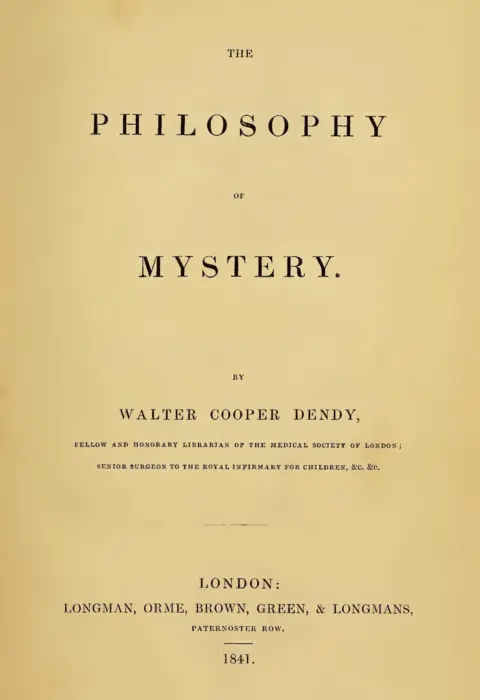
THE CLASSIC COLLECTION · 1841
"The Philosophy of Mystery" by Walter Cooper Dendy is a philosophical treatise examining the nature and implications of the supernatural, particularly focusing on ghosts, spirits, and their representations throughout history. Written in the early 19th century, it combines elements of philosophy, psychology, and anecdotal narrative to explore belief in the supernatural and the motivations behind such beliefs. The text likely appeals to readers interested in metaphysical discussions and the intersection of literature and philosophy. The beginning of the book introduces a scene set on the Wye River, featuring two young women and a thoughtful bachelor named Astrophel, who delves into ghostly phenomena and the pursuit of wisdom regarding the supernatural. As they discuss the existence of spirits, the dialogue reflects the contrasting beliefs about ghosts and the philosophical inquiries surrounding the nature of reality and illusion. The characters express a mixture of skepticism and curiosity, setting the stage for a philosophical exploration of mystery, belief, and the narratives that surround such spectral topics.
Introduction adapted from the source catalogue; source summaries may be automatically generated.
Free to read · English · 131,777 words · No account needed
MAKE TIME FOR A GOOD BOOK
On by default. Untick to stop anonymous reading totals. Each page counts after 10 seconds in view. How this works.
Anonymous counting is on unless you have switched it off.
EV. That I may explain to you the predisposition of a dream,—in other words, the state of broken slumber,—it is essential that I recur to the physiology of the brain; and I must humble our pride, by combining some of the debasing conditions of our nature, as influential on the divine mind, through the medium of its chambers of marrow; for to the intimate condition and function of the brain and its nerves, and its contained blood, we must chiefly look for elucidation of the physical causes of a dream.
Yet I may even grant you, for an argument, Astrophel, the flight of an immortal spirit, and all the amiable vagaries of Sir Thomas Brown; reserving to myself to prove at what moment we become conscious of this flight.
In natural actions, there are ever three requisites, like the points
of a syllogism:
1. A susceptibility of influence;
2. The influence itself;
3. The effect of this influence:
And these I call the predisposing, the exciting, and the proximate
causes.
1. The brain is brought to this susceptibility by excited temperament, study, intense and undivided thought; in short, by any intense impression.
2. The influence or excitement is applied; congestion of blood producing impression on extremities, or origin of a nerve, at the period of departing or returning consciousness. At these periods, the blood changes, and I believe, as it changes, the phenomena of mind, as in the waking state, obey these changes:—rational and light dreams being the effect of circulation of scarlet blood; dull and reasonless visions and “night-mare,” that of crimson, or black blood.
3. The effect of this influence is recurrence of idea, memory,—more or less erroneously associated, as the blood approximates to the black or scarlet state, or as the brain itself is constituted.
Now it is essential to the perfect function of the brain, not only that it shall have a due supply of blood, but that this blood shall be of that quality we term oxygenated. If there be a simple deficiency of this scarlet blood, a state of sound undisturbed sleep will ensue (slightly analogous to the condition of syncope, or fainting). This may be the consequence of any indirect impression, or the natural indication of that direct debility, which we witness in early infancy, and in the “second childishness and mere oblivion” of old age. But this deficiency of arterial blood may be depending on a more positive cause, venous congestion, impeding its flow; for in sleep, the breathing being slower, the blood becomes essentially darker. Even arterial blood itself will become to a certain degree carbonized, by lentor, or stagnation. Venous congestion and diminution of arterial circulation are not incompatible; indeed, Dr. Abercrombie reasons very ably on their relative nature, implying the necessity of some remora of venous circulation to supply that want or vacuum which the brain would otherwise experience from the deficiency of the current in the arterial system. Thus will the languid arterial circulation of the brain, which causes sleep in the first instance, produce, secondarily, that congestion of blood in the veins and sinuses, which shall reduce it to disturbed slumber, and excite the dream. May we not account, on this principle, for the difficulty which many persons experience in falling into a second slumber, when they have been disturbed in the first?
Your reading position is saved on this browser. Take it to another device with a library code. Reading pages adapt to text, rather than matching a printed edition.
Walter Cooper Dendy
BEHIND THE BOOK
This eBook is for the use of anyone anywhere in the United States and most other parts of the world at no cost and with almost no restrictions whatsoever. You may copy it, give it away or re-use it under the terms of the Project Gutenberg License included with this eBook or online at www.gutenberg.org. If you are not located in the United States, you will have to check the laws of the country where you are located before using this eBook. Read the source licence.
The original source file, including credits and licence, is retained by this library. Request an original-format copy at no charge. Please include the book title and Project Gutenberg identifier #56822.
KEEP YOUR CURIOSITY GOING

David Patterson (Spirit) Hatch
Coulson Kernahan

Ralph Waldo Emerson
Frances Wright

Edwin Abbott Abbott

Joseph Droz