The Islets of the Channel
Walter Cooper Dendy
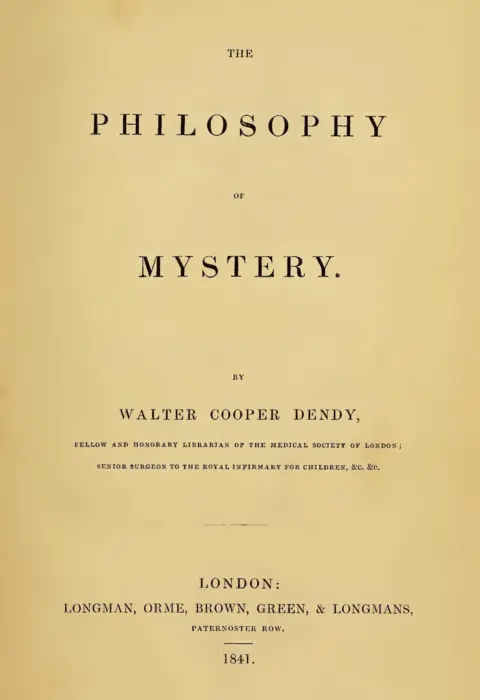
THE CLASSIC COLLECTION · 1841
"The Philosophy of Mystery" by Walter Cooper Dendy is a philosophical treatise examining the nature and implications of the supernatural, particularly focusing on ghosts, spirits, and their representations throughout history. Written in the early 19th century, it combines elements of philosophy, psychology, and anecdotal narrative to explore belief in the supernatural and the motivations behind such beliefs. The text likely appeals to readers interested in metaphysical discussions and the intersection of literature and philosophy. The beginning of the book introduces a scene set on the Wye River, featuring two young women and a thoughtful bachelor named Astrophel, who delves into ghostly phenomena and the pursuit of wisdom regarding the supernatural. As they discuss the existence of spirits, the dialogue reflects the contrasting beliefs about ghosts and the philosophical inquiries surrounding the nature of reality and illusion. The characters express a mixture of skepticism and curiosity, setting the stage for a philosophical exploration of mystery, belief, and the narratives that surround such spectral topics.
Introduction adapted from the source catalogue; source summaries may be automatically generated.
Free to read · English · 131,777 words · No account needed
MAKE TIME FOR A GOOD BOOK
On by default. Untick to stop anonymous reading totals. Each page counts after 10 seconds in view. How this works.
Anonymous counting is on unless you have switched it off.
The first impressions of childhood are bright as fancy; so that we think in waking more of things present. But, in dreams of things long agone there is, in fact, no complete oblivion, in a healthy mind, for any one of our infantile impressions may chance to be brought to us in our dream.
But if impression be intense, it may assimilate that of childhood, and become as permanent. My friend, Dr. Uwins, told me of a patient who, in a joke, once amused himself by throwing stones at the gibbeted pirates on the bank of the Thames. An epileptic tendency succeeded; and ever after this, his dreams were of gibbets and chains, and to that degree, that his judgment and philosophy were powerless in controlling his fears.
And in the book of the Prussian, Greding, we read of J. C. V., a youth, who, in his eighth year, had been attacked by a dog. His future, and, indeed, nightly dreams, were of this creature, and these so intense, as to reduce his health to a very low degree.
Now it is easy to believe the period of slumber so limited, that the subject of reflection shall not have disappeared, that the thought had scarcely time to cool:
“Lateat scintillula forsan.”
Thus Moses Mendelssohn had all the sounds, heard during the day, reverberating in his slumbering mind.
Or we may suppose, that the idea last imprinted on the mind, or by which it had been exclusively occupied, and the thoughts which are so much modified by our temperament, study, and contemplation, would be the first to influence as the mind awakened, ere the image of fresh objects had been again perceived.
Sir Walter, in his diary, thus writes: “When I had in former times to fill up a passage in a poem, it was always when I first opened my eyes that the desired ideas thronged upon me. I am in the habit of relying upon it, and saying to myself when I am at a loss, ‘Never mind, we shall have it all at seven o’clock to-morrow morning.’”
Warton, the professor of poetry at Oxford, after partaking of a Sunday dinner with a friend, repaired to his service at his Church. On his way, he was powerfully saluted with a cry of “Live mackarel.” He slumbered in his pulpit during the singing of the psalm, and, on the organ ceasing, he arose, half awake, and instead of his solemn prayer, cried with a loud voice, “All alive, all alive oh!”
Your reading position is saved on this browser. Take it to another device with a library code. Reading pages adapt to text, rather than matching a printed edition.
Walter Cooper Dendy
BEHIND THE BOOK
This eBook is for the use of anyone anywhere in the United States and most other parts of the world at no cost and with almost no restrictions whatsoever. You may copy it, give it away or re-use it under the terms of the Project Gutenberg License included with this eBook or online at www.gutenberg.org. If you are not located in the United States, you will have to check the laws of the country where you are located before using this eBook. Read the source licence.
The original source file, including credits and licence, is retained by this library. Request an original-format copy at no charge. Please include the book title and Project Gutenberg identifier #56822.
KEEP YOUR CURIOSITY GOING

David Patterson (Spirit) Hatch
Coulson Kernahan

Ralph Waldo Emerson
Frances Wright

Edwin Abbott Abbott

Joseph Droz