The Islets of the Channel
Walter Cooper Dendy
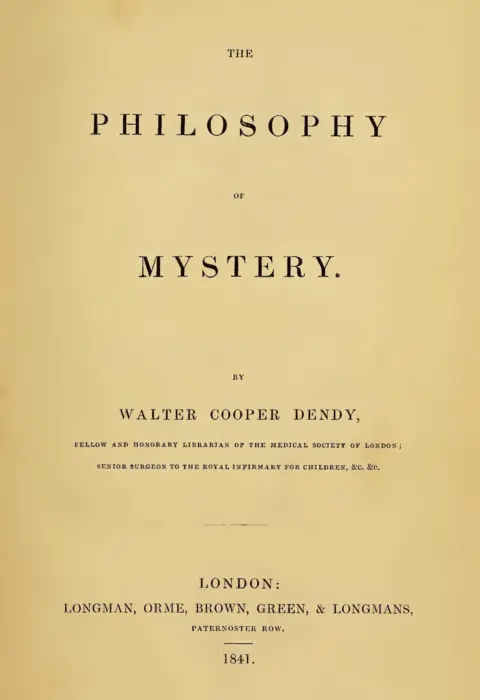
THE CLASSIC COLLECTION · 1841
"The Philosophy of Mystery" by Walter Cooper Dendy is a philosophical treatise examining the nature and implications of the supernatural, particularly focusing on ghosts, spirits, and their representations throughout history. Written in the early 19th century, it combines elements of philosophy, psychology, and anecdotal narrative to explore belief in the supernatural and the motivations behind such beliefs. The text likely appeals to readers interested in metaphysical discussions and the intersection of literature and philosophy. The beginning of the book introduces a scene set on the Wye River, featuring two young women and a thoughtful bachelor named Astrophel, who delves into ghostly phenomena and the pursuit of wisdom regarding the supernatural. As they discuss the existence of spirits, the dialogue reflects the contrasting beliefs about ghosts and the philosophical inquiries surrounding the nature of reality and illusion. The characters express a mixture of skepticism and curiosity, setting the stage for a philosophical exploration of mystery, belief, and the narratives that surround such spectral topics.
Introduction adapted from the source catalogue; source summaries may be automatically generated.
Free to read · English · 131,777 words · No account needed
MAKE TIME FOR A GOOD BOOK
On by default. Untick to stop anonymous reading totals. Each page counts after 10 seconds in view. How this works.
Anonymous counting is on unless you have switched it off.
Even Priestley’s master-mind was sometimes sleeping thus, being subject (to quote his own words) “to humbling failures of recollection;” so that he lost all ideas of things and persons, and had so forgotten his own writings, that, on the perusal of a work, he sat himself to make experiments on points which he had already illustrated, but on which his mind was then a “tabula rasa.”
Above all, the superlative memory of Sir Walter lay in a deep sleep, after a severe indisposition. It is recorded by Ballantyne, that when “the Bride of Lammermoor, in its printed form, was submitted to his perusal, he did not recognize, as his own, one single incident, character, or conversation it contained; yet the original tradition was perfect in his mind. When Mrs. Arkwright, too, sung some verses of his, one evening, at Lord Francis Egerton’s, the same oblivion was o’er his mind, and he whispered to Lockhart, ‘Capital words;—whose are they? Byron’s, I suppose; but I don’t remember them.’”
My friend, Dr. Copland, informed me (in May, 1839) of a lady of fifteen, Miss D——, who, in consequence of extreme exhaustion from disorder, forgot all her accomplishments, and had to begin her education afresh.
The Countess of Laval had, in her childhood, been taught the Armorican of Lower Brittany (which is a dialect of the Welch), but had, as she believed, forgotten it. On attaining the adult period, this lady had an acute fever, and, during her delirium, she ceased to speak in her native language, and chattered fluently in the bastard Welch.
A foreign gentleman, as we were told by Mr. Abernethy, after an accident on the head, spoke French only, and quite forgot the English, which he had before this spoken very fluently.
A Welch patient, in St. Thomas’s Hospital, some years since, having received an injury, began to speak in Welch, and ever after continued to do so, although before his accident he constantly conversed in English.
On the contrary, we learn, from Dr. Pritchard, of a lady who, after a fit of apoplexy, forgot her original language (the English), and spoke only in French, so that her nurses and servants conversed with her only by interpreters.
There may be a partial derangement of memory, one set of impressions
only being erased.
A friend of Dr. Beattie, in consequence of a blow on the head, lost only his attainments in Greek; and Professor Scarpa (whose corpus striatum was disorganised) lost only the memory of proper names.
Your reading position is saved on this browser. Take it to another device with a library code. Reading pages adapt to text, rather than matching a printed edition.
Walter Cooper Dendy
BEHIND THE BOOK
This eBook is for the use of anyone anywhere in the United States and most other parts of the world at no cost and with almost no restrictions whatsoever. You may copy it, give it away or re-use it under the terms of the Project Gutenberg License included with this eBook or online at www.gutenberg.org. If you are not located in the United States, you will have to check the laws of the country where you are located before using this eBook. Read the source licence.
The original source file, including credits and licence, is retained by this library. Request an original-format copy at no charge. Please include the book title and Project Gutenberg identifier #56822.
KEEP YOUR CURIOSITY GOING

David Patterson (Spirit) Hatch
Coulson Kernahan

Ralph Waldo Emerson
Frances Wright

Edwin Abbott Abbott

Joseph Droz