The Islets of the Channel
Walter Cooper Dendy
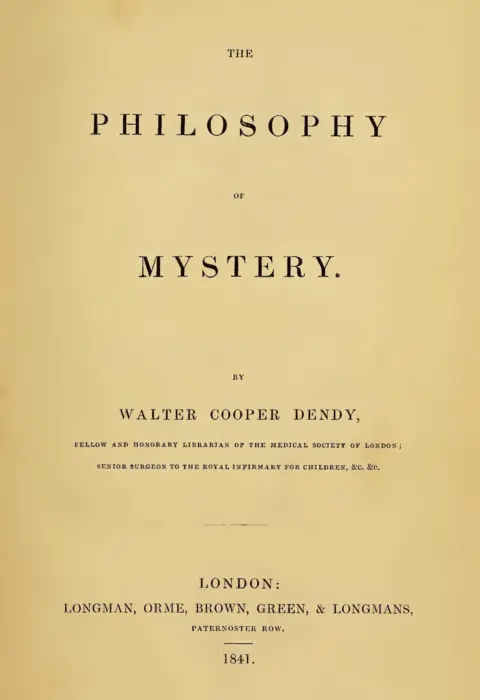
THE CLASSIC COLLECTION · 1841
"The Philosophy of Mystery" by Walter Cooper Dendy is a philosophical treatise examining the nature and implications of the supernatural, particularly focusing on ghosts, spirits, and their representations throughout history. Written in the early 19th century, it combines elements of philosophy, psychology, and anecdotal narrative to explore belief in the supernatural and the motivations behind such beliefs. The text likely appeals to readers interested in metaphysical discussions and the intersection of literature and philosophy. The beginning of the book introduces a scene set on the Wye River, featuring two young women and a thoughtful bachelor named Astrophel, who delves into ghostly phenomena and the pursuit of wisdom regarding the supernatural. As they discuss the existence of spirits, the dialogue reflects the contrasting beliefs about ghosts and the philosophical inquiries surrounding the nature of reality and illusion. The characters express a mixture of skepticism and curiosity, setting the stage for a philosophical exploration of mystery, belief, and the narratives that surround such spectral topics.
Introduction adapted from the source catalogue; source summaries may be automatically generated.
Free to read · English · 131,777 words · No account needed
MAKE TIME FOR A GOOD BOOK
On by default. Untick to stop anonymous reading totals. Each page counts after 10 seconds in view. How this works.
Anonymous counting is on unless you have switched it off.
I may grant that there is some latent effect,—passive memory, if you will,—for we do not count the hours in sleep, and calculate our time by the clock; but we wake, and soon the bell strikes.
We have on record some very curious instances of the periodical recurrence of ideas in a waking state, the measurement of time being referrible to mental impression, mechanically established by constant habit.
There was an idiot once, who was in the habit of amusing himself constantly by counting the hours as they were struck on the clock. It chanced, after some time, that the works of the clock were injured, so that the striking for a time had ceased. The idiot, notwithstanding, continued to measure the day with perfect correctness, by counting and beating the hour. This is a story of Dr. Plott’s, in his History of Staffordshire.
There is one of more modern date, somewhat analogous to this.
I may quote Holy Writ in support of this passive condition of true sleep; nay, even its similitude to death. How often do we find allusions to sleep and death as synonymous! Sir Thomas Brown was impressed so deeply with this likeness, that he “did not dare to trust it without his prayers.” And the Macedonian, who wished for more worlds to conquer, confessed his sleep proved to him his mortality. I may quote ancient poetry also in my support. Homer and Virgil describe sleep as the “Brother of Death;” and, among the profane poets of later times, the same sublime association is traced of this
“Mortis imago—et simulacrum.”
Among the ancient allegories, sleep is portrayed as a female, with black unfolded wings,—in her left hand, a white child, the image of Sleep; in her right, a black child, the image of Death.
On the tomb of Cypselus, according to Pausanias, night is thus
personified.
CAST. How true, then, was the thought of the first deep sleeper, on the
sensation of slumber:—
“——There gentle sleep First found me, and with soft oppression seiz’d My drownéd sense, untroubled; tho’ I thought I then was passing to my former state, Insensible, and forthwith to dissolve.”
But how fearful is this resemblance which changes “tir’d nature’s sweet restorer” into a type of death! Pr’ythee, Evelyn, do not affright me thus, by clothing sleep with terror, as if it were disease and danger.
EV. Why tremble for the mortal sleep of the just and good, who will feel, with William Hunter, on their death-bed, “how pleasant and easy it is to die;” and with another moralist,—
Your reading position is saved on this browser. Take it to another device with a library code. Reading pages adapt to text, rather than matching a printed edition.
Walter Cooper Dendy
BEHIND THE BOOK
This eBook is for the use of anyone anywhere in the United States and most other parts of the world at no cost and with almost no restrictions whatsoever. You may copy it, give it away or re-use it under the terms of the Project Gutenberg License included with this eBook or online at www.gutenberg.org. If you are not located in the United States, you will have to check the laws of the country where you are located before using this eBook. Read the source licence.
The original source file, including credits and licence, is retained by this library. Request an original-format copy at no charge. Please include the book title and Project Gutenberg identifier #56822.
KEEP YOUR CURIOSITY GOING

David Patterson (Spirit) Hatch
Coulson Kernahan

Ralph Waldo Emerson
Frances Wright

Edwin Abbott Abbott

Joseph Droz