
Abury, A Temple of the British Druids, With Some Others, Described
William Stukeley
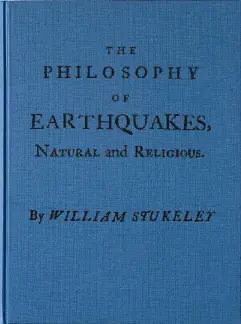
THE CLASSIC COLLECTION · 1756
"The Philosophy of Earthquakes, Natural and Religious" by William Stukeley is a scientific publication written in the mid-18th century. This work explores the nature of earthquakes from both philosophical and theological perspectives, attempting to understand their causes and meanings beyond mere physical phenomena. Stukeley examines historical accounts and various observations to connect the natural occurrences of earthquakes to deeper spiritual and moral insights. At the start of the text, Stukeley reflects on the impact of an earthquake felt in London, considering its significance as both a natural phenomenon and a spiritual warning. He acknowledges the fear and astonishment that such events evoke and argues against common explanations of subterranean activity, instead suggesting that electricity may play a role in these occurrences. Stukeley details the characteristics of earthquakes, citing observations from his own experiences and historical accounts, emphasizing the necessity of understanding these events in the context of divine judgment and morality. Through his discussions, he encourages readers to consider the moral implications of earthquakes and to reflect on their place in the spectrum of human experience.
Introduction adapted from the source catalogue; source summaries may be automatically generated.
Free to read · English · 18,955 words · No account needed
MAKE TIME FOR A GOOD BOOK
On by default. Untick to stop anonymous reading totals. Each page counts after 10 seconds in view. How this works.
Anonymous counting is on unless you have switched it off.
'Tis from hence we account for that observation, that when we electrify any person; upon a touch, the pain and blow of the shock is felt at the joints, the wrist, elbow, and shoulder, for instance, more than in the intermediate parts; because there is the greatest quantity of solid.
At the same time, that the force of electricity in solids, is as the quantity of matter: we see most evidently, by innumerable experiments, that water is equally assistant in strengthening, and conveying the force of electricity; and that in proportion too to its quantity. And hence is to be deduc'd the reason of my observation; that the most frequent and dreadful earthquakes have fallen upon maritime places. And I find the same is taken notice of in some degree, by Acosta, by Dolittle, who wrote on that in 1692, and others.
In the dreadful catastrophe at Port-Royal then, 'tis notorious, that its violence was chiefly near the sea. So Lima could not suffer without its port of Callao. Even in those so lately felt by us, they were sensibly more violent towards the river, than farther from it.
In that earthquake which was felt in England, in the year 1692, (which was very much like these with us) there were no houses thrown down, nor persons kill'd: but it reach'd more particularly Sheerness, Sandwich, Deal, Dover, Portsmouth, and the maritime parts of Holland, Flanders, and Normandy.
In this that happened on Sunday the 18th of March last, at Bath; it was felt particularly and strongly at Portsmouth, seven miles above and below it, on the sea-side; all round the isle of Wight, at Southampton, the sea-coast of Selsey, south of Chichester, Arundel, and the whole coast of Sussex, without going up the land; and across the sea to the islands of Jersey and Guernsey.
On Monday night, the 2d of this instant April, 1750, at ten o'clock, at Leverpool, a shock of an earthquake. And felt in several other places in the neighbourhood; but particularly at Chester, and Warington.
If we look into ancient history, we find 197 years before Christ, an earthquake shook terribly the isle of Rhodes, damag'd many cities: and some quite swallow'd up.
Seventeen years before Christ, many cities in the isle of Cyprus
destroy'd.
Six years before Christ, the isle of Coos vehemently afflicted.
During the Peloponnesian war among the Greeks, the isle of Delos shaken, and the most beautiful temple of Apollo thrown down.
Soon after, the city of Lacedæmon totally destroy'd.
A. D. 79. Three cities in Cyprus overthrown.
A. D. 82. The city of Smyrna ruined.
In the time of Valens the emperor, a terrible earthquake in Crete, whereby 100 cities were destroy'd.
Your reading position is saved on this browser. Take it to another device with a library code. Reading pages adapt to text, rather than matching a printed edition.
BEHIND THE BOOK
This eBook is for the use of anyone anywhere in the United States and most other parts of the world at no cost and with almost no restrictions whatsoever. You may copy it, give it away or re-use it under the terms of the Project Gutenberg License included with this eBook or online at www.gutenberg.org. If you are not located in the United States, you will have to check the laws of the country where you are located before using this eBook. Read the source licence.
The original source file, including credits and licence, is retained by this library. Request an original-format copy at no charge. Please include the book title and Project Gutenberg identifier #63322.
KEEP YOUR CURIOSITY GOING

David Patterson (Spirit) Hatch

David Patterson (Spirit) Hatch

David Patterson (Spirit) Hatch
Cécile Tormay

Moritz Busch
Coulson Kernahan