
Last letters from the living dead man
David Patterson (Spirit) Hatch
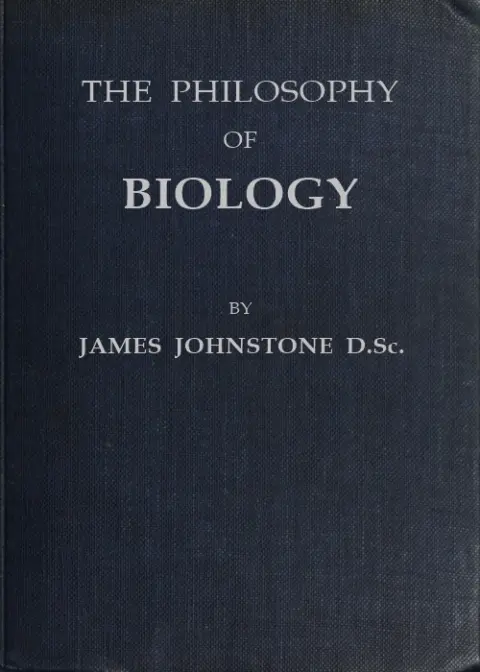
THE CLASSIC COLLECTION · 1914
"The Philosophy of Biology" by James Johnstone is a scientific publication written in the early 20th century. This work explores the philosophical implications and foundations of biological science, particularly focusing on concepts like consciousness, perception, and the nature of living organisms. Johnstone aims to develop a deeper understanding of biology through the lens of philosophy, suggesting that current biological theories may need to reassess their foundational philosophies as scientific knowledge evolves. At the start of the text, the author introduces the interplay between perception and the understanding of the biological organism's existence, arguing that consciousness shapes how organisms perceive and interact with their environment. Johnstone discusses the limitations of purely mechanistic explanations in biology, emphasizing that biological functions cannot be fully understood through the same frameworks that apply to physical phenomena. He sets the stage for a philosophical discussion on the nature of life, suggesting that much like physics evolved, biology too must evolve to grasp the complexities of life beyond mechanistic interpretations.
Introduction adapted from the source catalogue; source summaries may be automatically generated.
Free to read · English · 115,308 words · No account needed
MAKE TIME FOR A GOOD BOOK
On by default. Untick to stop anonymous reading totals. Each page counts after 10 seconds in view. How this works.
Anonymous counting is on unless you have switched it off.
Things that happen in a part of inorganic nature arbitrarily detached from the rest, and investigated by the methods of mathematical physics, do not endure. Let us suppose that we take some silver and add nitric acid to it: the metal dissolves. We can then add hydrochloric acid to the solution and precipitate the metal in the form of chloride; and we can then fuse this chloride with carbonate of soda, or some other substance, and so obtain the metal again. If we work carefully enough we can repeat this series of operations again and again and the original portion of silver will remain unchanged both in nature and in mass. All the chemical reactions into which it has entered have not affected it in any way; that is to say, these reactions have not endured.
If we inject a serum, containing a toxin, into the blood stream of a susceptible animal, certain things happen. The animal will become ill, but, provided that the amount of serum which has been injected was not too great, it will recover. If the toxin be again injected a reaction occurs, but the animal does not become so ill as on the first occasion, and after a number of injections the dose administered may be so great as to kill a susceptible animal but may yet produce no effect on the animal which is the subject of the process of immunisation: immunity has been conferred on it. Now can we compare the two operations, that of the solution and precipitation of the metal and that of the immunisation of the animal? We can to some extent, but the analogy soon fails, and indeed we should not attempt to formulate a theory of immunity on a physico-chemical basis if we did not start with the assumption that the series of operations was one in which only physico-chemical reactions were involved, that is to say, there is nothing in the phenomena of immunisation that suggests that what occurs in the animal body is similar to what we can cause to occur in inorganic materials outside the tissues of the living organism. We start with the assumption that the administration of the toxin causes the formation of an antitoxin in very much the same sort of way as the administration of hydrochloric acid to a solution of nitrate of silver causes the formation of chloride of silver. This antitoxin then neutralises the dose of toxin which may be administered after the process of immunisation has been effected, very much in the same sort of way as a certain amount of some acid can be neutralised by an equivalent amount of some base with which the acid can combine. If the reader will analyse any of the theories of immunisation current at the present day he will find that these are the physical ideas that are involved in it.[4] But physiological science has the much more formidable task of explaining the persistence of the immunity. The animal rendered immune to the toxins produced by certain species of bacteria may remain so for many years, that is, for a very long time after the antitoxins originally produced by the reaction of the tissues to the toxins first administered have disappeared. We must imagine, therefore, that the anti-substances produced originally by the reaction of the toxin are produced again and again by the tissues of the susceptible animal, for the latter may resist repeated infections, that is, repeated doses of toxin, without illness. But then the tissues of the animal body are transitory substances and they do not persist unchanged. Muscles, glands, connective tissues, even nerve-fibres and nerve-cells undergo metabolism, and the chemical substances of which they are composed break down into the excretory products, pass out into the blood stream, and are eliminated from the body; while at the same time these tissues are continually being renewed from the nutritive substances in the blood and lymph. It is the organisation of the tissues--their form and modes of reaction--that endure, but the material substances of which they are composed are in a state of continual flux. Yet the organisation of these tissues does not persist unchanged, for it is continually responding to new conditions experienced by it. The reactions that occur when a toxin is administered to a susceptible animal affect the organisation of its tissues in such a way that the latter acquire the capability of producing antitoxins which may--if we like to say so--neutralise the toxins that enter into them when they become infected. The reaction endures. But this is a different thing from saying that the process is a physico-chemical one alone.
Your reading position is saved on this browser. Take it to another device with a library code. Reading pages adapt to text, rather than matching a printed edition.
BEHIND THE BOOK
This eBook is for the use of anyone anywhere in the United States and most other parts of the world at no cost and with almost no restrictions whatsoever. You may copy it, give it away or re-use it under the terms of the Project Gutenberg License included with this eBook or online at www.gutenberg.org. If you are not located in the United States, you will have to check the laws of the country where you are located before using this eBook. Read the source licence.
The original source file, including credits and licence, is retained by this library. Request an original-format copy at no charge. Please include the book title and Project Gutenberg identifier #61663.
KEEP YOUR CURIOSITY GOING
David Patterson (Spirit) Hatch
Coulson Kernahan

Ralph Waldo Emerson
Frances Wright

Edwin Abbott Abbott

Joseph Droz