
Last letters from the living dead man
David Patterson (Spirit) Hatch
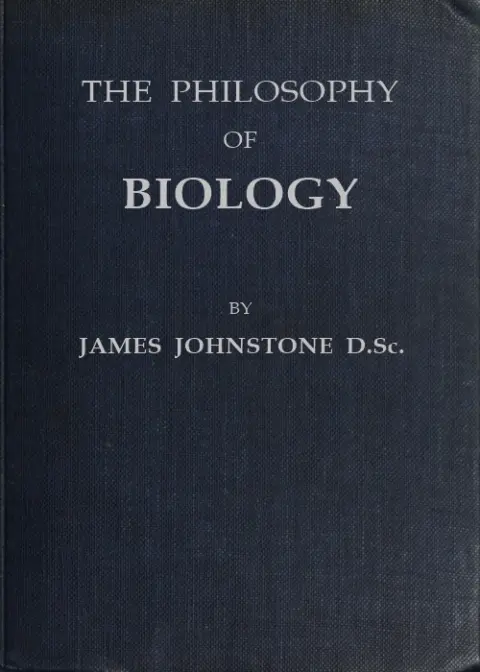
THE CLASSIC COLLECTION · 1914
"The Philosophy of Biology" by James Johnstone is a scientific publication written in the early 20th century. This work explores the philosophical implications and foundations of biological science, particularly focusing on concepts like consciousness, perception, and the nature of living organisms. Johnstone aims to develop a deeper understanding of biology through the lens of philosophy, suggesting that current biological theories may need to reassess their foundational philosophies as scientific knowledge evolves. At the start of the text, the author introduces the interplay between perception and the understanding of the biological organism's existence, arguing that consciousness shapes how organisms perceive and interact with their environment. Johnstone discusses the limitations of purely mechanistic explanations in biology, emphasizing that biological functions cannot be fully understood through the same frameworks that apply to physical phenomena. He sets the stage for a philosophical discussion on the nature of life, suggesting that much like physics evolved, biology too must evolve to grasp the complexities of life beyond mechanistic interpretations.
Introduction adapted from the source catalogue; source summaries may be automatically generated.
Free to read · English · 115,308 words · No account needed
MAKE TIME FOR A GOOD BOOK
On by default. Untick to stop anonymous reading totals. Each page counts after 10 seconds in view. How this works.
Anonymous counting is on unless you have switched it off.
Even on the other hypotheses, those of the formation of discrete suns and planets by the aggregation of meteoric dust, and the compensatory dispersal of such dust by radiation pressure, apparently insurmountable difficulties arise. All such hypotheses as we have indicated assume material substance and modes of energy-transformation similar to those that we study in laboratory processes, and all such hypotheses involve the notion of the degradation of energy. So long as we suppose that all cosmic processes are transformations of extended systems of material substances we must assume that energy is dissipated at every stage of the transformation, and whenever we assume this we admit that the processes are irreversible ones, and that the material universe as a whole tends towards a condition of inertia. Yet this, we see, cannot be true, for the universe teems with diversity. Is the progress towards the ultimate state of inertia an asymptotic one, as Ward suggests? This does not help us, since all that the suggestion does is to misapply a mathematical device of service only in the treatment of the problems for which it was developed. Somewhere or other, it has been said, the second law of thermodynamics must be evaded in our universe.
How can it be evaded? That movement or progress which we call inorganic is a movement of energy-transformations in one direction--towards their cessation. It is a movement which we can easily reverse in imagination. A cigarette consumed by a smoker represents the downfall of energy: the cellulose and oils of the tobacco burn with the liberation of heat, and the formation of water, carbon dioxide, and some soot; and this is what happens when potential energy contained in an organised substance becomes converted into kinetic energy. Now, the opposite process can clearly be conceived--it can even be pictured. If we make a kinematographic record of the smoking of the cigarette and then reverse the direction of motion of the film, we shall see the particles of soot recombining to form the substance of the cigarette, and we can imagine the concomitant combination of the water, carbon dioxide, and other substances formed during the combustion with the absorption of kinetic energy. This is not a mere analogy, for the same reversal of ordinary chemical happening occurs whenever a green plant builds up starch from the water and carbon dioxide of the atmosphere and it also occurs whenever a chemical synthesis of an “organic” compound, like that of urea by Wöhler, or that of the sugars by Fischer, is brought about in the laboratory. In all such syntheses the experimenter reverses the direction of inorganic chemical happening. He may cause endothermic chemical reactions, reactions accompanied by the absorption of available energy, to take place, and in these kinetic energy becomes transformed into potential energy. All the syntheses of organic compounds so complacently instanced by mechanistic biologists and chemists as indicative of the lack of distinction between the organic and the inorganic point to no such conclusion. Sugar is built up in the cells of the green plant from the inorganic compounds, water, and carbon dioxide, and is therefore a compound prepared by life--that of the plant organism. But sugar may also be built up in the laboratory from inorganic compounds, which may further have been synthesised by the chemist from their elements. Does this destroy the distinction between compounds formed by the agency of the organism and those formed by inorganic agencies? Obviously it does not, for in the green plant the sugar was formed as the result of the vital agency of the living chlorophyllian cell, while in the laboratory it was built up because of the intelligence of the experimenter. Apart from this intelligence or vital agency, the series of chemical transformations beginning with the elements carbon, oxygen, and hydrogen, and ending with the substance sugar, would not have occurred. We have no right to say, therefore, that such syntheses destroy the distinction between the organic and the inorganic. What they do indicate is the distinction between the tendency expressed by the second law of thermo-dynamics (inorganic processes), and those that occur as the result of direction conferred upon processes taken as a whole, either by the vital agency of the living cell, or by the intelligence of man (vital processes).
Your reading position is saved on this browser. Take it to another device with a library code. Reading pages adapt to text, rather than matching a printed edition.
BEHIND THE BOOK
This eBook is for the use of anyone anywhere in the United States and most other parts of the world at no cost and with almost no restrictions whatsoever. You may copy it, give it away or re-use it under the terms of the Project Gutenberg License included with this eBook or online at www.gutenberg.org. If you are not located in the United States, you will have to check the laws of the country where you are located before using this eBook. Read the source licence.
The original source file, including credits and licence, is retained by this library. Request an original-format copy at no charge. Please include the book title and Project Gutenberg identifier #61663.
KEEP YOUR CURIOSITY GOING
David Patterson (Spirit) Hatch
Coulson Kernahan

Ralph Waldo Emerson
Frances Wright

Edwin Abbott Abbott

Joseph Droz