
Last letters from the living dead man
David Patterson (Spirit) Hatch
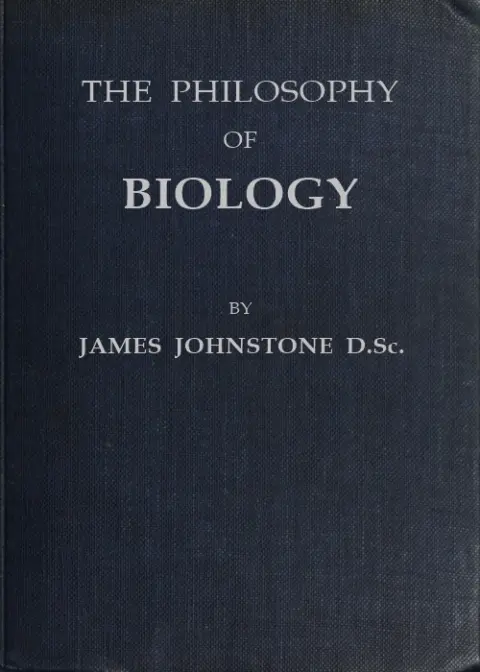
THE CLASSIC COLLECTION · 1914
"The Philosophy of Biology" by James Johnstone is a scientific publication written in the early 20th century. This work explores the philosophical implications and foundations of biological science, particularly focusing on concepts like consciousness, perception, and the nature of living organisms. Johnstone aims to develop a deeper understanding of biology through the lens of philosophy, suggesting that current biological theories may need to reassess their foundational philosophies as scientific knowledge evolves. At the start of the text, the author introduces the interplay between perception and the understanding of the biological organism's existence, arguing that consciousness shapes how organisms perceive and interact with their environment. Johnstone discusses the limitations of purely mechanistic explanations in biology, emphasizing that biological functions cannot be fully understood through the same frameworks that apply to physical phenomena. He sets the stage for a philosophical discussion on the nature of life, suggesting that much like physics evolved, biology too must evolve to grasp the complexities of life beyond mechanistic interpretations.
Introduction adapted from the source catalogue; source summaries may be automatically generated.
Free to read · English · 115,308 words · No account needed
MAKE TIME FOR A GOOD BOOK
On by default. Untick to stop anonymous reading totals. Each page counts after 10 seconds in view. How this works.
Anonymous counting is on unless you have switched it off.
Neither do those morphological schemata which we construct as diagnostic of phyla, or classes, or orders, etc., separate these groups from each other so clearly and unequivocally as our classifications suggest. It might seem for instance that the presence or absence of a notochord would sharply distinguish between the vertebrate and invertebrate, but structures which suggest in their development the true notochordal skeleton of the typical vertebrate animal are to be traced in animals which exhibit few or none of the characters which we regard as diagnostic of the Vertebrate. Typical Arthropods and typical Vertebrates seem to be distinct from each other, but the extinct Ostracoderms of Silurian times may have been animals which possessed an internal axial skeleton, and which were also armed by a heavy dermal exo-skeleton. It is a hypothesis of considerable plausibility that they really were Arthropods, on the other hand they are usually regarded as Vertebrates. So also with most other phyla: the morphological characters which absolutely distinguish between one group and others are very few indeed, and the small appended groups that lie about the bases of these larger groups may present one or other of the characters of several phyla. Looking at the morphology of the animal kingdom in a general kind of way, one does indeed see that a certain structural plan is characteristic of the organisms belonging to each of the great phyla, while more detailed structural plans may be said to be characteristic of the sub-groups. But minute morphological and embryological investigation reduces almost to nothing the characters which are absolutely diagnostic of these various groups.
No more than the nature of the energy-transformations, and the essential morphology, does the behaviour of animals afford us the means of setting up absolute distinctions between group and group. Really tropistic behaviour is exhibited by the movements of the stems, roots, and leaves of green plants, or in the movements of Bacteria, and perhaps some unicellular animals. Typically instinctive behaviour is exhibited by the individuals of societies of Insects and by many solitary-living animals belonging to this class; and typically intelligent behaviour is exhibited by the acting of the higher Mammalia. Yet there is undoubtedly much that is truly instinctive in the behaviour of Man, and something of the same nature as his intelligence seems to inhere in the instinctively-acting mammal or insect: how else could an instinctive action become capable of improvement? We cannot doubt that intelligence is manifested by a dog or by much that we see in the behaviour of ants. No rigid distinctions between tropisms, such as we have mentioned above, and the reflexes that may be taken to constitute instinctive behaviour, can be established. Minute analysis, such as that carried out by Jennings on the swimming movements of the Protozoa, leaves us quite in doubt as to how these modes of behaviour are most properly to be described; and all the controversy as to the nature of tropisms, reflexes, instinct, and intelligence surely indicates that these modes of behaviour have something that is common to all of them, and that no clear and certain distinction can be said to separate one from the other. Even those psychic processes which we call intellectual do not seem to be different in kind from some that we attribute to the lower animals: the Protozoan Paramœcium studied by Jennings, or the crabs, crayfishes, and starfishes studied by Yerkes and others really learn to perform actions, but this learning is said to be the result of a process of “trial and error.” The animal tries one series of movements and finds that it fails, tries another and another with a similar result, and in the end finds one that is effective. This is remembered, and when the same problem again confronts the animal it is solved after fewer trials, and finally, after experience, the end-result is attained at once without previous trials. Now many of what we call truly intellectual processes are certainly processes of precisely this nature. Hypothesis after hypothesis occurs to the scientific man (or to the detective, or to the engineer confronted with some exceptional difficulty), and one after another is tested by actual trial, or by a process of reasoning (which is really the rapid and formal resuming of previous experience), until a hypothesis verifiable, or a priori verifiable, is found. What, for instance, are our mathematical methods of integrating a function, or working a long division sum, but methods of scientific “guessing,” and verification of the hypotheses so made? They are truly instances of the method of trial and error practised by the lower animals.
Your reading position is saved on this browser. Take it to another device with a library code. Reading pages adapt to text, rather than matching a printed edition.
BEHIND THE BOOK
This eBook is for the use of anyone anywhere in the United States and most other parts of the world at no cost and with almost no restrictions whatsoever. You may copy it, give it away or re-use it under the terms of the Project Gutenberg License included with this eBook or online at www.gutenberg.org. If you are not located in the United States, you will have to check the laws of the country where you are located before using this eBook. Read the source licence.
The original source file, including credits and licence, is retained by this library. Request an original-format copy at no charge. Please include the book title and Project Gutenberg identifier #61663.
KEEP YOUR CURIOSITY GOING
David Patterson (Spirit) Hatch
Coulson Kernahan

Ralph Waldo Emerson
Frances Wright

Edwin Abbott Abbott

Joseph Droz