
Last letters from the living dead man
David Patterson (Spirit) Hatch
THE CLASSIC COLLECTION · 1914
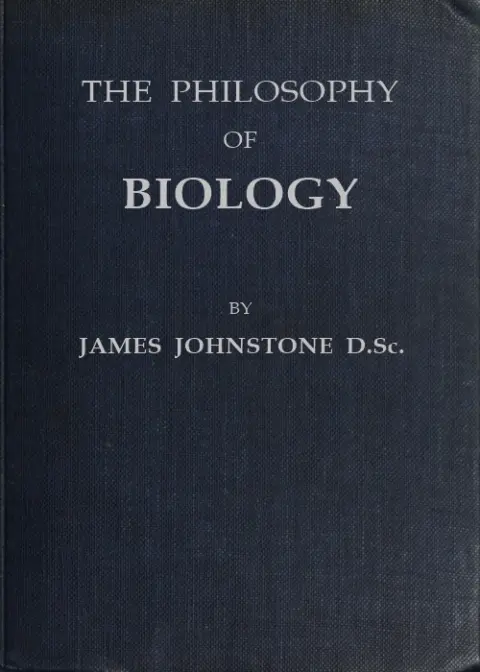
"The Philosophy of Biology" by James Johnstone is a scientific publication written in the early 20th century. This work explores the philosophical implications and foundations of biological science, particularly focusing on concepts like consciousness, perception, and the nature of living organisms. Johnstone aims to develop a deeper understanding of biology through the lens of philosophy, suggesting that current biological theories may need to reassess their foundational philosophies as scientific knowledge evolves. At the start of the text, the author introduces the interplay between perception and the understanding of the biological organism's existence, arguing that consciousness shapes how organisms perceive and interact with their environment. Johnstone discusses the limitations of purely mechanistic explanations in biology, emphasizing that biological functions cannot be fully understood through the same frameworks that apply to physical phenomena. He sets the stage for a philosophical discussion on the nature of life, suggesting that much like physics evolved, biology too must evolve to grasp the complexities of life beyond mechanistic interpretations.
Introduction adapted from the source catalogue; source summaries may be automatically generated.
Free to read · English · 115,308 words · No account needed
MAKE TIME FOR A GOOD BOOK
On by default. Untick to stop anonymous reading totals. Each page counts after 10 seconds in view. How this works.
Anonymous counting is on unless you have switched it off.
Thus there may be suppression of parts leading to entire disappearance or to mere vestiges of the original morphology. A structure degenerating through disuse may become removed from its typical relations with other structures and may acquire altogether new ones. Or its increasing importance may lead to its hypertrophy and to increased complexity of structure, and perhaps to the inclusion of new anatomical elements, or to the incorporation of other parts, the function of which may originally have been quite different. In all sorts of ways organs and organ-systems may become anatomically different as the result of adaptive modifications, or indirectly as non-adaptive modifications induced by the adaptive modifications of adjacent parts. It is the task of comparative anatomy to trace these changes of morphology, aided by the study of embryology and by the comparison of the structure of the parts of fossil animals. Regarding the process of transformism as proved by experiments and observations in breeding and heredity, the naturalist endeavours to trace the lines along which evolution has proceeded from the results of morphological investigations.
Such results cannot have more than a very limited value, and it is often the case that several interpretations of morphological results are equally probable. We may conclude that the existing Teleost and Elasmobranch fishes are descended from a common stock which no longer exists; we may similarly conclude that the Birds and Reptiles are closely allied, more so than either group is to the Mammals; and we may conclude that the Primates--the group of Mammals to which Man belongs--is descended from some group allied to the existing Ungulates or Insectivores, while the Mammals themselves may have come down from some group of vertebrates related to both the Amphibia and the Reptiles. But as to the nature of the animals which combined the characters of the Birds and Reptiles, or of the Reptiles and Amphibia, we know nothing. Palæontology, if its results were more numerous than they are, would afford us the material for the discovery of these “missing links,” and there can be no doubt that as the world becomes better known our knowledge of palæontological stages in the history of existing groups will become more complete, so that we may, in time, possess an actual historical record of the phylogeny of the main groups of animals. But it is remarkable that while the results of comparative anatomy and embryology, aided by those of palæontology, enable us to trace back short series of stages in the evolutionary process, they still show us gaps at all the places where lines of descent ought to converge. They show us, for instance, that the oldest Birds known were decidedly reptilian in their morphology, but they do not show us an animal which was neither Bird nor Reptile, but from which both groups of Vertebrata have descended; and this is almost always the case in our hypothetical schemes of phylogeny. Morphology has continually to postulate the existence of “annectant” forms, “Archi-Mollusc,” “Protosaurian,” “Protochordate,” etc.: hypothetical animals which combine the characters of those which lie near the bases of diverging lines of descent. There is nothing to guide us in the construction of these annectant forms except the progressive simplicity of structure indicated in the morphological and palæontological series. The earlier Birds had teeth, for instance, and so have the Reptiles, therefore the annectant form had teeth, and it was an animal combining the schematic morphology of both Birds and Reptiles. But just according to the value which we attach to one morphological character rather than another, so will the structure of the annectant form differ. Is, for instance, the alimentary canal of the Vertebrate the most fundamental and conservative part of its morphology: that is, is it the structure which has been most resistant to change in the course of the evolutionary process? Then we may regard the Vertebrates as having descended from some animal which was closely related to the Annelid worms. Or is the nervous system the most conservative part of the Vertebrate anatomy? If so, we may trace back the main Chordate stem to animals which included among their characters those of the most primitive Arthropods. In the one case the annectant form joins together the Vertebrate and Annelid stems, but in the other case it would join together the Vertebrate and Arthropod stems, a conclusion which a rigid application of the results of morphology would seem to make the more probable one.
Your reading position is saved on this browser. Take it to another device with a library code. Reading pages adapt to text, rather than matching a printed edition.
BEHIND THE BOOK
This eBook is for the use of anyone anywhere in the United States and most other parts of the world at no cost and with almost no restrictions whatsoever. You may copy it, give it away or re-use it under the terms of the Project Gutenberg License included with this eBook or online at www.gutenberg.org. If you are not located in the United States, you will have to check the laws of the country where you are located before using this eBook. Read the source licence.
The original source file, including credits and licence, is retained by this library. Request an original-format copy at no charge. Please include the book title and Project Gutenberg identifier #61663.
KEEP YOUR CURIOSITY GOING
David Patterson (Spirit) Hatch
Coulson Kernahan

Ralph Waldo Emerson
Frances Wright

Edwin Abbott Abbott

Joseph Droz