
A Tour Through the Pyrenees
Hippolyte Taine
THE CLASSIC COLLECTION · 1871
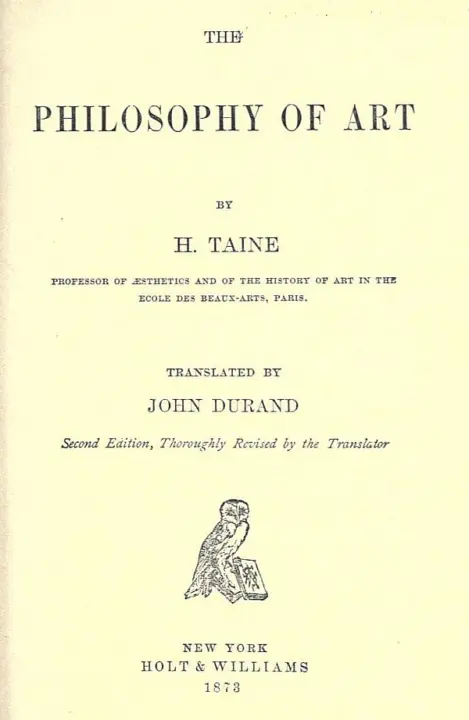
"The Philosophy of Art" by Hippolyte Taine is a philosophical treatise on aesthetics and art theory, written in the mid-19th century. This work consolidates Taine's lectures delivered at the École des Beaux-Arts in Paris, where he explores the influence of social and historical contexts on artistic expression. The book aims to provide a systematic framework for understanding the nature and production of art, emphasizing the relationship between art and the moral and intellectual atmosphere of its time. At the start of the text, Taine addresses his audience, outlining the purpose of his lectures which center on the history of art, particularly painting in Italy. He discusses his systematic method of analyzing art as a product of both the artist's individual background and the broader social influences that shape it. By highlighting the interconnectedness of art, culture, and society, Taine sets the stage for a detailed exploration of various artistic movements and their historical contexts, asserting that to understand a work of art, one must also understand the milieu that nurtured it.
Introduction adapted from the source catalogue; source summaries may be automatically generated.
Free to read · English · 25,036 words · No account needed
MAKE TIME FOR A GOOD BOOK
On by default. Untick to stop anonymous reading totals. Each page counts after 10 seconds in view. How this works.
Anonymous counting is on unless you have switched it off.
The general features of this tragedy first claim attention; they are all calculated to please noblemen and members of the court. The poet does not fail in the blandishment, of truth, which by its nature is often crude; he allows no murders on the stage; he disguises brutality and repudiates violence, such as blows, butcheries, yells, and groans, everything that might offend the senses of a spectator accustomed to moderation and the elegancies of the salon. For the same reason he excludes disorder, never abandoning himself to the caprices of fancy and imagination like Shakespeare; his plan is regular, he admits no unforeseen incidents, no romantic poesy. He elaborates his scenes, explains entrances, graduates the interest of his piece, prepares the way for sudden turns of fortune, and skilfully anticipates and directs dénouements. Finally, he diffuses throughout the dialogue, like a uniform brilliant varnish, a studied versification composed of the choicest terms and the most harmonious rhymes. If we seek the costume of this drama in the engravings of the time we find heroes and princesses appearing in furbelows, embroideries, bootees, swords and plumes--a dress, in short, Greek in name, but French in taste and fashion; such as the king, the dauphin, and the princesses paraded in, to the music of violins, at the court performances of ballets.
Note, moreover, that all his personages are courtiers, kings and queens, princes and princesses of royal blood, ambassadors, ministers, officers of the guard, menins,[1] dependants and confidants. The associates of princes are not here, as in ancient Greek tragedy, slaves of the palace and nurses born under their master's roof, but ladies-in-waiting, equerries, and gentlemen of the antechamber, charged with certain duties in the royal household; we readily detect this in their conversational ability, in their skill in flattery, in their perfect education, in their exquisite deportment, and in their monarchical sentiments as subjects and vassals. Their masters, like themselves, are French noblemen of the seventeenth century, proud and courteous, heroic in Corneille and noble in Racine; they are gallants with the ladies, faithful to their name and race, capable of sacrificing their dearest interests and strongest affections to their honor, and incapable of uttering a word or an act which the most rigid courtesy would not authorize. Iphigenia, in Racine, delivered up by her father to her executioners, does not regret life, weeping like a girl, as in Euripides, but thinks it her duty to obey her father and her king without a murmur, and to die without shedding a tear, because she is a princess. Achilles, who in Homer stamps, still unappeased, on the body of the dying Hector, feeling like a lion or wolf, as if he would "eat the raw flesh" of his vanquished antagonist, is, in Racine, a Prince of Condé, at once brilliant and seductive, passionate concerning honor, devoted to the fair, impetuous, it is true, and irritable, but with the reserved vivacity of a young officer who, even when most excited, maintains good breeding and never stoops to brutality. All these characters are models of polite address, and show a knowledge of the world never at fault. Head, in Racine, the first dialogue of Oreste and Pyrrhus, and the whole of the part of Acomat and of Ulysse; nowhere is greater tact or oratorical dexterity apparent; nowhere more ingenious compliments and flatteries, exordiums so well poised, such a quick revelation, such an ingenious adjustment, such a delicate insinuation of appropriate motives. The wildest and most impetuous lovers--Hippolyte, Britannicus, Pyrrhus, Oreste, and Xipharès --are accomplished cavaliers who turn a madrigal and bow with the utmost deference. However violent their passions may be, Hermione, Andromaqne, Boxane, and Bérénice, preserve the tone of the best society. Mithridate, Phèdre, and Athalie, when expiring, express themselves in correct periods, for a prince has to be a prince to the last, and die in due form. This drama might be called a perfect picture of the fashionable world. Like Gothic architecture, it represents a positive complete side of the human mind, and this is why, like that, it has become so universal. It has been imported into, or imitated by, along with its accompanying taste, literature, and manners, every court of Europe--in England, after the restoration of the Stuarts; in Spain, on the advent of the Bourbons; and in Italy, Germany, and Russia, in the eighteenth century. We are warranted in saying that at this epoch France was the educator of Europe; she was the source from which was derived all that was elegant and agreeable, whatever was proper in style, delicate in ideas, and perfect in the art of social intercourse. If a savage Muscovite, a dull German, a stolid Englishman, or any other uncivilized or half-civilized man of the North quit his brandy, pipe, and furs, his feudal or hunting or rural life, it was to French salons and to French books he betook himself, in order to acquire the arts of politeness, urbanity, and conversation.
Your reading position is saved on this browser. Take it to another device with a library code. Reading pages adapt to text, rather than matching a printed edition.
Hippolyte Taine
BEHIND THE BOOK
This eBook is for the use of anyone anywhere in the United States and most other parts of the world at no cost and with almost no restrictions whatsoever. You may copy it, give it away or re-use it under the terms of the Project Gutenberg License included with this eBook or online at www.gutenberg.org. If you are not located in the United States, you will have to check the laws of the country where you are located before using this eBook. Read the source licence.
The original source file, including credits and licence, is retained by this library. Request an original-format copy at no charge. Please include the book title and Project Gutenberg identifier #52980.
KEEP YOUR CURIOSITY GOING

David Patterson (Spirit) Hatch
Coulson Kernahan

Ralph Waldo Emerson
Frances Wright

Edwin Abbott Abbott

Joseph Droz