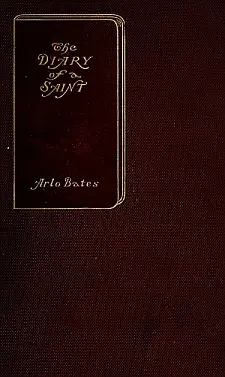
The Diary of a Saint
Arlo Bates
THE CLASSIC COLLECTION · 1889
"The Philistines" by Arlo Bates is a novel written during the late 19th century. The book explores the tensions between artistic integrity and commercial success through the character of Arthur Fenton, an artist who negotiates the complex social landscape of Boston's elite art patrons. As he navigates his relationship with his well-connected wife, Edith Caldwell, the story delves into themes of ambition, societal expectations, and the realities of artistic life amidst the superficiality of the society they live in. The opening of the novel introduces Arthur Fenton, an outspoken member of an artistic group known as the Pagans, who marries Edith Caldwell with the intent to leverage her connections for his own gain within the art world. He is characterized as a pragmatic artist willing to compromise his ideals for success, finding recognition as a fashionable portrait painter. The chapter also sets the stage for a larger dialogue on the nature of honesty and the moral compromises individuals make for societal acceptance. In this initial portion, the reader encounters Fenton's complex inner life, his social maneuvering, and the delicate dynamics within his marriage, suggesting an intricate exploration of personal and professional conflict that will unfold throughout the novel.
Introduction adapted from the source catalogue; source summaries may be automatically generated.
Free to read · English · 96,918 words · No account needed
MAKE TIME FOR A GOOD BOOK
On by default. Untick to stop anonymous reading totals. Each page counts after 10 seconds in view. How this works.
Anonymous counting is on unless you have switched it off.
"It is in regard to the statue of America that I want you to be useful," Mrs. Staggchase said, replying to her visitor's proffer of service with a smile. "Do you know what the chances are in regard to the choice of a sculptor?"
"Why, I suppose Grant Herman will have the commission."
"But I think not."
"You think not? Who will then?"
"That is just it. Mr. Hubbard has been backing Mr. Herman; and Mr. Irons, who never will agree to anything that Mr. Hubbard wants, is putting up the claims of this new woman, just to be contrary."
"What new woman? Mrs. Greyson?"
"Yes. Mrs. Frostwinch told me all about it yesterday. Now there is a young man that we are interested in"--
"Who is 'we'?" interrupted Rangely.
"Oh, Mrs. Frostwinch, and Mrs. Bodewin Ranger, and a number of us."
"But whom have you got on the committee?"
"Mr. Calvin; and don't you see that Mr. Calvin's name in a matter of art is worth a dozen of the other two."
"Yes," Rangely assented, rather doubtfully, "in the matter of giving commissions it certainly is."
Mrs. Staggchase smiled indulgently, playing with the ring in which blazed a splendid ruby, and which she was putting on and off her finger.
"If you think," she said, "that you are going to entrap me into a discussion of the merits of art and Philistinism, you are mistaken. I told you long ago that I was a Philistine of the Philistines, deliberately and avowedly. The true artistic soul which you delight to call Pagan is only the servant of Philistinism, and I own that I prefer to stand with the ruling party. As, indeed," she added, with a mischievous gleam in her eye, "do many who will not confess it."
Rangely flushed. The thrust too closely resembled reproaches which in his more sensitive moments he received at the hand of his own inner consciousness, so to speak, not to make him wince. He felt himself, besides, becoming involved in a painful position. He had long been the intimate friend of Grant Herman, and felt that the sculptor had a right to expect whatever aid he could give him in a matter like this.
"But who," he asked, "is your protege?"
"His name," Mrs. Staggchase replied, "is Orin Stanton. He is a fellow of the greatest talent, and he has worked his way"--
Rangely put up his hand in a gesture of impatience.
"I know the fellow," he said. "He made a thing he called Hop Scotch, of which Fenton said the title was far too modest, since he'd not only scotched the subject but killed it."
Your reading position is saved on this browser. Take it to another device with a library code. Reading pages adapt to text, rather than matching a printed edition.
Arlo Bates
Arlo Bates
Arlo Bates
Arlo Bates
BEHIND THE BOOK
This eBook is for the use of anyone anywhere in the United States and most other parts of the world at no cost and with almost no restrictions whatsoever. You may copy it, give it away or re-use it under the terms of the Project Gutenberg License included with this eBook or online at www.gutenberg.org. If you are not located in the United States, you will have to check the laws of the country where you are located before using this eBook. Read the source licence.
The original source file, including credits and licence, is retained by this library. Request an original-format copy at no charge. Please include the book title and Project Gutenberg identifier #8570.
KEEP YOUR CURIOSITY GOING
Coulson Kernahan

Maurice Baring
Frances Wright
Cécile Tormay

Frederic Jesup Stimson

W. H. P. (William Henry Pope) Jarvis