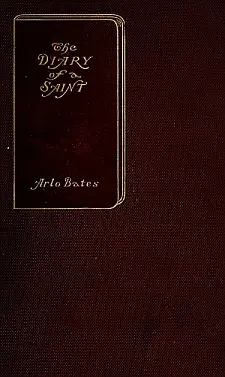
The Diary of a Saint
Arlo Bates
THE CLASSIC COLLECTION · 1889
"The Philistines" by Arlo Bates is a novel written during the late 19th century. The book explores the tensions between artistic integrity and commercial success through the character of Arthur Fenton, an artist who negotiates the complex social landscape of Boston's elite art patrons. As he navigates his relationship with his well-connected wife, Edith Caldwell, the story delves into themes of ambition, societal expectations, and the realities of artistic life amidst the superficiality of the society they live in. The opening of the novel introduces Arthur Fenton, an outspoken member of an artistic group known as the Pagans, who marries Edith Caldwell with the intent to leverage her connections for his own gain within the art world. He is characterized as a pragmatic artist willing to compromise his ideals for success, finding recognition as a fashionable portrait painter. The chapter also sets the stage for a larger dialogue on the nature of honesty and the moral compromises individuals make for societal acceptance. In this initial portion, the reader encounters Fenton's complex inner life, his social maneuvering, and the delicate dynamics within his marriage, suggesting an intricate exploration of personal and professional conflict that will unfold throughout the novel.
Introduction adapted from the source catalogue; source summaries may be automatically generated.
Free to read · English · 96,918 words · No account needed
MAKE TIME FOR A GOOD BOOK
On by default. Untick to stop anonymous reading totals. Each page counts after 10 seconds in view. How this works.
Anonymous counting is on unless you have switched it off.
"'Here, we've got callous to the Virgin's winks
That used to puzzle people wholesomely.'"
"Of course he can't mean that the Madonna winks; that would be too
irreverent."
There were little murmurs of satisfaction that the question had been asked, confusing explanations which evidently puzzled some who had not thought of being confused before; and then another girl, ignoring the fact that the first difficulty had not been disposed of, propounded another.
"Isn't the phrase rather bold," she asked, "where he speaks of 'blessed
evil?'"
"Where is that?" some one asked.
"On page 106, in my edition," was the reply; and a couple of moments were given to finding the place in the various books.
"Oh, I see the line," said an old lady, at last. "It's one--two--three--five lines from the bottom of the page:"
"'And that's what all the blessed evil's for.'"
"You don't think," queried the first speaker, appealing personally to the president, "that Mr. Browning can really have meant that evil is blessed, do you?"
The president regarded her with an affectionate and fatherly smile.
"I think," he said, with an air of settling everything, "that the explanation of his meaning is to be found in the line which follows,--
"'It's use in Time is to environ us.'"
"Heavens!" whispered Fenton to Mrs. Staggchase; "fancy that incarnate respectability environed by 'blessed evil!'"
"For my part," she returned, in the same tone, "I feel as if I were visiting a lunatic asylum." "Yes, that line does make it beautifully clear," observed the voice of Miss Catherine Penwick; "and I think that's so beautiful about the exposed brain, and lidless eyes, and disemprisoned heart. The image is so exquisite when he speaks of their withering up at once."
Fenton made a droll grimace for the benefit of his neighbor, and then observed with great apparent seriousness,--
"The poem is most remarkable for the intimate knowledge it shows of human nature. Take a line like:"
'Men have outgrown the shame of being fools;'
"We can see such striking instances of its truth all about us."
"How can you?" exclaimed Elsie Dimmont, under her breath.
Fenton had not been able wholly to keep out of his tone the mockery which he intended, and several people looked at him askance. Fortunately for him, a nice old gentleman who, being rather hard of hearing, had not caught what was said, now broke in with the inevitable question, which, sooner or later, was sure to come into every discussion of the club:
"Isn't this poem to be most satisfactorily understood when it is
regarded as an allegory?"
Your reading position is saved on this browser. Take it to another device with a library code. Reading pages adapt to text, rather than matching a printed edition.
Arlo Bates
Arlo Bates
Arlo Bates
Arlo Bates
BEHIND THE BOOK
This eBook is for the use of anyone anywhere in the United States and most other parts of the world at no cost and with almost no restrictions whatsoever. You may copy it, give it away or re-use it under the terms of the Project Gutenberg License included with this eBook or online at www.gutenberg.org. If you are not located in the United States, you will have to check the laws of the country where you are located before using this eBook. Read the source licence.
The original source file, including credits and licence, is retained by this library. Request an original-format copy at no charge. Please include the book title and Project Gutenberg identifier #8570.
KEEP YOUR CURIOSITY GOING
Coulson Kernahan

Maurice Baring
Frances Wright
Cécile Tormay

Frederic Jesup Stimson

W. H. P. (William Henry Pope) Jarvis