THE CLASSIC COLLECTION✦The story of Keedon BluffsCLASSIC FREE BOOKS
The story of Keedon Bluffs
Charles Egbert Craddock
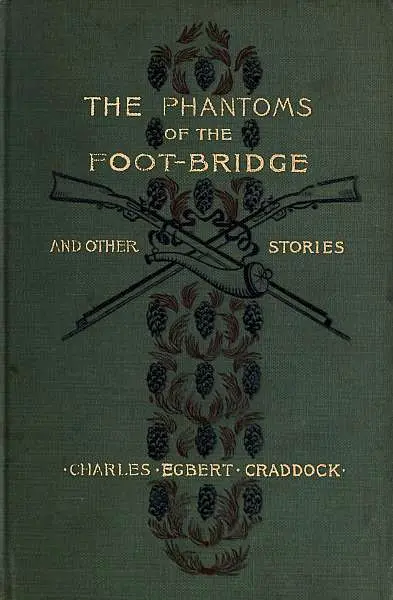
THE CLASSIC COLLECTION · 1895
"The Phantoms of the Foot-Bridge and Other Stories" by Charles Egbert Craddock is a collection of short stories written in the late 19th century. The stories delve into themes of the supernatural and the human experience, often exploring life in rural America, particularly in the Appalachian region. The collection sets its tone with rich descriptive language that evokes a sense of mystery and the uncanny, featuring characters that navigate both the physical and metaphysical realities of their world. At the start of the opening story, "The Phantoms of the Foot-Bridge," we meet two characters, Simeon Roxby and his silent companion, who discuss the haunted nature of a dilapidated footbridge spanning a gorge. Roxby reveals chilling tales of ghosts associated with the bridge, including a young mother who lost her child there and now wanders in sorrowful remembrance. The atmosphere is steeped in a mix of local superstition and natural beauty, highlighting the contrast between the mundane and the supernatural as Roxby speaks of various specters encountered over the years. This setting establishes a compelling narrative of loss and the spectral remnants of the past, setting the stage for the eerie tales that follow in the collection.
Introduction adapted from the source catalogue; source summaries may be automatically generated.
Free to read · English · 93,141 words · No account needed
MAKE TIME FOR A GOOD BOOK
On by default. Untick to stop anonymous reading totals. Each page counts after 10 seconds in view. How this works.
Anonymous counting is on unless you have switched it off.
"Topknot hev jes kem off'n her nest with fourteen deedies, an' she an' 'Melia hev gone ter the barn ter see 'bout'n 'em."
"Whar's Pete?"
"A-huntin'."
A pause. The fire smouldered audibly; a hickory-nut fell with a sharp thwack on the clapboards of the roof, and rolled down and bounded to the ground.
Suddenly: "I seen yer dad ter-day," he began, without coercion. "He gin me a cussin', in the court-room, 'fore all the folks. He cussed all the Kittredges, all o' 'em; him too"--he glanced in the direction of the cradle--"cussed 'em black an' blue, an' called me a thief fur marryin' ye an kerry-in' ye off."
Her face turned scarlet, then pale. She sat down, her trembling hands reaching out to rock the cradle, as if the youthful Kittredge might be disturbed by the malediction hurled upon his tribe. But he slept sturdily on.
"Waal, now," she said, making a great effort at self-control, "ye oughtn't ter mind it. Ye know he war powerful tried. I never purtended ter be ez sweet an' pritty ez the baby air, but how would you-uns feel ef somebody ye despised war ter kem hyar an' tote him off from we-uns forever?"
"I'd cut thar hearts out," he said, with prompt barbarity.
"Thar, now!" exclaimed his wife, in triumphant logic.
He gloomily eyed the smouldering coals. He was beginning to understand the paternal sentiment. By his own heart he was learning the heart of his wife's father.
"I'd chop 'em inter minch-meat," he continued, carrying his just
reprisals a step further.
"Waal, don't do it right now," said his wife, trying to laugh, yet vaguely frightened by his vehemence.
"Eveliny," he cried, springing to his feet, "I be a-goin' ter tell ye all 'bout'n it. I jes called on the cheerman fur the law agin him."
"Agin dad!--the law!" Her voice dropped as she contemplated aghast this terrible uncomprehended force brought to oppress old Joel Quimbey; she felt a sudden poignant pang for his forlorn and lonely estate.
"Never mind, never mind, Eveliny," Absalom said, hastily, repenting of his frantic candor and seeking to soothe her.
"I will mind," she said, sternly. "What hev ye done ter dad?"
"Nuthin'," he replied, sulkily--"nuthin'."
"Ye needn't try ter fool me, Abs'lom Kittredge. Ef ye ain't minded ter tell me, I'll foot it down ter town an' find out. What did the law do ter him?"
"Jes fined him," he said, striving to make light of it.
Your reading position is saved on this browser. Take it to another device with a library code. Reading pages adapt to text, rather than matching a printed edition.
Charles Egbert Craddock
Charles Egbert Craddock
Charles Egbert Craddock
Charles Egbert Craddock
BEHIND THE BOOK
This eBook is for the use of anyone anywhere in the United States and most other parts of the world at no cost and with almost no restrictions whatsoever. You may copy it, give it away or re-use it under the terms of the Project Gutenberg License included with this eBook or online at www.gutenberg.org. If you are not located in the United States, you will have to check the laws of the country where you are located before using this eBook. Read the source licence.
The original source file, including credits and licence, is retained by this library. Request an original-format copy at no charge. Please include the book title and Project Gutenberg identifier #36771.
KEEP YOUR CURIOSITY GOING
Coulson Kernahan

Maurice Baring
Frances Wright
Cécile Tormay
Francis Greenleaf Allinson & Anne C. E. (Anne Crosby Emery) Allinson

Frederic Jesup Stimson