THE CLASSIC COLLECTION✦The story of Keedon BluffsCLASSIC FREE BOOKS
The story of Keedon Bluffs
Charles Egbert Craddock
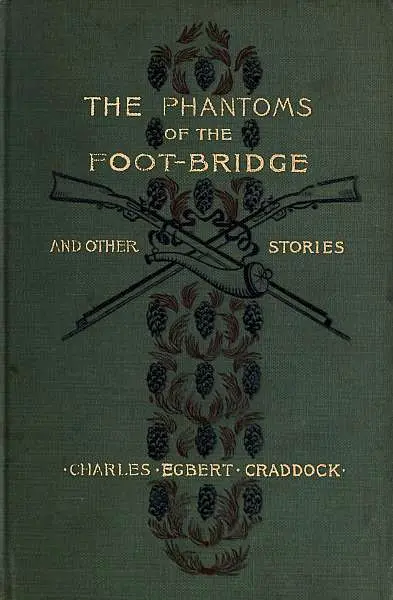
THE CLASSIC COLLECTION · 1895
"The Phantoms of the Foot-Bridge and Other Stories" by Charles Egbert Craddock is a collection of short stories written in the late 19th century. The stories delve into themes of the supernatural and the human experience, often exploring life in rural America, particularly in the Appalachian region. The collection sets its tone with rich descriptive language that evokes a sense of mystery and the uncanny, featuring characters that navigate both the physical and metaphysical realities of their world. At the start of the opening story, "The Phantoms of the Foot-Bridge," we meet two characters, Simeon Roxby and his silent companion, who discuss the haunted nature of a dilapidated footbridge spanning a gorge. Roxby reveals chilling tales of ghosts associated with the bridge, including a young mother who lost her child there and now wanders in sorrowful remembrance. The atmosphere is steeped in a mix of local superstition and natural beauty, highlighting the contrast between the mundane and the supernatural as Roxby speaks of various specters encountered over the years. This setting establishes a compelling narrative of loss and the spectral remnants of the past, setting the stage for the eerie tales that follow in the collection.
Introduction adapted from the source catalogue; source summaries may be automatically generated.
Free to read · English · 93,141 words · No account needed
MAKE TIME FOR A GOOD BOOK
On by default. Untick to stop anonymous reading totals. Each page counts after 10 seconds in view. How this works.
Anonymous counting is on unless you have switched it off.
"I guided him hyar, like old Sim Roxby axed me ter do, an' that's all. I ain't keerin' ef I never lay eyes on him again," he said to himself.
"Going?" said Dundas, pleasantly, noticing the motion. "You'll look in
again, won't you?"
"Wunst in a while, I reckon," drawled Keenan, a trifle thrown off his
balance by this courtesy.
He paused at the door, looking back over his shoulder for a moment at the illumined room, then stepped out into the night, leaving the tenant of the lonely old house filling his pipe by the fire.
His tread rang along the deserted gallery, and sudden echoes came tramping down the vacant halls as if many a denizen of the once populous place was once more astir within its walls. Long after Dundas had heard him spring from the lower piazza to the ground, and the rusty gate clang behind him, vague footfalls were audible far away, and were still again, and once more a pattering tread in some gaunt and empty apartment near at hand, faint and fainter yet, till he hardly knew whether it were the reverberations of sound or fancy that held his senses in thrall.
And when all was still and silent at last he felt less solitary than when these elusive tokens of human presence were astir.
Late, late he sat over the dwindling embers. His mind, no longer diverted by the events of the day, recurred with melancholy persistence to a theme which even they, although fraught with novelty and presage of danger, had not altogether crowded out. And as the sense of peril dulled, the craft of sophistry grew clumsy. Remorse laid hold upon him in these dim watches of the night. Self-reproach had found him out here, defenceless so far from the specious wiles and ways of men. All the line of provocations seemed slight, seemed naught, as he reviewed them and balanced them against a human life. True, it was not in some mad quarrel that his skill had taken it and had served to keep his own--a duel, a fair fight, strictly regular according to the code of "honorable men" for ages past--and he sought to argue that it was doubtless but the morbid sense of the wild fastnesses without, the illimitable vastness of the black night, the unutterable indurability of nature to the influences of civilization, which made it taste like murder. He had brought away even from the scene of action, to which he had gone with decorous deliberation--his worldly affairs arranged for the possibility of death, his will made, his volition surrendered, and his sacred honor in the hands of his seconds--a humiliating recollection of the sudden revulsion of the aspect of all things; the criminal sense of haste with which he was hurried away after that first straight shot; the agitation, nay, the fright of his seconds; their eagerness to be swiftly rid of him, their insistence that he should go away for a time, get out of the country, out of the embarrassing purview of the law, which was prone to regard the matter as he himself saw it now, and which had an ugly trick of calling things by their right names in the sincere phraseology of an indictment. And thus it was that he was here, remote from all the usual lines of flight, with his affectation of being a possible purchaser for the old hotel, far from the railroad, the telegraph, even the postal service. Some time--soon, indeed, it might be, when the first flush of excitement and indignation should be overpast, and the law, like a barking dog that will not bite, should have noisily exhausted the gamut of its devoirs--he would go back and live according to his habit in his wonted place, as did other men whom he had known to be "called out," and who had survived their opponents. Meantime he heard the ash crumble; he saw the lighted room wane from glancing yellow to a dull steady red, and so to dusky brown; he marked the wind rise, and die away, and come again, banging the doors of the empty rooms, and setting timbers all strangely to creaking as under sudden trampling feet; then lift into the air with a rustling sound like the stir of garments and the flutter of wings, calling out weirdly in the great voids of the upper atmosphere.
Your reading position is saved on this browser. Take it to another device with a library code. Reading pages adapt to text, rather than matching a printed edition.
Charles Egbert Craddock
Charles Egbert Craddock
Charles Egbert Craddock
Charles Egbert Craddock
BEHIND THE BOOK
This eBook is for the use of anyone anywhere in the United States and most other parts of the world at no cost and with almost no restrictions whatsoever. You may copy it, give it away or re-use it under the terms of the Project Gutenberg License included with this eBook or online at www.gutenberg.org. If you are not located in the United States, you will have to check the laws of the country where you are located before using this eBook. Read the source licence.
The original source file, including credits and licence, is retained by this library. Request an original-format copy at no charge. Please include the book title and Project Gutenberg identifier #36771.
KEEP YOUR CURIOSITY GOING
Coulson Kernahan

Maurice Baring
Frances Wright
Cécile Tormay
Francis Greenleaf Allinson & Anne C. E. (Anne Crosby Emery) Allinson

Frederic Jesup Stimson