THE CLASSIC COLLECTION✦The story of Keedon BluffsCLASSIC FREE BOOKS
The story of Keedon Bluffs
Charles Egbert Craddock
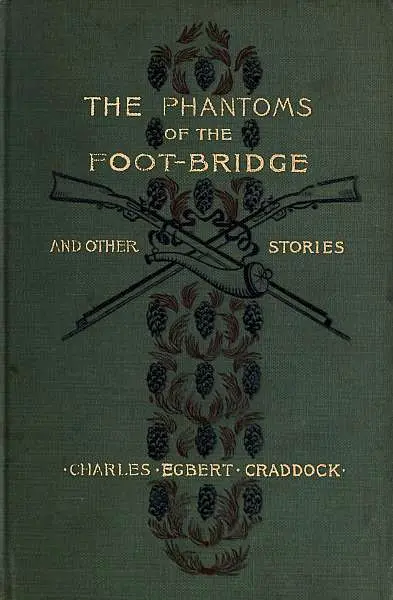
THE CLASSIC COLLECTION · 1895
"The Phantoms of the Foot-Bridge and Other Stories" by Charles Egbert Craddock is a collection of short stories written in the late 19th century. The stories delve into themes of the supernatural and the human experience, often exploring life in rural America, particularly in the Appalachian region. The collection sets its tone with rich descriptive language that evokes a sense of mystery and the uncanny, featuring characters that navigate both the physical and metaphysical realities of their world. At the start of the opening story, "The Phantoms of the Foot-Bridge," we meet two characters, Simeon Roxby and his silent companion, who discuss the haunted nature of a dilapidated footbridge spanning a gorge. Roxby reveals chilling tales of ghosts associated with the bridge, including a young mother who lost her child there and now wanders in sorrowful remembrance. The atmosphere is steeped in a mix of local superstition and natural beauty, highlighting the contrast between the mundane and the supernatural as Roxby speaks of various specters encountered over the years. This setting establishes a compelling narrative of loss and the spectral remnants of the past, setting the stage for the eerie tales that follow in the collection.
Introduction adapted from the source catalogue; source summaries may be automatically generated.
Free to read · English · 93,141 words · No account needed
MAKE TIME FOR A GOOD BOOK
On by default. Untick to stop anonymous reading totals. Each page counts after 10 seconds in view. How this works.
Anonymous counting is on unless you have switched it off.
The little girl accepted it humbly; it was a good baby doubtless of its sort, but it was not alive, which could not be denied of the Grinnell baby, Grinnell though it was.
"An' Job Grinnell he kem down ter the fence, an' 'lowed he'd slit our ears, an' named us shoats," continued her brother. Purdee lifted his head. "An' sent a word ter dad," said the boy, tremulously.
"What word did he send ter--me?" cried Purdee.
The boy quailed to tell him. "He tole me ter ax ye ef ye ever read sech ez this on Moses' tables in the mountings--'An' ye shell claim sech ez be yer own, an' yer neighbors' belongings shell ye in no wise boastfully medjure fur yourn, nor look upon it fur covetiousness, nor yit git a big name up in the kentry fur ownin' sech ez be another's,'" faltered the sturdy Abner.
The next moment he felt an infinite relief. He suddenly recognized the fact that he had been chiefly restrained from repeating the words by an unrealized terror lest they prove true--lest something his father claimed was not his, indeed.
But the expression of anger on Purdee's face was merged first in blank astonishment, then in perplexed cogitation, then in renewed and overpowering amazement.
The wife turned from the warping-bars with a vague stare of surprise, one hand poised uncertainly upon a peg of the frame, the other holding a hank of "spun truck." The grandmother looked over her spectacles with eyes sharp enough to seem subsidized to see through the mystery.
"In the name o' reason and religion, Roger Purdee," she adjured him, "what air that thar perverted Philistine talkin' 'bout?"
"It air more'n I kin jedge of," said Purdee, still vainly cogitating.
He sat for a time silent, his dark eyes bent on the fire, his broad, high forehead covered by his hat pulled down over it, his long, tangled, dark locks hanging on his collar.
Suddenly he rose, took down his gun, and started toward the door.
"Roger," cried his wife, shrilly, "I'd leave the critter be. Lord knows thar's been enough blood spilt an' good shelter burned along o' them Purdees' an' Grinnells' quar'ls in times gone. Laws-a-massy!"--she wrung her hands, all hampered though they were in the "spun truck"--"I'd ruther be a sheep 'thout a soul, an' live in peace."
"A sca'ce ch'ice," commented her mother. "Sheep's got ter be butchered. I'd ruther be the butcher, myself--healthier."
Purdee was gone. He had glanced absently at his wife as if he hardly heard. He waited till she paused; then, without answer, he stepped hastily out of the door and walked away.
Your reading position is saved on this browser. Take it to another device with a library code. Reading pages adapt to text, rather than matching a printed edition.
Charles Egbert Craddock
Charles Egbert Craddock
Charles Egbert Craddock
Charles Egbert Craddock
BEHIND THE BOOK
This eBook is for the use of anyone anywhere in the United States and most other parts of the world at no cost and with almost no restrictions whatsoever. You may copy it, give it away or re-use it under the terms of the Project Gutenberg License included with this eBook or online at www.gutenberg.org. If you are not located in the United States, you will have to check the laws of the country where you are located before using this eBook. Read the source licence.
The original source file, including credits and licence, is retained by this library. Request an original-format copy at no charge. Please include the book title and Project Gutenberg identifier #36771.
KEEP YOUR CURIOSITY GOING
Coulson Kernahan

Maurice Baring
Frances Wright
Cécile Tormay
Francis Greenleaf Allinson & Anne C. E. (Anne Crosby Emery) Allinson

Frederic Jesup Stimson