THE CLASSIC COLLECTION✦The story of Keedon BluffsCLASSIC FREE BOOKS
The story of Keedon Bluffs
Charles Egbert Craddock
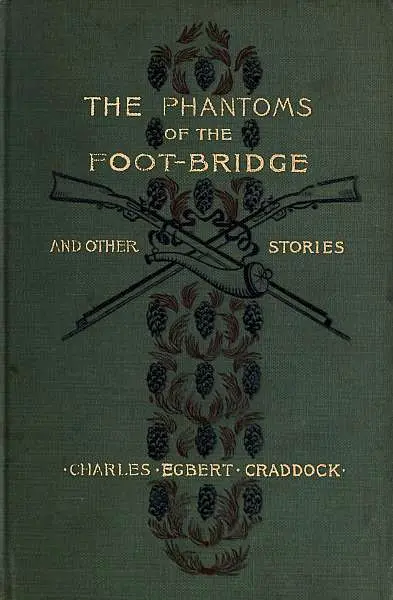
THE CLASSIC COLLECTION · 1895
"The Phantoms of the Foot-Bridge and Other Stories" by Charles Egbert Craddock is a collection of short stories written in the late 19th century. The stories delve into themes of the supernatural and the human experience, often exploring life in rural America, particularly in the Appalachian region. The collection sets its tone with rich descriptive language that evokes a sense of mystery and the uncanny, featuring characters that navigate both the physical and metaphysical realities of their world. At the start of the opening story, "The Phantoms of the Foot-Bridge," we meet two characters, Simeon Roxby and his silent companion, who discuss the haunted nature of a dilapidated footbridge spanning a gorge. Roxby reveals chilling tales of ghosts associated with the bridge, including a young mother who lost her child there and now wanders in sorrowful remembrance. The atmosphere is steeped in a mix of local superstition and natural beauty, highlighting the contrast between the mundane and the supernatural as Roxby speaks of various specters encountered over the years. This setting establishes a compelling narrative of loss and the spectral remnants of the past, setting the stage for the eerie tales that follow in the collection.
Introduction adapted from the source catalogue; source summaries may be automatically generated.
Free to read · English · 93,141 words · No account needed
MAKE TIME FOR A GOOD BOOK
On by default. Untick to stop anonymous reading totals. Each page counts after 10 seconds in view. How this works.
Anonymous counting is on unless you have switched it off.
And thus reminded of the instrument, he picked it up, and once more, with the bow held aloft in his hand, he dexterously twanged the strings, and with his deft fingers rapidly and discriminatingly turned the screws, this one up and that one down. The earnest would-be musician, who had languished while the discussion was in progress, now plucked up a freshened interest, and begged that the furnace door might be set ajar to enable him to watch the process of tuning and perchance to detect its subtle secret. No objection was made, for the still was nearly empty, and arrangements tending to replenishment were beginning to be inaugurated by several of the men, who were examining the mash in tubs in the further recesses of the place. They were lighted by a lantern which, swinging to and fro as they moved, sometimes so swiftly as to induce a temporary fluctuation threatening eclipse, suggested in the dusk the erratic orbit of an abnormally magnified fire-fly. It barely glimmered, the dullest point of white light, when the rich flare from the opening door of the furnace gushed forth and the whole rugged interior was illumined with its color. The inadequate moonlight fell away; the chastened white splendor on the foam of the cataract, the crystalline glitter, timorously and elusively shifting, were annihilated; the swiftly descending water showed from within only a continuously moving glow of yellow light, all the brighter from the dark-seeming background of the world glimpsed without. A wind had risen, unfelt in these recesses and on the weighty volume of the main sheet of falling water, but at its verge the fitful gusts diverted its downward course, tossing slender jets aslant, and sending now and again a shower of spray into the cavern. Nehemiah remembered his rheumatism with a shiver. The shadows of the men, instead of an unintelligible comminglement with the dusk, were now sharp and distinct, and the light grotesquely duplicated them till the cave seemed full of beings who were not there a moment before--strange gnomes, clumsy and burly, slow of movement, but swift and mysterious of appearance and disappearance. The beetling ledges here and there imprinted strong black similitudes of their jagged contours on the floor; with the glowing, weird illumination the place seemed far more uncanny than before, and Leander, with his face pensive once more in response to the gentle strains slowly elicited by the bow trembling with responsive ecstasy, his large eyes full of dreamy lights, his curling hair falling about his cheek as it rested upon the violin, his figure, tall and slender and of an adolescent grace, might have suggested to the imagination a reminiscence of Orpheus in Hades. They all listened in languid pleasure, without the effort to appraise the music or to compare it with other performances--the bane of more cultured audiences; only the ardent amateur, seated close at hand on a bowlder, watched the bowing with a scrutiny which betokened earnest anxiety that no mechanical trick might elude him. The miller's half-grown son, whose ear for any fine distinctions in sound might be presumed to have been destroyed by the clamors of the mill, sat a trifle in the background, and sawed away on an imaginary violin with many flourishes and all the exaggerations of mimicry; he thus furnished the zest of burlesque relished by the devotees of horse-play and simple jests, and was altogether unaware that he had a caricature in his shadow just behind him, and was doing double duty in making both Leander and himself ridiculous. Sometimes he paused in excess of interest when the music elicited an amusement more to his mind than the long-drawn, pathetic cadences which the violinist so much affected. For in sudden changes of mood and in effective contrast the tones came showering forth in keen, quick staccato, every one as round and distinct as a globule, but as unindividualized in the swift exuberance of the whole as a drop in a summer's rain; the bow was but a glancing line of light in its rapidity, and the bounding movement of the theme set many a foot astir marking time. At last one young fellow, an artist too in his way, laid aside his pipe and came out to dance. A queer pas seul it might have been esteemed, but he was light and agile and not ungraceful, and he danced with an air of elation--albeit with a grave face--which added to the enjoyment of the spectator, for it seemed so slight an effort. He was long-winded, and was still bounding about in the double-shuffle and the pigeon-wing, his shadow on the wall nimbly following every motion, when the violin's cadence quavered off in a discordant wail, and Leander, the bow pointed at the water-fall, exclaimed: "Look out! Somebody's thar! Out thar on the rocks!"
Your reading position is saved on this browser. Take it to another device with a library code. Reading pages adapt to text, rather than matching a printed edition.
Charles Egbert Craddock
Charles Egbert Craddock
Charles Egbert Craddock
Charles Egbert Craddock
BEHIND THE BOOK
This eBook is for the use of anyone anywhere in the United States and most other parts of the world at no cost and with almost no restrictions whatsoever. You may copy it, give it away or re-use it under the terms of the Project Gutenberg License included with this eBook or online at www.gutenberg.org. If you are not located in the United States, you will have to check the laws of the country where you are located before using this eBook. Read the source licence.
The original source file, including credits and licence, is retained by this library. Request an original-format copy at no charge. Please include the book title and Project Gutenberg identifier #36771.
KEEP YOUR CURIOSITY GOING
Coulson Kernahan

Maurice Baring
Frances Wright
Cécile Tormay
Francis Greenleaf Allinson & Anne C. E. (Anne Crosby Emery) Allinson

Frederic Jesup Stimson