
Last letters from the living dead man
David Patterson (Spirit) Hatch
THE CLASSIC COLLECTION · 1877
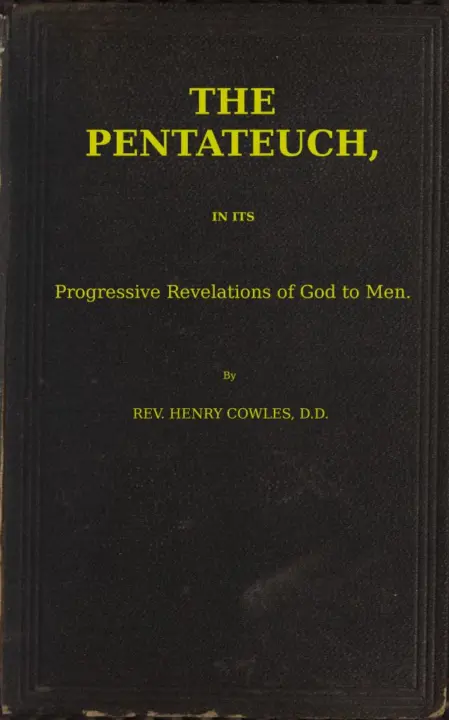
"The Pentateuch, in Its Progressive Revelations of God to Men" by Henry Cowles is a religious examination of the first five books of the Bible written in the late 19th century. The work addresses the themes presented in the Pentateuch, focusing on the progressive nature of divine revelations of God to humanity, with a strong emphasis on moral implications and historical contexts. It aims to clarify common misconceptions while delving into the relationship between Biblical text and contemporary scientific inquiries. At the start of the text, Cowles outlines his rationale for addressing the Pentateuch thematically rather than strictly textually. He expresses his intention to tackle the moral and critical dimensions of key themes while also addressing popular objections and misconceptions, particularly regarding Genesis and its relevance to modern science. Cowles suggests that the complexity of divine revelation requires a thoughtful and multi-faceted approach, inviting readers to engage with the text meaningfully while considering its historical context and its implications for understanding God and His works.
Introduction adapted from the source catalogue; source summaries may be automatically generated.
Free to read · English · 162,911 words · No account needed
MAKE TIME FOR A GOOD BOOK
On by default. Untick to stop anonymous reading totals. Each page counts after 10 seconds in view. How this works.
Anonymous counting is on unless you have switched it off.
16 – Hodge’s Systematic Theology, vol. 2, p. 33.
17 – See Lyell’s Antiquity of Man, pp. 9–11.
18 – See “Antiquity and Unity of the Human Race,” by Rev. Ebenezer Burgess, pp. 25–30.
19 – Josephus states explicitly that Samuel and Saul combined
fill out 40 years.
20 – It is a telling fact that according to Julius Africanus, Manetho’s numbers for the entire reigns of all the kings foot up 5404 years, while the aggregate duration of all the dynasties (within the same chronological termini) is 3555 years――i. e. the sum of all the dynasties is less by 1849 years than the sum of all the kings’ reigns which make up those dynasties. See Burgess on the Antiquity of Man, pp. 70, 73.
21 – Bunsen is cited not as the best authority, but as one of the most strenuous for an exceedingly, not to say excessively, long duration.
23 – Or this one hundred and twenty years may be the reduced standard duration of human life, the thought being――So long a probation, almost a thousand years, is too much; my Spirit shall not prolong his effort in vain to this extent; I reduce the average life-period to one hundred and twenty years.
24 – See Smith’s Bible Dictionary, “Noah,” for numerous
traditions of the flood.
27 – Many an American reader will be reminded of John Brown striking for the redemption of the American slave.
28 – See on the Scripture usage of “the angel of the Lord,”
p. 130.
30 – Hengstenberg’s Egypt and Moses, pp. 115 and 116.
32 – That this fear was by no means groundless appears in the panic which smote their hearts when they saw Pharaoh’s host pursuing (Ex. 14: 10–12), and also in the unbelieving fear manifested on hearing the report of ten of the spies returned from their forty days traversing of Canaan (Num. 13: 28, 31–33, and 14: 1–4).
33 – Connecting the fact given in profane history that Egypt worshiped the ox and the cow as gods, with the fact of sacred history――that all the first-born of their cattle fell in this fearful plague, we shall understand how signally God “executed judgment on Egypt’s gods.”
34 – See Bibliotheca Sacra, Oct., 1863, p. 881.
35 – The term “Bekhen” is used for any kind of building――a temple, palace, or even a common house. Descriptions of what they built correspond to the sacred record, “treasure-cities.”
36 – See Burgess on “The Antiquity of Man,” pp. 68–84, on the unreliability of Manetho’s lists and on the relative value of other authorities in Egyptian chronologies.
37 – The passages which treat of it are Ex. 16: 14–36 and Num. 11: 7–9 and Deut. 8: 3, 16 and Josh. 5: 12, Ps. 78: 24, 25 and Wisdom 16: 20, 21.
Your reading position is saved on this browser. Take it to another device with a library code. Reading pages adapt to text, rather than matching a printed edition.
BEHIND THE BOOK
This eBook is for the use of anyone anywhere in the United States and most other parts of the world at no cost and with almost no restrictions whatsoever. You may copy it, give it away or re-use it under the terms of the Project Gutenberg License included with this eBook or online at www.gutenberg.org. If you are not located in the United States, you will have to check the laws of the country where you are located before using this eBook. Read the source licence.
The original source file, including credits and licence, is retained by this library. Request an original-format copy at no charge. Please include the book title and Project Gutenberg identifier #61241.
KEEP YOUR CURIOSITY GOING
David Patterson (Spirit) Hatch

David Patterson (Spirit) Hatch

David Patterson (Spirit) Hatch
Cécile Tormay

Moritz Busch
John L. Ransom