
Last letters from the living dead man
David Patterson (Spirit) Hatch
THE CLASSIC COLLECTION · 1877
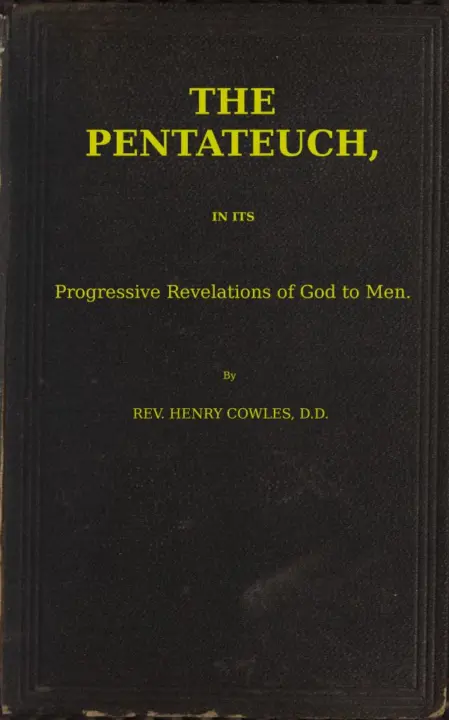
"The Pentateuch, in Its Progressive Revelations of God to Men" by Henry Cowles is a religious examination of the first five books of the Bible written in the late 19th century. The work addresses the themes presented in the Pentateuch, focusing on the progressive nature of divine revelations of God to humanity, with a strong emphasis on moral implications and historical contexts. It aims to clarify common misconceptions while delving into the relationship between Biblical text and contemporary scientific inquiries. At the start of the text, Cowles outlines his rationale for addressing the Pentateuch thematically rather than strictly textually. He expresses his intention to tackle the moral and critical dimensions of key themes while also addressing popular objections and misconceptions, particularly regarding Genesis and its relevance to modern science. Cowles suggests that the complexity of divine revelation requires a thoughtful and multi-faceted approach, inviting readers to engage with the text meaningfully while considering its historical context and its implications for understanding God and His works.
Introduction adapted from the source catalogue; source summaries may be automatically generated.
Free to read · English · 162,911 words · No account needed
MAKE TIME FOR A GOOD BOOK
On by default. Untick to stop anonymous reading totals. Each page counts after 10 seconds in view. How this works.
Anonymous counting is on unless you have switched it off.
=THE FORWARD=, London.
“This work is cheap, compact, and suited to this hard-working age. The plan is new and useful.”
=BAPTIST MESSENGER=, London.
“In ordinary cases we do not consult commentators in two cases out of ten with real advantage. But in the ‘Suggestive Commentary’ we have not in a single instance been disappointed.”
=BRITISH QUARTERLY=, London.
“Dr. Van Doren, in the form of short sentences, brings together the gist of all previous commentators, and supplies abundance of hints to those who have but little leisure.”
=ENGLISH PRESBYTERIAN=, London.
“To clergymen and students this work is invaluable. We have brought the work under the special notice of our friends in private.”
=WESLEYAN TIMES=, London.
“An excellent idea, admirably worked out. We have tested the work on the Lord’s Prayer, and we cordially commend it.”
“It is a work to make men think, and not save them from thinking. These volumes will be welcome to many a student of the Scriptures. Hard-worked ministers and Bible-class teachers will be well repaid by studying them.”
=THE INDEPENDENT=, London.
“This is a remarkable work, and valuable as well. If there ever was multum in parvo, it is here found. The labor in preparing it must have been immense. The work is eminently suggestive, and will save an enormous amount of time.”
=L. HALSEY, D.D.=, Professor Theological Seminary, Chicago.
“Every page bears marks of thorough and accurate scholarship, and of patient, careful study. It is the most readable commentary we have ever met. It is impossible to say things in quicker time or narrower space than he has said them.”
=Rev. Prof. SWING=, late of Miami University.
“In my pulpit preparations, I prefer the ‘Suggestive Commentary’ to
Lange.”
“This work has been highly recommended by the journals of Great Britain. It certainly evinces thought, labor, and learning.”
Footnotes.
2 – Lay sermons on spontaneous generation; pp. 364–366.
3 – Dr. A. M’Caul in “Aids to Faith,” page 241 renders it――“And evening happened and morning happened――one day.” Precisely this is the sense of the Septuagint and of the Syriac. See also Tayler Lewis in Lange’s Genesis, pp. 132, 133.
4 – See the usage in David (Ps. 55: 17), “Evening and morning and at noon will I pray.”
6 – The following synoptical view of the passages in which כרא or בכרא occurs is given in the Bibliotheca Sacra (Oct. 1856, pp. 763, 764) by Prof. E. P. Barrows.――“It is used,
Your reading position is saved on this browser. Take it to another device with a library code. Reading pages adapt to text, rather than matching a printed edition.
BEHIND THE BOOK
This eBook is for the use of anyone anywhere in the United States and most other parts of the world at no cost and with almost no restrictions whatsoever. You may copy it, give it away or re-use it under the terms of the Project Gutenberg License included with this eBook or online at www.gutenberg.org. If you are not located in the United States, you will have to check the laws of the country where you are located before using this eBook. Read the source licence.
The original source file, including credits and licence, is retained by this library. Request an original-format copy at no charge. Please include the book title and Project Gutenberg identifier #61241.
KEEP YOUR CURIOSITY GOING
David Patterson (Spirit) Hatch

David Patterson (Spirit) Hatch

David Patterson (Spirit) Hatch
Cécile Tormay

Moritz Busch
John L. Ransom