
Last letters from the living dead man
David Patterson (Spirit) Hatch
THE CLASSIC COLLECTION · 1877
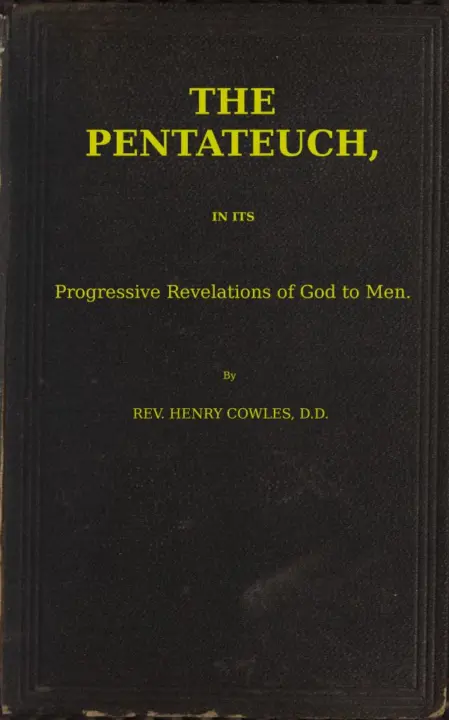
"The Pentateuch, in Its Progressive Revelations of God to Men" by Henry Cowles is a religious examination of the first five books of the Bible written in the late 19th century. The work addresses the themes presented in the Pentateuch, focusing on the progressive nature of divine revelations of God to humanity, with a strong emphasis on moral implications and historical contexts. It aims to clarify common misconceptions while delving into the relationship between Biblical text and contemporary scientific inquiries. At the start of the text, Cowles outlines his rationale for addressing the Pentateuch thematically rather than strictly textually. He expresses his intention to tackle the moral and critical dimensions of key themes while also addressing popular objections and misconceptions, particularly regarding Genesis and its relevance to modern science. Cowles suggests that the complexity of divine revelation requires a thoughtful and multi-faceted approach, inviting readers to engage with the text meaningfully while considering its historical context and its implications for understanding God and His works.
Introduction adapted from the source catalogue; source summaries may be automatically generated.
Free to read · English · 162,911 words · No account needed
MAKE TIME FOR A GOOD BOOK
On by default. Untick to stop anonymous reading totals. Each page counts after 10 seconds in view. How this works.
Anonymous counting is on unless you have switched it off.
Does any one ask――How could an ass speak with man’s voice? Were real words uttered, words which any other ears within hearing could have heard as well as Balaam’s? Or was it simply a miraculous sensation upon his ear, having no cause whatever in the mouth of the ass?――――I answer: It is of small avail to push such inquiries. We can say wisely but two things:――(a.) That God could work a miracle as easily in one of these ways as in the other:――and (b.) Therefore the method which the description most naturally suggests is the most probable; viz. that the ass spake audible words, and Balaam heard them as men are wont to hear words audibly spoken.
The points of real prophecy in Balaam’s visions should be noticed.
Observe that in each case, before Balaam inquired of God he directed Balak to prepare seven altars and to offer upon each one bullock and one ram. The object in this seems to have been to propitiate the Lord and secure his favorable consideration. It is remarkable that Balaam, coming from the region of the Euphrates, should have these ideas as to the sacrifice of clean animals. The fact seems to show that the idea of animal sacrifices was revealed to the race in its infancy and that it prevailed extensively over the Eastern world.
The offerings having been made, Balaam retired to “an high place” (23: 3) as our version puts it, but really to a hill of bare, naked summit to await the Lord’s presence and word there. [Such a summit was chosen for its range of view]. The Lord came and gave him his word for Balak, put thus: “Balak, the king of Moab, hath brought me from Aram, out of the mountains of the East, saying: ‘Come, curse me, Jacob; come, defy [in the sense only of curse, maledict] Israel.’ How shall I curse whom God hath not cursed? Or how shall I defy whom God hath not defied”? [How can I gainsay the Almighty; how put my word against his? Balak asks this of me: I have no power to do it].――――“From the top of the rocks I see him, and from the hills I behold him: lo! the people shall dwell alone and shall not be reckoned among the nations.”――――From his naked mountain top Balaam saw their encampment spread out before him; there they were, a peculiar, secluded people, having neither political, social, or religious connection with any other nation under heaven. In this most salient feature of their case Balaam saw a symbol of their whole future history――dwelling alone, a scattered people, never reckoned as being of or like any other nation of the earth.――――Their great numbers also were prophetic of their prosperous future: “Who can count the dust of Jacob, and the number of the fourth part of Israel”?――the reference to a “fourth part” coming of the fact that their encampment was in four parts, three tribes to each.――――His closing words are weighty: “Let me die the death of the righteous, and let my last end be like his.”――――In interpreting these words I can by no means assent to the view of many commentators (largely German) who suppose Balaam had no ideas of a happy future life, it being as they maintain far too early in the progress of religious thought for any such ideas. They therefore restrict his meaning to a happy earthly life, prosperous even to its natural end in death.――――I have no faith in such interpretations. They do not come by any fair construction from the text. What Balaam said was: “Let my soul die the death of the righteous, and let my after destiny be like his.” After destiny――the afterpart of my existence, is the legitimate sense of the word here used.――――Besides, to pray that I may die of the same disease, at the same age, amid the same surroundings, as the righteous, is very tame, is a very insignificant blessing at best, and no sensible man could put his soul very earnestly into such a prayer. I see no reason why we should emasculate the prayer even of a Balaam in this style. Let us rather say that he prayed like one “whose eyes were open; who had heard the words of God and knew the knowledge of the most High and saw the vision of the Almighty” (24: 15, 16) as he himself said.――――As to toning down the sense of his words because their Christian construction would be so far in advance of the age, I can not accept the assumed fact that they were in advance of the age. I can not believe that Enoch, “walking with God” and translated to heaven knew nothing of heaven until he found himself there; or that Noah whose faith and whose preaching of righteousness breasted the wickedness of that whole generation had no thoughts as to the blessed world to come; nor that Abraham’s faith was limited to the hills and to the corn and wine of Canaan and had never an outlook of longing desire and assured hope of a “better country even an heavenly one” (Heb. 11: 16); nor that Moses, “esteeming reproach for Christ greater riches than the treasures of Egypt,” had no “respect to the [future] recompense of reward.” The writer to the Hebrews reasons far better than the Neological critics as to the faith and the hopes of those glorious patriarchs. I find my sense of fitness and my convictions of truth far better met in his reasoning than in their speculations.
Your reading position is saved on this browser. Take it to another device with a library code. Reading pages adapt to text, rather than matching a printed edition.
BEHIND THE BOOK
This eBook is for the use of anyone anywhere in the United States and most other parts of the world at no cost and with almost no restrictions whatsoever. You may copy it, give it away or re-use it under the terms of the Project Gutenberg License included with this eBook or online at www.gutenberg.org. If you are not located in the United States, you will have to check the laws of the country where you are located before using this eBook. Read the source licence.
The original source file, including credits and licence, is retained by this library. Request an original-format copy at no charge. Please include the book title and Project Gutenberg identifier #61241.
KEEP YOUR CURIOSITY GOING
David Patterson (Spirit) Hatch

David Patterson (Spirit) Hatch

David Patterson (Spirit) Hatch
Cécile Tormay

Moritz Busch
John L. Ransom