
Last letters from the living dead man
David Patterson (Spirit) Hatch
THE CLASSIC COLLECTION · 1877
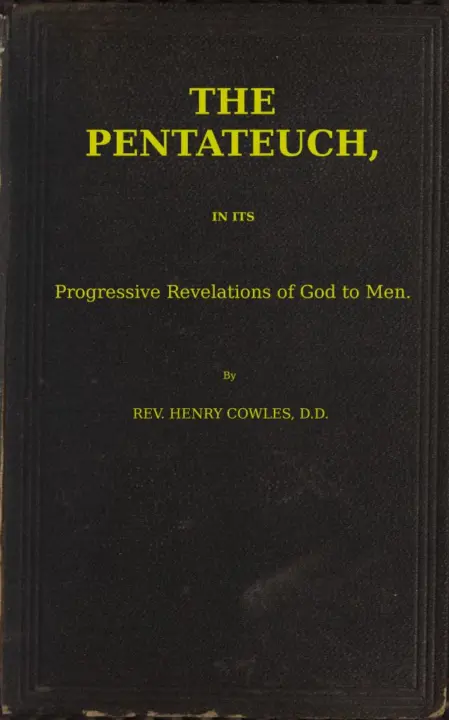
"The Pentateuch, in Its Progressive Revelations of God to Men" by Henry Cowles is a religious examination of the first five books of the Bible written in the late 19th century. The work addresses the themes presented in the Pentateuch, focusing on the progressive nature of divine revelations of God to humanity, with a strong emphasis on moral implications and historical contexts. It aims to clarify common misconceptions while delving into the relationship between Biblical text and contemporary scientific inquiries. At the start of the text, Cowles outlines his rationale for addressing the Pentateuch thematically rather than strictly textually. He expresses his intention to tackle the moral and critical dimensions of key themes while also addressing popular objections and misconceptions, particularly regarding Genesis and its relevance to modern science. Cowles suggests that the complexity of divine revelation requires a thoughtful and multi-faceted approach, inviting readers to engage with the text meaningfully while considering its historical context and its implications for understanding God and His works.
Introduction adapted from the source catalogue; source summaries may be automatically generated.
Free to read · English · 162,911 words · No account needed
MAKE TIME FOR A GOOD BOOK
On by default. Untick to stop anonymous reading totals. Each page counts after 10 seconds in view. How this works.
Anonymous counting is on unless you have switched it off.
The ten unbelieving spies perish at once by the plague before the wrath of God. The people were sorely distressed by this decision. Some of them rushed at once to the mad extreme of marching unbidden against the Canaanites――only to be smitten before them.
Thus issued this sad case of strange, cruel unbelief. The conquest of Canaan was postponed almost forty years; the generation of twenty years and over when they came out from Egypt were doomed to fruitless wandering and an early death in the wilderness; and that nation and the world had one more lesson on the wisdom of believing God, and on the infinite folly as well as guilt of refusing to believe and trust the Lord.――――Moses (in Deut. 1: 19–46) gives a somewhat full recapitulation of these scenes. In Ps. 90 he puts in the form of sacred song his meditation and prayer on this sad yet most instructive event.
The Rebellion of Korah and his Company.
During the period of thirty-seven years intervening between the scenes at Kadesh last noted and the return to Kadesh in the last year of the wandering, one event of most signal and solemn moment occurred, viz. the rebellion of Korah and his company, recorded Num. 16, and referred to Num. 26: 9–11. The leaders were Korah of the tribe of Levi, a near relative of Moses, and Dathan, Abiram, and On, of the tribe of Reuben;――the former ambitious of the distinction enjoyed by Moses and Aaron, and doubtless believing himself at least equally capable and worthy; the latter probably restive under the loss of that pre-eminence which was normally conceded to the first-born. Associated with them were two hundred and fifty leading men of the tribes, not otherwise distinctly designated. The movement thus assumed formidable proportions in the outset. They seem to have demanded that Moses and Aaron should retire from office and give place to themselves; or at least that they should resign and open the way for another election by the people.――――Moses wisely referred this matter at once to the Lord. Let him say who shall be the Leader of this people, and who shall come near before him as High Priest. Take you, said he, every man his censer and put fire therein, and come before the Lord. Let him pass upon this great question.――――Expostulating with Korah, he said, Should it not suffice you that God has given the whole tribe of Levi special responsibilities and honors? Why should ye murmur against Aaron because the Lord hath chosen him to lead in the most holy services?――――The Reubenite faction, resisting the summons of Moses, stood off obstinately. With falsehood and insult they arraign Moses upon two grave charges: (a.) that he had brought them out of a land of plenty to kill them in the wilderness; and (b.) had utterly failed to bring them into a land of plenty as he had promised. And now, said they, “wilt thou put out the eyes of these men”? Wilt thou dupe them and lead them on blind-fold to their utter ruin?――――These were cutting charges. Moses was indignant. Appealing to God he said, “Respect not thou their offering. I have not taken one ass from them, neither have I hurt one of them.”――――Again Moses refers the decision of the great question to God. “The glory of the Lord appeared (we read) unto all the congregation.” Inasmuch as the pillar of cloud and of fire was always visible to the people, we must suppose that on this occasion these words imply an unusual brilliancy――a blaze of glory.――――The first words from the August Presence indicated the divine purpose: “Stand ye aloof from those rebels; separate yourselves from that whole congregation that I may consume them in a moment”! Suddenly Moses and Aaron are on their faces in supplication that God would stay his hand; for they seem to have feared a most sweeping judgment. “Shall one man sin” (said they) “and wilt thou be wroth with all the congregation”? Promptly the Lord replied: Give orders to the people to withdraw from the tents of those leading rebels as they would escape their doom. They did so, leaving only the leaders and their households in their tents, awaiting the result――with what feelings and anticipations we know not. Whether their impudent hardihood failed them and terror seized upon them, or whether they stood boldly or stupidly, awaiting the issue, nothing is said to show.――――With words inspired of God, Moses put the great question of God’s choice of Leader upon its decision: “If those men die only the common death of mortals, the Lord hath not sent me; but if the Lord create a new creation [Heb.], i. e. work a miracle; do something outside the course of nature; if the earth open and swallow up those men alive and all that appertain to them, then ye shall understand that these men have provoked the Lord.”――――With not one moment’s delay, as the last word fell from his lips, the earth opened her mouth beneath their feet and they went down into that awful grave, and the earth closed over them! They perished from among the congregation. Their place was thenceforth vacant forever!――――Significantly it is added “all Israel that were round about them fled at the cry of them”――those shrieks of awful horror as they went down thrilled the whole people with terror and they fled from the scene; for they said, “Lest the earth swallow up us also.”
Your reading position is saved on this browser. Take it to another device with a library code. Reading pages adapt to text, rather than matching a printed edition.
BEHIND THE BOOK
This eBook is for the use of anyone anywhere in the United States and most other parts of the world at no cost and with almost no restrictions whatsoever. You may copy it, give it away or re-use it under the terms of the Project Gutenberg License included with this eBook or online at www.gutenberg.org. If you are not located in the United States, you will have to check the laws of the country where you are located before using this eBook. Read the source licence.
The original source file, including credits and licence, is retained by this library. Request an original-format copy at no charge. Please include the book title and Project Gutenberg identifier #61241.
KEEP YOUR CURIOSITY GOING
David Patterson (Spirit) Hatch

David Patterson (Spirit) Hatch

David Patterson (Spirit) Hatch
Cécile Tormay

Moritz Busch
John L. Ransom