
Last letters from the living dead man
David Patterson (Spirit) Hatch
THE CLASSIC COLLECTION · 1877
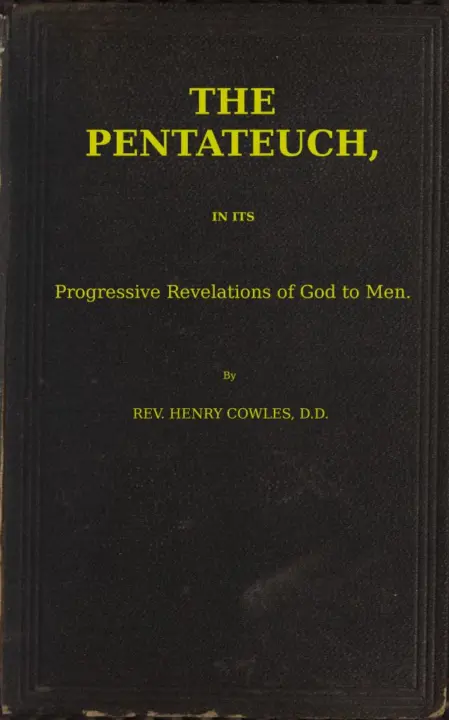
"The Pentateuch, in Its Progressive Revelations of God to Men" by Henry Cowles is a religious examination of the first five books of the Bible written in the late 19th century. The work addresses the themes presented in the Pentateuch, focusing on the progressive nature of divine revelations of God to humanity, with a strong emphasis on moral implications and historical contexts. It aims to clarify common misconceptions while delving into the relationship between Biblical text and contemporary scientific inquiries. At the start of the text, Cowles outlines his rationale for addressing the Pentateuch thematically rather than strictly textually. He expresses his intention to tackle the moral and critical dimensions of key themes while also addressing popular objections and misconceptions, particularly regarding Genesis and its relevance to modern science. Cowles suggests that the complexity of divine revelation requires a thoughtful and multi-faceted approach, inviting readers to engage with the text meaningfully while considering its historical context and its implications for understanding God and His works.
Introduction adapted from the source catalogue; source summaries may be automatically generated.
Free to read · English · 162,911 words · No account needed
MAKE TIME FOR A GOOD BOOK
On by default. Untick to stop anonymous reading totals. Each page counts after 10 seconds in view. How this works.
Anonymous counting is on unless you have switched it off.
In Num. 13 and 14 stands the record of a series of events of exceedingly vital moment to the children of Israel.――――By a route not definitely ascertainable at this distance of time, they had come (eleven days’ journey Deut. 1: 2) from Sinai to Kadesh-barnea which most critics concur in locating in the northern part of the wilderness of Paran, near “the mountain of the Amorites,” and also near the southern border of the land of Canaan. Leaving the wilderness of Sinai (Num. 10: 12, 13) “on the twentieth day of the second month of the second year” [from Egypt]; spending at least one month (Num. 11: 20, 21) at Kibroth-hattaavah, they were supposably about two years out from Egypt when the question came up the second time whether the people were prepared to march into the land of Canaan. On the former occasion, as we have seen (Ex. 13: 17, 18) the Lord decided this question at once, rejecting the short route to Canaan and heading their hosts through the wilderness, because, being then just from bondage in Egypt, they were in no condition, physically or morally, to enter Canaan.――――Now at Kadesh the question comes up again. As the case is put by Moses (Deut. 1: 22) it would seem that the people suggested the mission of the spies: “Ye came near unto me, every one of you, and said――We will send men before us and they shall search us out the land and bring us word again by what way we must go up and into what city we shall come. And the saying pleased me well, and I took twelve men,” etc. But the more full account in Num. 13 ascribes the movement to the Lord himself: “The Lord spake unto Moses, saying, Send thou men that they may search the land of Canaan” (vs. 1, 2). This is probably the more exact account. The people however heartily concurred.――――Very wisely the explorers designated were thoroughly representative men, “heads of the children of Israel,” “every one a ruler among them.” Thus selected, they would fairly represent the moral tone of the people on the great point of faith or unbelief; and moreover were men reliable as judges of the country and of the people of Canaan.――――The points which they were to investigate and report were well defined: “To see the land, what it is; whether good or bad; the people, whether strong or weak, few or many; what cities they dwell in; whether in tents or strongholds; and whether the land be fat or lean; and also” (a point of interest to men so long on the desert) “whether there be wood therein or not.”――――In a tour of forty days they traversed Canaan to the very northern border and seem so far to have done their work well. It being the time of first ripe grapes, they brought a magnificent specimen cluster from Eshcol, so large as to be borne by two men.――――Their report made two strongly marked points――that the land was truly “flowing with milk and honey”――all in this respect that they could desire; but on the other hand, ten of their number concurred in saying that the people were strong; their cities walled and very great, and some of their warriors, men of Anak, giants of stature, in whose sight they were only as grasshoppers. Their conclusion was――“We be not able to go up against that people, for they are stronger than we” (Num. 13: 31).――――Two of the spies――Caleb representing Judah and Joshua of Ephraim――brought in a minority report, differing totally in the one only vital point, viz. whether Israel were able to drive out the Canaanites and take possession of the land. Or, more fundamentally, they based their conviction upon their faith in God; while the men of the majority report seem to have made not the least account of God’s help in the case. Caleb and Joshua said――“The land is exceedingly good; and if the Lord delight in us, then he will bring us into this land and give it to us; only rebel not ye against the Lord, neither fear ye the people of the land, for they are bread for us; their defense is departed from them, and the Lord is with us; fear them not.”――――Sad to say, these considerations fell powerless upon the hearts of the ten unbelieving spies, and also upon the mass of the people. “All the people murmured against Moses and Aaron; the whole congregation said unto them: Would God that we had died in the land of Egypt, or would God we had died in this wilderness”!――――They even proposed to “make themselves a captain and return into Egypt”!――――It was inevitable that the Lord should feel himself dishonored and even insulted. “How long,” said he, “will this people provoke me? How long will it be ere they believe me for all the signs which I have showed among them”? And again referring to what was most disheartening and cruel of all: “Those men who have seen my glory and my miracles which I did in Egypt and in the wilderness, and have tempted me now these ten times, and have not obeyed my voice――they shall not see the land which I sware unto their fathers to give them.” Ah, they had seen all the plagues on Egypt; they had seen Pharaoh’s proud host buried in the Red Sea; they had seen Amalek smitten before Israel while the hands of prayer were upstayed before the Lord――and must all this go for nothing? God had promised to give them Canaan; could they not trust him? They had bound themselves by most solemn covenant to follow him as their king; and shall they go back upon this great covenant; make another captain; and return to their old bondage in Egypt? Alas, for such treachery! Alas, that they will not believe in God; that they have no faith in his power to save; and apparently no faith in his readiness to attempt it!
Your reading position is saved on this browser. Take it to another device with a library code. Reading pages adapt to text, rather than matching a printed edition.
BEHIND THE BOOK
This eBook is for the use of anyone anywhere in the United States and most other parts of the world at no cost and with almost no restrictions whatsoever. You may copy it, give it away or re-use it under the terms of the Project Gutenberg License included with this eBook or online at www.gutenberg.org. If you are not located in the United States, you will have to check the laws of the country where you are located before using this eBook. Read the source licence.
The original source file, including credits and licence, is retained by this library. Request an original-format copy at no charge. Please include the book title and Project Gutenberg identifier #61241.
KEEP YOUR CURIOSITY GOING
David Patterson (Spirit) Hatch

David Patterson (Spirit) Hatch

David Patterson (Spirit) Hatch
Cécile Tormay

Moritz Busch
John L. Ransom