
Last letters from the living dead man
David Patterson (Spirit) Hatch
THE CLASSIC COLLECTION · 1877
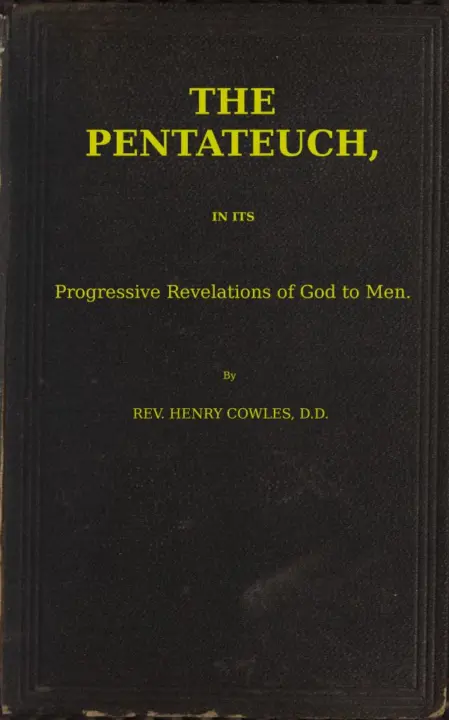
"The Pentateuch, in Its Progressive Revelations of God to Men" by Henry Cowles is a religious examination of the first five books of the Bible written in the late 19th century. The work addresses the themes presented in the Pentateuch, focusing on the progressive nature of divine revelations of God to humanity, with a strong emphasis on moral implications and historical contexts. It aims to clarify common misconceptions while delving into the relationship between Biblical text and contemporary scientific inquiries. At the start of the text, Cowles outlines his rationale for addressing the Pentateuch thematically rather than strictly textually. He expresses his intention to tackle the moral and critical dimensions of key themes while also addressing popular objections and misconceptions, particularly regarding Genesis and its relevance to modern science. Cowles suggests that the complexity of divine revelation requires a thoughtful and multi-faceted approach, inviting readers to engage with the text meaningfully while considering its historical context and its implications for understanding God and His works.
Introduction adapted from the source catalogue; source summaries may be automatically generated.
Free to read · English · 162,911 words · No account needed
MAKE TIME FOR A GOOD BOOK
On by default. Untick to stop anonymous reading totals. Each page counts after 10 seconds in view. How this works.
Anonymous counting is on unless you have switched it off.
(b.) Throughout at least the first three of these creative epochs there was no sun-rising and setting to mark off the ordinary day. These therefore were not the common human day; but, as Augustine long ago said, these are the days of God――divine days――measuring off his great creative periods. God moved through these six great periods by successive stages of labor and of rest. Beginning with the long evening of chaos; then advancing to a glorious day of light; then, after a cessation analogous to man’s rest by night, he proceeded to the work of the second day――the joyous and beautiful development of the firmament in the heavens. So onward by stages of repose and of activity, these figurative evenings and mornings continued through the six successive epochs of creation.
(c.) In some at least of these creative epochs, the work done demands more time than twenty-four hours. For example, the gathering of the waters from under the heavens into one place to constitute the seas or oceans and leave portions of the earth’s surface dry land. Nothing short of absolute miracle could effect this in one human day. But miracle should not be assumed here, the rule of reason and the normal law of God’s operations being never to work a miracle in a case where the ordinary course of nature will accomplish the same results equally well. We must the more surely exclude miracle and assume the action of natural law only throughout these processes of the creative work because the very purpose of a protracted rather than an instantaneous creation looked manifestly to the enlightenment, instruction, interest, and joy of those “morning stars,” the “sons of God” who beheld the scene, then “sang together and shouted for joy” (Job 38: 7).――――
The greatness of the work assigned to the fourth day stringently forbids our compressing it within the limits of one ordinary human day. Especially is this the case if we understand the verse to speak of the original creation of these light-bearers――the sun and the moon and the stars also, and of their adjustment in their spheres for their assigned work. Think of the vastness of the sun and of the numbers, magnitude, and immense distances of the stars; and ask how it is possible that the creation of these bodies could be either instructive or joyful to the beholding angels if it had been all rushed through within twenty-four hours of human time.――――This difficulty is in a measure relieved if we suppose the fourth day’s work to have been, not the original creation of these heavenly bodies, but only the bringing of them into the view of a supposed spectator upon the earth――i. e. by clearing the atmosphere so as to make these heavenly bodies visible. The question at issue between these two constructions of the fourth day’s work must be examined in its place.――――The amount of creative and other work brought within the sixth day should be noticed. First, God created all the land animals; then Adam; then he brought “every beast of the field and every fowl of the air” to Adam to see what he would call them――which at least must assume that Adam had attained a somewhat full knowledge of language, and that he had time enough to study the special character of each animal so as to give each one its appropriate name, and time enough also to ascertain that there was not one among them all adapted to be a “helpmeet” for himself. Then the “deep sleep” of Adam――how long protracted, the record saith not; and finally the creation of Eve from one of his ribs――all to come within the sixth day; for the creation of Eve certainly falls within this day, being a part of the creative work, and accomplished, therefore, before God’s seventh day of rest from all his work began. These labors of the sixth day, moreover, were precisely such as should not be rushed through in haste. The importance, not to say solemnity, of these transactions and the special interest they must be supposed to awaken in the first-born “sons of God” most stringently preclude precipitate haste. It is not easy to see how Moses or his intelligent readers of the early time could have supposed all this to have transpired within the twelve hours of light in a human day.――――We may say, moreover, in regard to each and all of these six creative periods that if the holy angels were indeed spectators of these scenes and if God adjusted his methods of creation to the capacities of these pupils――these admiring students of his glorious works――then surely we must not think of his compressing them within the period of six human days. Divine days they certainly must have been, sufficiently protracted to afford finite minds scope for intelligent study, adoring contemplation, and as the Bible indicates, most rapturous shouts of joy.
Your reading position is saved on this browser. Take it to another device with a library code. Reading pages adapt to text, rather than matching a printed edition.
BEHIND THE BOOK
This eBook is for the use of anyone anywhere in the United States and most other parts of the world at no cost and with almost no restrictions whatsoever. You may copy it, give it away or re-use it under the terms of the Project Gutenberg License included with this eBook or online at www.gutenberg.org. If you are not located in the United States, you will have to check the laws of the country where you are located before using this eBook. Read the source licence.
The original source file, including credits and licence, is retained by this library. Request an original-format copy at no charge. Please include the book title and Project Gutenberg identifier #61241.
KEEP YOUR CURIOSITY GOING
David Patterson (Spirit) Hatch

David Patterson (Spirit) Hatch

David Patterson (Spirit) Hatch
Cécile Tormay

Moritz Busch
John L. Ransom