
Last letters from the living dead man
David Patterson (Spirit) Hatch
THE CLASSIC COLLECTION · 1877
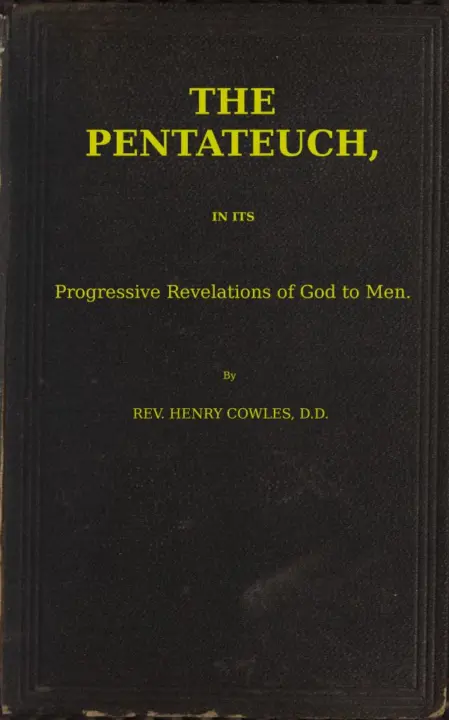
"The Pentateuch, in Its Progressive Revelations of God to Men" by Henry Cowles is a religious examination of the first five books of the Bible written in the late 19th century. The work addresses the themes presented in the Pentateuch, focusing on the progressive nature of divine revelations of God to humanity, with a strong emphasis on moral implications and historical contexts. It aims to clarify common misconceptions while delving into the relationship between Biblical text and contemporary scientific inquiries. At the start of the text, Cowles outlines his rationale for addressing the Pentateuch thematically rather than strictly textually. He expresses his intention to tackle the moral and critical dimensions of key themes while also addressing popular objections and misconceptions, particularly regarding Genesis and its relevance to modern science. Cowles suggests that the complexity of divine revelation requires a thoughtful and multi-faceted approach, inviting readers to engage with the text meaningfully while considering its historical context and its implications for understanding God and His works.
Introduction adapted from the source catalogue; source summaries may be automatically generated.
Free to read · English · 162,911 words · No account needed
MAKE TIME FOR A GOOD BOOK
On by default. Untick to stop anonymous reading totals. Each page counts after 10 seconds in view. How this works.
Anonymous counting is on unless you have switched it off.
The manner and circumstances of this proclamation in the case before us are altogether unique and striking. The ground idea is that, in human relationships, we learn the character by seeing the man. We depend on the eye and the sense of sight above the testimony of any other sense, and we expect to see the character in the face. To “see the face” is, therefore, the most complete and satisfactory means of learning the character――of knowing the man――that we can have under the limitations of our present mortal state. The language and the whole transaction before us rest on these simple facts of our present life.――――The Lord said to Moses: “Thou canst not see my face; for there shall no man see me and live.” To see the very face of God would imply a more full revelation of his ineffable glory than mortal man could bear. A softened manifestation of those unutterable glories is all, therefore, that can be granted even to the man of God, Moses; and this is expressively put by saying: “Thou shalt see my back parts; my face shall not be seen.” This was the Lord’s proposal: “Behold, there is a place by me, and thou shalt stand upon a rock; and it shall come to pass while my glory passeth by that I will put thee in a cleft of the rock, and I will cover thee with my hand while I pass by: then I will take away my hand and thou shalt see my back parts, but my face shall not be seen” (Ex. 33: 21–23).
It will be noted that in this narrative Moses makes no attempt to describe the scenes of this visible manifestation, or the impressions it made on his mind. Words are too weak for such a service. Those glorious views of God which sight may give, and which we may assume that Moses obtained in this proposed manifestation, each one must have for himself alone and not for another. They will come to all the Lord’s true children in the day when they shall see even as they are seen and know as they are known.――――The matters which Moses does record at this point are, that the Lord bade him prepare two other stone tablets to replace the broken and to appear with them the next morning on the top of the mount; that he must come alone and let no other man be seen in all the mount, nor let any animal of the flock or herd feed before the mount; that then the Lord descended in the cloud and stood with him there, and proclaimed the name of the Lord. The words of this proclamation are recorded:――“The Lord [the Jehovah], Jehovah God, merciful and gracious; long-suffering and abundant in goodness and truth; keeping mercy for thousands; forgiving iniquity, transgression and sin, and that will by no means clear the guilty; visiting the iniquity of the fathers upon the children and upon children’s children unto the third and to the fourth generation.”――――Profoundly awed by these words and by this impressive manifestation; encouraged by the prominence given in it to the ideas of mercy and loving-kindness, Moses made haste, and bowed his head to the earth and worshiped, and then lifted up his prayer――“If now I have found grace in thy sight, O Lord, let my Lord, I pray thee, go among us (for it is a stiff-necked people) and pardon our iniquity and our sin and take us for thine inheritance.”――――The same points are prominent here as before (Ex. 32: 11–13)――that God would forgive the great sin of the people; that he would go among them again, and dwell in the midst of them; and that he would truly take and hold them as his own inheritance. Upon all these points the heart of Moses is intently set, and he brings them before God every time. The Lord responds――I renew my covenant; I shall go on to work marvelously among this people. The revelations of my great name before them and before all the world by means of them, are only begun. I will go before this people to drive out the Canaanite; but this one thing I must insist upon: My people must wash out every stain of idol-worship; they must destroy all idol-altars, break down their images, cut down their groves, have no associations with corrupt idol-worshipers; worship no other than the one true and holy God, for the Lord whose name is Jealous is a jealous God. Other requirements follow as may be seen (Ex. 34); Moses fills out another forty days on the mount; the law is again written on two tablets like the former; Moses comes down with his face (unconsciously to himself) shining as if the reflection of the more shining face of God still lingered upon it. When Aaron and all Israel saw this, they feared to come near him. Moses called to them (i. e. to come); Aaron and the rulers (not the people) came and Moses talked with them. Afterward all the people drew near and Moses rehearsed the recently revealed commandments of the Lord, putting a vail on his face while speaking with the people. This glory on his face was the sensible witness that he had been in very deed talking with the all-glorious God, and that it behooved them to accept him as God’s authorized messenger.
Your reading position is saved on this browser. Take it to another device with a library code. Reading pages adapt to text, rather than matching a printed edition.
BEHIND THE BOOK
This eBook is for the use of anyone anywhere in the United States and most other parts of the world at no cost and with almost no restrictions whatsoever. You may copy it, give it away or re-use it under the terms of the Project Gutenberg License included with this eBook or online at www.gutenberg.org. If you are not located in the United States, you will have to check the laws of the country where you are located before using this eBook. Read the source licence.
The original source file, including credits and licence, is retained by this library. Request an original-format copy at no charge. Please include the book title and Project Gutenberg identifier #61241.
KEEP YOUR CURIOSITY GOING
David Patterson (Spirit) Hatch

David Patterson (Spirit) Hatch

David Patterson (Spirit) Hatch
Cécile Tormay

Moritz Busch
John L. Ransom