
Last letters from the living dead man
David Patterson (Spirit) Hatch
THE CLASSIC COLLECTION · 1877
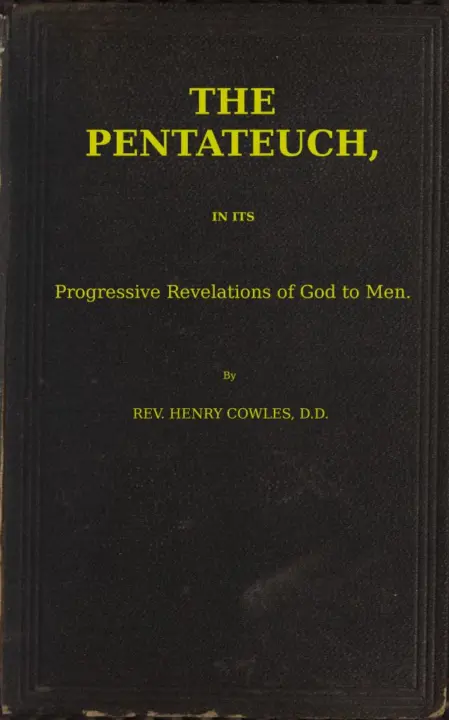
"The Pentateuch, in Its Progressive Revelations of God to Men" by Henry Cowles is a religious examination of the first five books of the Bible written in the late 19th century. The work addresses the themes presented in the Pentateuch, focusing on the progressive nature of divine revelations of God to humanity, with a strong emphasis on moral implications and historical contexts. It aims to clarify common misconceptions while delving into the relationship between Biblical text and contemporary scientific inquiries. At the start of the text, Cowles outlines his rationale for addressing the Pentateuch thematically rather than strictly textually. He expresses his intention to tackle the moral and critical dimensions of key themes while also addressing popular objections and misconceptions, particularly regarding Genesis and its relevance to modern science. Cowles suggests that the complexity of divine revelation requires a thoughtful and multi-faceted approach, inviting readers to engage with the text meaningfully while considering its historical context and its implications for understanding God and His works.
Introduction adapted from the source catalogue; source summaries may be automatically generated.
Free to read · English · 162,911 words · No account needed
MAKE TIME FOR A GOOD BOOK
On by default. Untick to stop anonymous reading totals. Each page counts after 10 seconds in view. How this works.
Anonymous counting is on unless you have switched it off.
Partly because of advances made within recent times in physical science, partly because of speculations not always friendly in tone to the inspired record, and partly because of the intrinsic interest and importance of the subject, some special points in this narrative demand very particular attention.
1. The origin of the written record and the manner of its revelation
to men.
The entire book of Genesis is ascribed to Moses on most valid grounds; whether as compiler only or as original author, is, therefore, the first question.――――I do not see how this point can be determined with absolute certainty. The probabilities in my view favor the supposition of previously written documents, these probabilities arising, not to any considerable extent from manifest differences of style in its various portions, and not at all from diversities in the use of the names of God, Jehovah and Elohim; but mainly from the strong presumption that such genealogical records as abound in Genesis, coupled so largely with numbers, would be put in writing before the age of Moses. Men who had the knowledge of writing would certainly appreciate its utility for the preservation of such facts as these.――――And further; the very use of the word “generations”[1] (Gen. 2: 4) in the sense of history, and much more still the statement (Gen. 5: 1), “This is the book of the generations of Adam,” raise this presumption nearly or quite to a certainty.――――In making up the historical portions of the Scriptures it seems rational to assume that the Lord moved “holy men of old” to put in writing such facts falling under their personal observation and immediate knowledge as he deemed useful for these sacred records. In some cases the writer might be (as was Luke) just one remove from the original eye-witnesses, yet in a position to learn the facts with “perfect understanding” and “certainty.” We should not doubt the power of God to give to holy men these historic facts by immediate revelation; but the question is not one of power, but of wisdom, of divine policy, and of fact. The divine policy seems to have been (in this case as in miracles) never to introduce the supernatural, the miraculous, to do what the natural might accomplish equally well. On this principle inspired men were moved of God to use their own eyes and minds in writing Scripture history in all cases when the facts came within their certain knowledge. There were facts, like these of the creation, which fell under no human eye, and which therefore do not come under this principle. Some form of direct revelation from God is, therefore, to be assumed here. Though the supposition of a revealing angel might find some support from subsequent prophetic Scriptures, yet a direct revelation from God to some inspired writer is the more obvious supposition.――――It has been asked――Was this creation in its processes and announcements shown in a manner analogous to prophetic vision――the writer then recording in his own phrase what he saw and heard?――――There being no testimony on this point from either of the two parties――the divine Revealer or the human writer――we must leave it undecided. Fortunately it is of no particular importance to us.――――It is, however, of some importance that we consider the question whether in this account of the creation we are to look for statements adjusted to science――not merely to the stage of its progress in this present year of the nineteenth century, but to the perfect science of ultimate fact; or, on the other hand, for statements adapted to the average mind of Hebrew readers in the age of Moses, written for their comprehension, instruction and spiritual culture. I answer unhesitatingly, the latter. “All Scripture, given by inspiration of God, is profitable for doctrine ... and for instruction in righteousness” (2 Tim. 3: 16), and was of God designed and shaped for these ends.――――Yet let it be borne in mind; these statements respecting the processes of creation, being in the sense intended, actually true, will not conflict with any true science. They may omit processes which human analysis and research may render probable, passing them as not germain to the scope of a moral revelation and as not likely to be intelligible to the masses of mankind.――――Finally――that the assumed stand-point of view from which these processes of creation are contemplated is on this earth and not elsewhere in the universe is certain from the fact that it was written to be read and understood by men and not by angels. Hence we must expect the facts to be presented as they would have appeared to a supposed observer upon our globe.
Your reading position is saved on this browser. Take it to another device with a library code. Reading pages adapt to text, rather than matching a printed edition.
BEHIND THE BOOK
This eBook is for the use of anyone anywhere in the United States and most other parts of the world at no cost and with almost no restrictions whatsoever. You may copy it, give it away or re-use it under the terms of the Project Gutenberg License included with this eBook or online at www.gutenberg.org. If you are not located in the United States, you will have to check the laws of the country where you are located before using this eBook. Read the source licence.
The original source file, including credits and licence, is retained by this library. Request an original-format copy at no charge. Please include the book title and Project Gutenberg identifier #61241.
KEEP YOUR CURIOSITY GOING
David Patterson (Spirit) Hatch

David Patterson (Spirit) Hatch

David Patterson (Spirit) Hatch
Cécile Tormay

Moritz Busch
John L. Ransom