
Last letters from the living dead man
David Patterson (Spirit) Hatch
THE CLASSIC COLLECTION · 1877
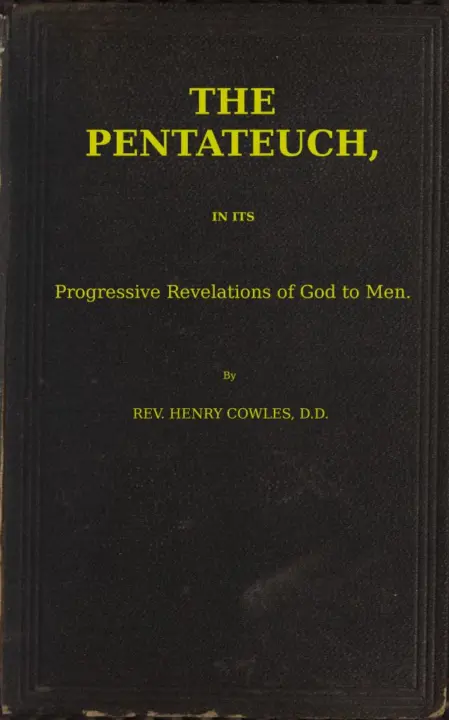
"The Pentateuch, in Its Progressive Revelations of God to Men" by Henry Cowles is a religious examination of the first five books of the Bible written in the late 19th century. The work addresses the themes presented in the Pentateuch, focusing on the progressive nature of divine revelations of God to humanity, with a strong emphasis on moral implications and historical contexts. It aims to clarify common misconceptions while delving into the relationship between Biblical text and contemporary scientific inquiries. At the start of the text, Cowles outlines his rationale for addressing the Pentateuch thematically rather than strictly textually. He expresses his intention to tackle the moral and critical dimensions of key themes while also addressing popular objections and misconceptions, particularly regarding Genesis and its relevance to modern science. Cowles suggests that the complexity of divine revelation requires a thoughtful and multi-faceted approach, inviting readers to engage with the text meaningfully while considering its historical context and its implications for understanding God and His works.
Introduction adapted from the source catalogue; source summaries may be automatically generated.
Free to read · English · 162,911 words · No account needed
MAKE TIME FOR A GOOD BOOK
On by default. Untick to stop anonymous reading totals. Each page counts after 10 seconds in view. How this works.
Anonymous counting is on unless you have switched it off.
Furthermore, Egyptian records show that they put their prisoners of war to such labors; for their kings record on the temples the number of captives they have taken to labor upon the temples of their gods.
Two of these documents on papyri belong to the reign of Rameses II, whom Mons. Chabas assumes to be the king whose daughter adopted Moses and whose son and successor, Mei-en-ptah, experienced the ten plagues and fell in the Red Sea. (Bib. Sacra, Oct., 1865, p. 685.)
6. It is a well-established fact of history that at one period――not yet located definitely――Lower Egypt was subdued and held by a Shepherd race, called by Josephus, “Hyksos,” supposed to have come from adjacent provinces of Arabia or from Phenicia or both, and to have held the country from 350 to 500 years――a Vandal race, savagely desolating the noble monuments of Egyptian art and civilization, and known by the native Egyptians as “the Scourge.” This Shepherd race was ultimately driven out by the kings of Upper Egypt (a Theban dynasty)――probably before the age of Moses; perhaps before Jacob went down into Egypt. It may be considered certain that Josephus and others err in confounding them with the Hebrew people.――――Geo. Rawlinson [in Aids to Faith, p. 293] says――“The period of the Shepherd Kings is estimated variously as continuing 500, 600, 900, and even 2,000 years; that historic monuments were generally destroyed during their dominion; that no reliable historic records exist older than the beginning of the eighteenth dynasty which expelled the Shepherd Kings; and that previously to their times, ‘Association’ in Royalty was practiced, two or even three kings sitting on the same throne at the same time, dividing its labors and its honors between themselves.”
As to the date of this Shepherd rule, the diversity in opinion among the best informed students of Egyptian antiquity is by no means comforting or assuring. Dr. Lepsius and others have placed their invasion of Egypt directly after the twelfth dynasty (B. C. 2101), and their expulsion about B. C. 1591. In his chronology, Jacob went down into Egypt B. C. 1414; Moses led the people out B. C. 1314――neither date having the least regard to the scripture chronology.――――Mons. Mariette dates it in the eighteenth century B. C., i. e. between B. C. 1700 and B. C. 1800. With this we might compare the sojourn of the Israelites in Egypt from B. C. 2033 to B. C. 1603; or on the chronology of Usher, from B. C. 1706 to B. C. 1491.――――Brugsch dates their incursion B. C. 2115, and supposes them to have been Arabs from Arabia Petraea.――――Bunsen’s latest recension places their invasion B. C. 1983; their expulsion, B. C. 1548; and the Exodus of the Hebrews B. C. 1320――the last date being certainly wide of the truth.――――The evidence is conclusive that their expulsion preceded the resplendent eighteenth dynasty whose kings ruled over all Egypt, and among whom was the Pharaoh “who would not let the people go.” Dr. Thompson argues at considerable length that the entire occupation of Lower Egypt by the Hyksos must have preceded the residence of the Hebrews there; but feels the difficulties of the problem. He says――“As yet the terminus a quo remains in obscurity” [the point at which their occupation begins]; “while the terminus ad quem is beginning to take a fixed place in history.” The date of their expulsion is mostly relieved of doubt. The war which resulted in their expulsion was begun by Seneken-Ra, about the commencement of the 18th dynasty of Thebes [Upper Egypt], and was prosecuted by Ahmes I, otherwise called Nebpeh-Ra, in whose fifth year they were finally expelled. The reign of Ahmes I is proximately assigned to the 17th century B. C., i. e. from B. C. 1600 to B. C. 1700.――――A curious inscription has recently been discovered by Mons. Dumischen, referring to a brilliant triumph over the Lybians, achieved by a certain king Menephtah――this war being dated nearly 400 years after the expulsion of the Hyksos. The scribe appended the remark――“One could not have seen the like in the time of the kings of Lower Egypt when the country of Egypt was held by the ‘Scourge,’ and the kings of Upper Egypt could not drive them out.”――――This authority seems to prove that the Hyksos held only Lower Egypt; that Upper Egypt was under another dynasty, for a time unable to expel the Shepherd race, but ultimately successful, and subsequently attaining much greater military power; also that the Hyksos people were accounted a savage and barbarous race.
Your reading position is saved on this browser. Take it to another device with a library code. Reading pages adapt to text, rather than matching a printed edition.
BEHIND THE BOOK
This eBook is for the use of anyone anywhere in the United States and most other parts of the world at no cost and with almost no restrictions whatsoever. You may copy it, give it away or re-use it under the terms of the Project Gutenberg License included with this eBook or online at www.gutenberg.org. If you are not located in the United States, you will have to check the laws of the country where you are located before using this eBook. Read the source licence.
The original source file, including credits and licence, is retained by this library. Request an original-format copy at no charge. Please include the book title and Project Gutenberg identifier #61241.
KEEP YOUR CURIOSITY GOING
David Patterson (Spirit) Hatch

David Patterson (Spirit) Hatch

David Patterson (Spirit) Hatch
Cécile Tormay

Moritz Busch
John L. Ransom