
Last letters from the living dead man
David Patterson (Spirit) Hatch
THE CLASSIC COLLECTION · 1877
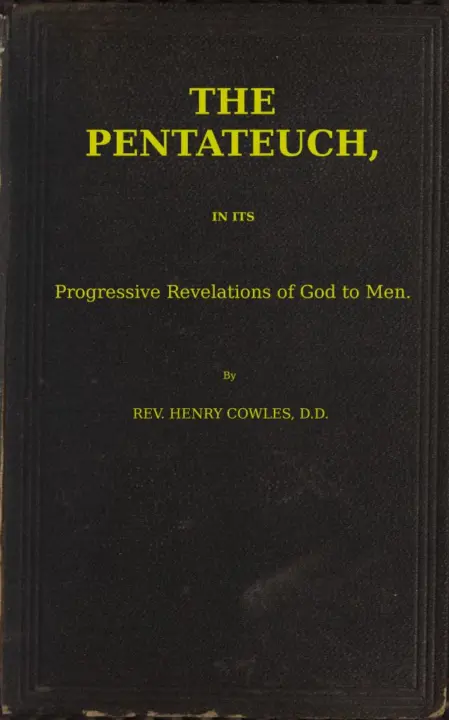
"The Pentateuch, in Its Progressive Revelations of God to Men" by Henry Cowles is a religious examination of the first five books of the Bible written in the late 19th century. The work addresses the themes presented in the Pentateuch, focusing on the progressive nature of divine revelations of God to humanity, with a strong emphasis on moral implications and historical contexts. It aims to clarify common misconceptions while delving into the relationship between Biblical text and contemporary scientific inquiries. At the start of the text, Cowles outlines his rationale for addressing the Pentateuch thematically rather than strictly textually. He expresses his intention to tackle the moral and critical dimensions of key themes while also addressing popular objections and misconceptions, particularly regarding Genesis and its relevance to modern science. Cowles suggests that the complexity of divine revelation requires a thoughtful and multi-faceted approach, inviting readers to engage with the text meaningfully while considering its historical context and its implications for understanding God and His works.
Introduction adapted from the source catalogue; source summaries may be automatically generated.
Free to read · English · 162,911 words · No account needed
MAKE TIME FOR A GOOD BOOK
On by default. Untick to stop anonymous reading totals. Each page counts after 10 seconds in view. How this works.
Anonymous counting is on unless you have switched it off.
They are getting ready now for home; their sacks are filled with corn again, and again the money is put back into each sack’s mouth, and worst of all, Joseph’s silver cup is slipped into the mouth of Benjamin’s sack. Ere they are fairly out of the city Joseph posts his steward after them, abruptly charging them with having ungratefully stolen his lord’s silver cup. Consciously innocent and deeply indignant, they are rash enough to say――Let the man in whose sack it is found die, and take all the rest of us for slaves! How were they amazed and overwhelmed when the cup was found in Benjamin’s sack! They rent their clothes in bitterness of heart, and all return to the city. Judah comes to the front here; it is “Judah and his brethren” who come to Joseph’s house, and Judah who makes the plea in behalf of Benjamin. The historian is careful to say again that when they met Joseph “they fell before him on the ground.” He also remarks that Joseph was yet in his house, having remained there ever since the caravan left in the early morning, too full of thought on this subject to turn to any other business.――――Now he expects to learn how they feel toward Benjamin and toward their aged father. He must be sure they are all right on these points before he lifts the vail and shows them himself.――――They are brought back as criminals before him. With a sternness that is not at all in his heart but in his assumed manner only, he says――What deed is this that ye have done? Were ye not aware that I have the power of positive and certain divination?――――Judah is in deep perplexity――but he speaks frankly: “What shall we say unto my lord? or how shall we clear ourselves? God hath found out the iniquity of thy servants”――which words can not, it would seem, refer to any iniquity in the matter of the silver cup, but must have referred to the long past crime of the brethren toward Joseph. He can not say less than that they will all become the slaves of Joseph, all including even Benjamin.――――No, replies Joseph; I want only the guilty man, Benjamin; all the rest of you may go in peace to your father!――――Now the crisis so long dreaded has come. A terrible responsibility falls upon Judah. With wonderful simplicity, with most touching filial affection toward his father, and with masterly skill he rises to the moral sublimity of the occasion. He comes near to Joseph and begins his great plea. Every reader must study it. We shall need to go far to find more touching eloquence, a more masterly setting forth of the facts of the case including the whole story from the beginning to the end. The case of the aged father and of his two younger sons left him by his best beloved wife――put in the aged patriarch’s own words――ran thus: “Ye know that my wife bear me two sons, and the one went out from me, and I said――Surely he is torn in pieces, and I have not seen him since; and if ye take this also from me, and mischief befall him, ye shall bring down my gray hairs with sorrow to the grave. Now therefore when I come to thy servant my father and the lad be not with us; (seeing that his life is bound up in the lad’s life)――when he shall see that the lad is not with us he will die; and thy servants will bring down the gray hairs of our father with sorrow to the grave. I said to him, If I bring not Benjamin back, I will bear the blame forever. Now therefore I pray thee, let me abide instead of Benjamin, the bond-servant of my lord, and let him go back to his father. For how shall I go to my father and the lad be not with me? Lest peradventure I see the evil that shall come on my father.”――――This was more than Joseph could bear. He could refrain himself no longer; the tears would come; the swelling emotions must have vent. Joseph cried: “Have every man away from me save these men of Canaan.” The proof of their love to their aged father and to Benjamin is unmistakable; Joseph is satisfied. They are penitent for their long past crime against him, and he can therefore at length break the secret and show himself their long lost brother! How do their ears tingle as they hear him say――“I am Joseph: Doth my father yet live?”――――The first shock is almost stunning: they can not answer him, for they are troubled at his presence. More kind words and the kindest possible manner are now in place. “Joseph said to his brethren, Come near to me, I pray you; and they came near.” Again he says――“I am Joseph, your brother, whom ye sold into Egypt.” Then with a turn which evinces the exquisite tenderness of his heart, he begs them “not to be grieved nor angry with themselves;” but to think rather of the design of God in permitting and providentially shaping this wonderful series of events. “God did send me before you to preserve life. There are five more years of famine yet to come; God sent me before you to preserve you a posterity in the earth and to save your lives by a great deliverance. So now it was not you that sent me hither, but God.” The best thing he could say under just those circumstances to soothe their mind, to assure them of his full forgiveness and to give them consolation in place of the agitation, fear, and remorse that so nearly overwhelmed their spirits.
Your reading position is saved on this browser. Take it to another device with a library code. Reading pages adapt to text, rather than matching a printed edition.
BEHIND THE BOOK
This eBook is for the use of anyone anywhere in the United States and most other parts of the world at no cost and with almost no restrictions whatsoever. You may copy it, give it away or re-use it under the terms of the Project Gutenberg License included with this eBook or online at www.gutenberg.org. If you are not located in the United States, you will have to check the laws of the country where you are located before using this eBook. Read the source licence.
The original source file, including credits and licence, is retained by this library. Request an original-format copy at no charge. Please include the book title and Project Gutenberg identifier #61241.
KEEP YOUR CURIOSITY GOING
David Patterson (Spirit) Hatch

David Patterson (Spirit) Hatch

David Patterson (Spirit) Hatch
Cécile Tormay

Moritz Busch
John L. Ransom