
Last letters from the living dead man
David Patterson (Spirit) Hatch
THE CLASSIC COLLECTION · 1877
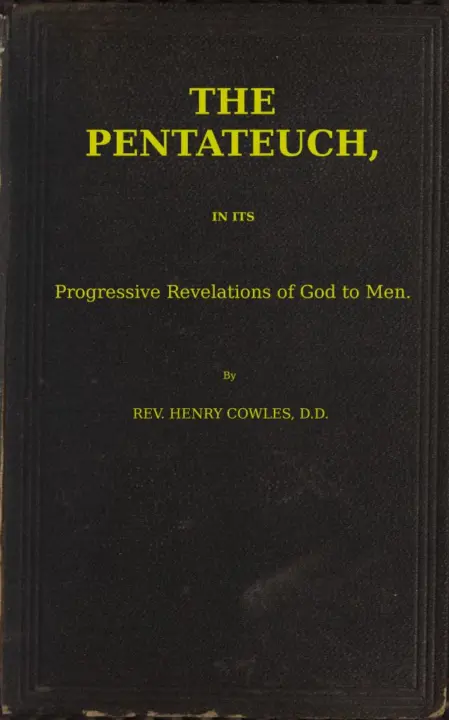
"The Pentateuch, in Its Progressive Revelations of God to Men" by Henry Cowles is a religious examination of the first five books of the Bible written in the late 19th century. The work addresses the themes presented in the Pentateuch, focusing on the progressive nature of divine revelations of God to humanity, with a strong emphasis on moral implications and historical contexts. It aims to clarify common misconceptions while delving into the relationship between Biblical text and contemporary scientific inquiries. At the start of the text, Cowles outlines his rationale for addressing the Pentateuch thematically rather than strictly textually. He expresses his intention to tackle the moral and critical dimensions of key themes while also addressing popular objections and misconceptions, particularly regarding Genesis and its relevance to modern science. Cowles suggests that the complexity of divine revelation requires a thoughtful and multi-faceted approach, inviting readers to engage with the text meaningfully while considering its historical context and its implications for understanding God and His works.
Introduction adapted from the source catalogue; source summaries may be automatically generated.
Free to read · English · 162,911 words · No account needed
MAKE TIME FOR A GOOD BOOK
On by default. Untick to stop anonymous reading totals. Each page counts after 10 seconds in view. How this works.
Anonymous counting is on unless you have switched it off.
In the next scene these brethren were if possible more heartless still. It commonly happens that one crime demands another and yet another to conceal the first. So in this case, the next thing is to deceive their father even though it torture him with the agony of supposing his favorite son devoured by some evil beast. They kill a kid; stain Joseph’s coat with its blood; and then send it to their father, saying, “This have we found; see whether it be thy son’s coat or not.” There was no mistaking the coat, and Jacob’s grief is heart-breaking. Remarkably it is said that “all his sons and all his daughters rose up to comfort him, but he refused to be comforted”; and he said, “I will go down into the grave to my son mourning. Thus his father wept for him.”――――How easily those sons might have said: “Father, we have sinned against God and against thee; but Joseph is not slain by lions; we sold him into Egypt! You may live to see him again.” But not even Reuben or Judah had conscience, and truthfulness, and filial affection enough to reveal the guilty secret. Miserable comforters were they all to their father’s broken heart!
Leaving Jacob to long years of bitterest grief, we follow the fortunes of Joseph. From this point the thread of the story takes him into Egypt a slave. Sold to Potiphar, an officer under Pharaoh, it soon became apparent that the Lord was with him and made every thing prosper under his hand. He rises rapidly in the confidence of his master; is put in charge of all his house――but here springs up a new trial. Joseph is beautiful in person and amiable in manners. Potiphar’s wife, lewd and shameless, tempts him with solicitations to adultery. Joseph’s bearing in this case was worthy to be put on permanent record to pass down through all future generations to the end of time, a perfect model of both virtue and wisdom――the virtue that resists seductive temptation with unwavering firmness; and the wisdom that comprehends and applies the perfect methods of resisting temptation. Joseph did not dally with his tempter; did not suffer the temptation to gather new force, but met it instantly with the strongest considerations possible――“How can I do this great wickedness and sin against God!” God, said he to himself, is my best friend; I am his servant. He has stood by me through all my trials and given me this great prosperity; his pure eye is on me; I can not do this great wickedness against him!――――The sense of a present God settled the question forever. There was indeed another line of considerations――his obligations to the husband of this lewd woman. Potiphar had trusted him most entirely; shall he abuse this trust? Never.――――Thus Joseph’s course was at once decided. But this vile woman persisted in her solicitations, till at length, maddened by her failure, she plotted his death. She laid hold of his garment; he escaped leaving it in her hands. With this for her proof she accuses Joseph of the crime of which she alone was guilty. Joseph is thrown into prison――because of his virtue and not because of any crime. Of course the Lord was with him still, and again Joseph rises in the favor and confidence of those in power; is put in charge of all matters in the prison, and thus the Lord turned this great trial to account to bring Joseph before Pharaoh. Long was the trial; the story of his relations to the chief butler and the chief baker is in point chiefly as showing how ungratefully the butler could forget his imprisoned friend and prolong his imprisonment. But the hour of deliverance came at last. Pharaoh’s two dreams impressed and disturbed his mind so much that he summoned all his wise men to his help――but in vain. At this opportune moment the chief butler remembers Joseph. He should have spoken of him to the king two years before; but engrossed with his own prosperity, he forgot his prison benefactor till this time. Joseph comes to the help of the king. His first answer is beautifully modest and fragrant with piety. “I have heard of thee, said the king, that thou canst understand a dream to interpret it.” Joseph replies: “It is not in me; God shall give Pharaoh an answer of peace” (Gen. 41: 16). The dreams are interpreted to signify seven years of overflowing plenty, followed by seven of extreme famine throughout all the land. Joseph suggests to the king to store up the excess of the plentiful years against the deficiencies of the famine years. The king sees the wisdom of this suggestion and at once appoints Joseph to this responsibility; in fact, sets him over all Egypt save only in the honors of the throne.
Your reading position is saved on this browser. Take it to another device with a library code. Reading pages adapt to text, rather than matching a printed edition.
BEHIND THE BOOK
This eBook is for the use of anyone anywhere in the United States and most other parts of the world at no cost and with almost no restrictions whatsoever. You may copy it, give it away or re-use it under the terms of the Project Gutenberg License included with this eBook or online at www.gutenberg.org. If you are not located in the United States, you will have to check the laws of the country where you are located before using this eBook. Read the source licence.
The original source file, including credits and licence, is retained by this library. Request an original-format copy at no charge. Please include the book title and Project Gutenberg identifier #61241.
KEEP YOUR CURIOSITY GOING
David Patterson (Spirit) Hatch

David Patterson (Spirit) Hatch

David Patterson (Spirit) Hatch
Cécile Tormay

Moritz Busch
John L. Ransom